Manger Myth Meaning & Symbolism
A child of prophecy is born in a stable's feeding trough, a divine paradox where the infinite is cradled in the most humble of earthly vessels.
The Tale of the Manger
Listen. The world was heavy, its spine bent under the weight of empire and expectation. The air in Judea was cold, sharp with the scent of dust and distant promise. A decree had gone out from Augustus, a ripple of imperial will that set a man and his heavily pregnant wife on a desperate journey. Their destination: the town of his ancestor, David. But the town was swollen with returning souls; every door was shut, every hearth claimed.
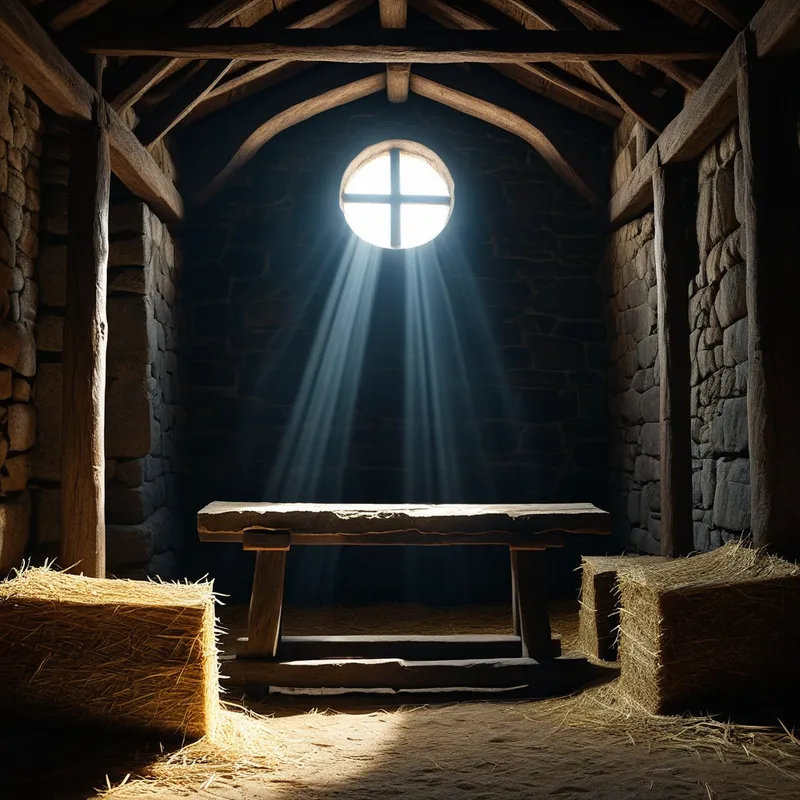
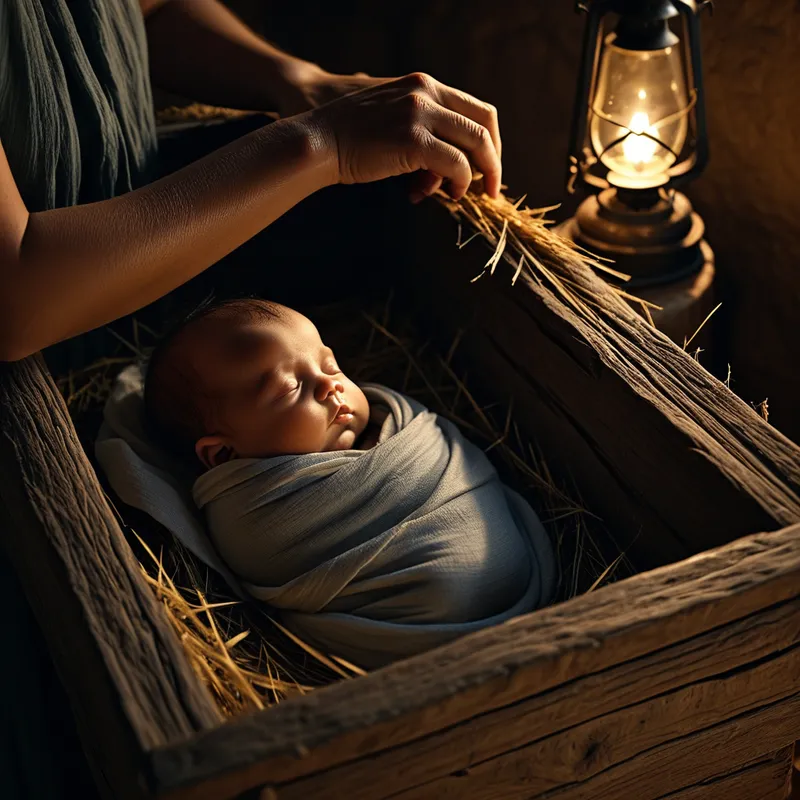
The night deepened, a velvet cloak pricked with indifferent stars. The woman’s time came, not in a chamber prepared, but on the road, in the press of necessity. The only shelter offered was the lee of a stable, a cave carved into the limestone hill, breathing out the warm, animal smell of hay and hide. Here, among the quiet shuffling of beasts, the Child was born. There was no crib, no gilded bassinet fit for a king. Instead, they took the feeding trough—the manger—a hollowed-out stone or rough-hewn wood, its purpose to sustain the lowly and the four-legged.
They lined it with straw, this humble vessel, and laid the newborn within. His first breaths mingled with the scent of earth and barley. His first cradle was a thing of function, not form. And into this scene of profound simplicity, a strange light began to gather. Not from the lamp, but from the very air. Out in the fields, shepherds keeping watch over their flocks were seized not by fear, but by a dazzling awe as the darkness shattered and a heavenly host declared glory. The message was not for palaces, but for pastures. The sign was not a scepter, but a feeding trough: “You will find a baby wrapped in cloths and lying in a manger.”
And so they came, these rough men of the field, their faces etched with wonder. They knelt not on marble, but on packed dirt strewn with straw, before the child in the manger. The ox and the donkey breathed warm air into the space. The infinite, whispered the cosmos, had drawn itself into finite form, and its first throne was a vessel meant for grain.
Cultural Origins & Context
The manger narrative is found in the Gospel of Luke, a text composed in the latter half of the first century CE. Its author, likely a Hellenistic Gentile, wrote for a broad audience familiar with Roman and Greek cultural motifs, yet deeply interested in Jewish prophetic history. The story functions as an overture, setting the thematic tone for a biography that consistently elevates the lowly, the poor, and the marginalized.
In the ancient Near East, a king’s birth was announced with fanfare in citadels. Luke’s account deliberately subverts this. The announcement comes to shepherds, a socio-economic class often viewed as ritually unclean and socially peripheral in the urban, temple-centered culture of the time. The manger itself is the central, tangible “sign.” In an agrarian society, every listener knew what a manger was—the most mundane, utilitarian object imaginable. By placing the Christos within it, the story performs a profound cultural alchemy. It translates the cosmic, prophetic hope of Israel into a symbol accessible to anyone who had ever fed an animal. It was an oral story meant to be told and retold, a narrative seed designed to grow in the imagination, reinforcing a core tenet: the divine modality is kenotic, arriving in self-emptying humility.
Symbolic Architecture
The manger is not merely a setting; it is the central symbol of the nativity, a vessel of profound paradox. It represents the container for the incarnation—the moment the formless takes form, the eternal enters time.
The most sacred thing is not found in the temple’s inner sanctum, but in the stable’s feeding trough. Holiness is revealed in its opposite.
Psychologically, the manger symbolizes the vessel of the nascent Self. It is the humble, often overlooked, or even despised container within the psyche that holds the germ of new consciousness. This new life—the potential for wholeness or individuation—does not typically announce itself in grandiosity. It appears in the “stable” of our inner world: among the domesticated animals of our instincts, in the shadowy places we consider beneath us, in the utilitarian aspects of our daily existence we take for granted. The manger is the humble ego-structure, the simple, honest awareness that can receive and nurture this new birth without initially comprehending its full divinity. The shepherds represent the instinctual, intuitive function of the psyche—the first to recognize and pay homage to this emerging inner reality, guided by the “angelic” promptings of the unconscious.
The Dreamer's Resonance
When the image of a manger surfaces in a modern dream, it rarely appears with biblical pageantry. Instead, it manifests as a container of humble significance. One might dream of finding a precious gem or a living flame in a cardboard box, a kitchen sink, or the hollow of an old tree stump. The somatic feeling is often one of quiet awe, a hushed discovery in an unexpected, “lowly” place within the dream landscape.
This dream motif signals a process of psychic incarnation. The dreamer is experiencing the birth of a new potential, a new attitude, or a fragment of the Self that is seeking embodiment. The conflict lies in the disconnect between the value of the content (the divine child) and the nature of the container (the manger). The dream asks: Can you honor what is being born in you, even if its arrival lacks prestige? Are you rejecting a vital new development because it emerged amidst your “animal” nature—your raw emotions, bodily needs, or simple, unadorned life? The manger dream is an invitation to kneel like the shepherd—to bring your attentive, reverent consciousness to the most ordinary-seeming vessel within you, for it may be cradling your own becoming.

Alchemical Translation
The alchemical process mirrored in the manger myth is the *incarnation of the Lapis Philosophorum, the Philosopher’s Stone, into base matter. In the alchemical nigredo, the primal materia is in a state of darkness and confusion—symbolized by the crowded, inhospitable town and the dark stable. The “child” is the filius philosophorum, the divine son born from the union of opposites (the journey of Joseph and Mary represents the coniunctio).
The goal of the work is not to escape the material vessel, but for the divine spark to fully inhabit it, thereby transforming the very nature of the vessel itself.
For the modern individual, this models the process of individuation as humble embodiment. Our spiritual or psychological work is not about ascending out of our humanity but about allowing the transcendent function—the new, reconciling consciousness—to be born into our human condition. The “manger” is our actual, imperfect life: our body, our daily routine, our simple acts of care, our unglamorous struggles. The alchemical triumph is to recognize that this ordinary container is the only suitable throne for the extraordinary. We do not find wholeness by rejecting the stable, but by sanctifying it through the act of receiving what is born there. The light does not abolish the rough wood of the trough; it illuminates its grain, revealing its essential role in the mystery. We become integrated not when we are purely spiritual, but when the spiritual is profoundly, irreducibly, and humbly incarnate.
Associated Symbols
Explore related symbols from the CaleaDream lexicon: