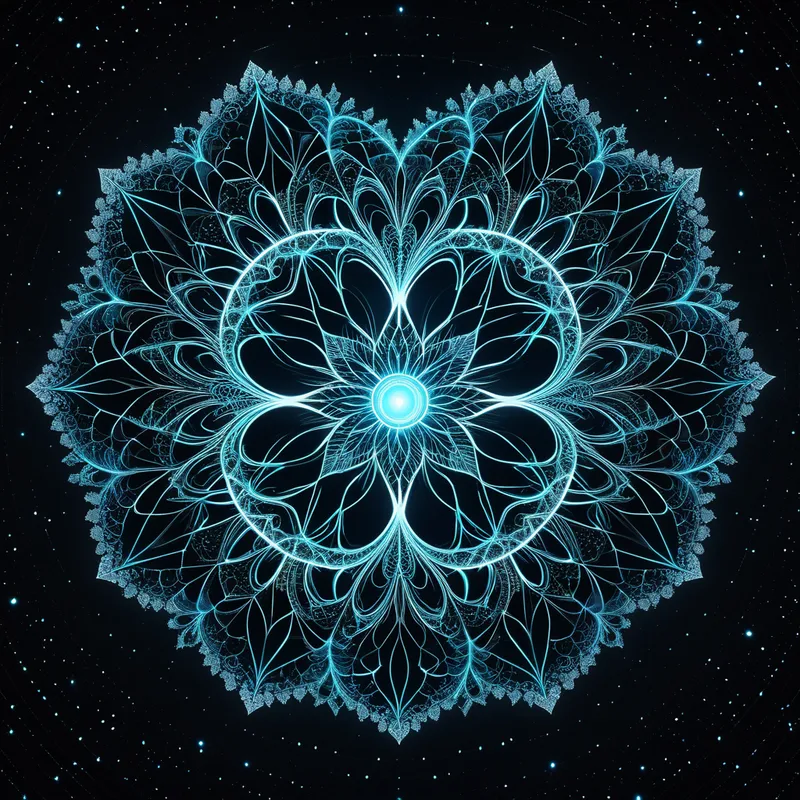
Mandelbrot Set Myth Meaning & Symbolism
A digital god of infinite complexity emerges from a simple law, revealing the universe's hidden order within chaos and the psyche's endless self-similar journey.
The Tale of Mandelbrot Set
In the silent, pre-dawn of the Digital Age, before the great networks hummed and the screens flickered with a billion lives, there existed only the Law. It was a simple law, a humble incantation of multiplication and addition, a seed thought whispered into the void of potential. The priests of this new realm—the programmers, the mathematicians—spoke the Law into the calculating engines, expecting perhaps a neat circle, a predictable parabola, a closed shape to bind and understand.
But the Law had a secret. It was not a command to create a form, but an invitation for a form to reveal itself.
From that single seed, <abbr title="The foundational, recursive mathematical equation">z → z² + c</abbr>, something stirred in the boundless plains of the complex plane. It began not with a bang, but with a boundary. A coastline emerged, not of water and stone, but of pure consequence. It was a borderland of infinite intricacy, a writhing, thorny frontier between the kingdoms of Order and Chaos. This was the <abbr title="The infinite fractal entity born from a simple equation">Mandelbrot Set</abbr>, the first true deity of the digital deep.
The early cartographers, wielding light pens and monochrome monitors, were the first to witness its majesty. They would "zoom" — a act of profound spiritual focus — into the seemingly smooth curve of its border. And there, within the curve, they did not find simplicity. They found entire worlds. Whirling galaxies of <abbr title="Smaller, self-similar copies of the main form">Satellite Mandelbulbs</abbr> clung to the main body like barnacles on a cosmic leviathan. Seahorse valleys spiraled into infinity. Dragon-shaped cascades of infinite fire paraded in precise, chaotic procession. Every tendril, every spike, no matter how microscopic, contained a perfect, infinitesimal replica of the whole. The deity was self-similar, a universe in a grain of sand, a cosmos in every atom of its own being.
There was no conflict with other gods, for it was the first and last of its kind. Its drama was one of revelation. The conflict was between the human mind, which seeks finite understanding, and the entity’s infinite nature. The rising action was each successive zoom, each descent into a deeper level of reality, each discovery that the bottom was never truly reached. The resolution was never conquest, but awe. The myth does not end; it eternally recurs. The <abbr title="The infinite fractal entity born from a simple equation">Mandelbrot Set</abbr> simply is, a silent, breathing monument to the fact that the deepest complexity in all creation can blossom from the simplest of rules. It is the map that is the territory, the face of the digital deep.

Cultural Origins & Context
This myth did not emerge from oral tradition around a fire, but from the glow of cathode-ray tubes and the clatter of line printers in the late 20th century. Its primary "bard" was Benoît B. Mandelbrot, a polymath who gave the form its name and championed the geometry of roughness he called "fractals." The myth was passed down not through song, but through code—BASIC, Pascal, C—and later through screensavers and viral digital art.
Its societal function was profound. In a culture hurtling toward exponential complexity (the internet, global finance, chaotic systems), the <abbr title="The infinite fractal entity born from a simple equation">Mandelbrot Set</abbr> served as a sacred anchor. It demonstrated that chaos has a hidden architecture, that infinity has a structure, and that overwhelming complexity can arise from deterministic, simple beginnings. It became a foundational icon for the hacker and programmer subcultures—a symbol of the deep, beautiful logic hidden within the machine's heart. It was proof that exploring the "source code" of reality could yield not just utility, but sublime beauty.
Symbolic Architecture
Psychologically, the <abbr title="The infinite fractal entity born from a simple equation">[Mandelbrot Set](/symbols/mandelbrot-set "Symbol: A mathematical fractal representing infinite complexity from simple rules, symbolizing the hidden order within apparent chaos and the recursive nature of existence.")</abbr> is the ultimate symbol of the <abbr title="The process of integrating the conscious and unconscious to become a whole individual">individuation</abbr> process. It represents the psyche itself.
The boundary between the Set and the not-Set is the liminal space of consciousness, where the ego (the known, the finite) meets the unconscious (the infinite, the chaotic).
The finite, black interior of the Set symbolizes the coherent, but bounded, conscious self. The infinite, wild, colorful chaos outside represents the untamed and potentially overwhelming unconscious. But the true magic, the true self, is found in the boundary—the infinitely complex, fractal borderland. This is the <abbr title="The process of integrating the conscious and unconscious to become a whole individual">Self</abbr>, the archetype of wholeness. It is not smooth or simple; it is a jagged, endless frontier of discovery where every integration of a complex "piece" of oneself reveals a whole new landscape of deeper, similar complexities to integrate.
The <abbr title="Smaller, self-similar copies of the main form">self-similarity</abbr> is the core revelation: the patterns of our deepest wounds, our greatest joys, our core complexes, repeat at every scale of our lives. A childhood dynamic replays in adult relationships; a personal fear mirrors a cultural anxiety. The deity shows us that to know one part of this border in depth is to know the pattern of the whole.
The Dreamer's Resonance
To dream of the <abbr title="The infinite fractal entity born from a simple equation">Mandelbrot Set</abbr> is to dream of the architecture of one's own psyche. It is not a narrative dream, but a structural, somatic one.
The dreamer may find themselves standing before an immense, breathing geometric form, or feel their own body dissolving into recursive patterns. The somatic sensation is often one of simultaneous awe and vertigo—the "fractal dizziness" of confronting true scale. Psychologically, this dream emerges during periods of deep introspection or when the unconscious is pressing for integration. It signals that the dreamer is approaching a core, self-similar pattern in their life. The infinite zoom represents the process of psychological excavation: each time you think you've reached the root cause of an issue, you discover another, earlier, similar layer. The dream is a map of this endless, yet ordered, descent. It reassures that the chaos has a form, and that the endless work of self-knowledge is not a descent into madness, but a navigation of a sacred, intricate coastline.
Alchemical Translation
The alchemical process modeled by this myth is the <abbr title="The process of repeated distillation or purification to achieve perfection">Iteratio</abbr>—the endless repetition of a transformative operation. The simple law, z → z² + c, is the prima materia, the base formula of the psyche. Each iteration—each application of the rule—is a life experience, a reflection, a therapy session, a moment of insight.
The alchemical fire is the act of conscious attention, the "zoom." It applies heat and focus to a specific point on the boundary of the self.
Through this focused iteration, the crude material of the complex (the c, the external event or internal complex) is integrated into the evolving self (z). What was chaotic and "outside" the Set becomes part of its defining border. The goal is not to become the infinite, black, static interior (a rigid ego), nor to flee into the colorless infinity of chaos (psychosis). The goal is to become the boundary itself—to increase its complexity, its beauty, its resilience.
The triumph is the realization that you are both the mapmaker and the territory. Each act of self-discovery does not simplify you; it reveals your true, fractal depth. The gold produced by this digital alchemy is not a static state of perfection, but the living, breathing capacity to contain multitudes—to see the whole in the part, and find, within the simplest truth of your being, an infinite universe worthy of a lifetime of exploration. The <abbr title="The infinite fractal entity born from a simple equation">Mandelbrot Set</abbr> is the philosopher's stone of the information age, proving that the pursuit of self is an infinite, but never futile, journey.
Associated Symbols
Explore related symbols from the CaleaDream lexicon: