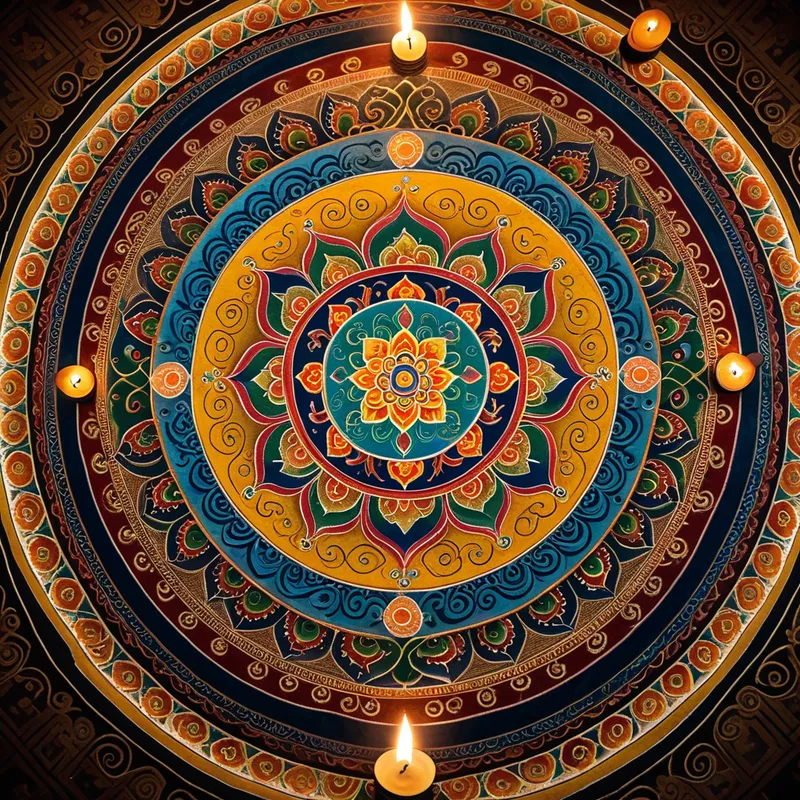
Mandala Myth Meaning & Symbolism
A sacred geometric cosmogram, the mandala maps the universe and the mind, guiding the seeker from chaos to the still, enlightened center.
The Tale of Mandala
Listen, and let the world fall away. In the beginning, there is only the swirling, formless chaos—a storm of potential, a canvas of pure, undifferentiated space. From this void, a point of intention emerges. It is not a sound, but a vibration; not a thought, but a knowing. This is the Bīja, the seed.
From this seed, a circle blooms. It is the first boundary, the rakṣā cakra, a ring of fire that contains the infinite within the finite. Inside this circle of becoming, the world is born. Lines of power, straight as sunbeams, cross at the center, dividing the unity into the four sacred directions. At each cardinal point, a gate of glorious architecture arises—not to keep out, but to invite in, a passage for the seeker.
Now, the deities descend. Or perhaps they ascend from the very center itself. In the heart, upon a throne of lotus petals, sits the Yab-Yum, the union of wisdom and compassion, stillness and dynamic action. Radiating outward in concentric courts are their retinues: peaceful bodhisattvas with gentle smiles, and wrathful dharmapālas with flaming halos, dancing within rings of lotus, vajra, and jewel.
This is the palace, the garbha-gṛha. Its walls are made of rainbow light and perception. The seeker—you, the pilgrim of the spirit—stands at the eastern gate. The path inward is a labyrinth of meaning. You must recognize each deity, not as an external statue, but as a facet of your own consciousness. You traverse the rings, from the outer realms of the senses, through the inner courts of meditation, confronting projections and illusions that shimmer and dissolve like mirages.
The conflict is the journey itself—the temptation to stop, to mistake a beautiful courtyard for the center, to identify with a single radiant deity and forget the source. The rising action is the gradual dissolution of the self that walks, as each step inward requires the offering of a cherished delusion. The palace grows more vivid, more real, as the outer world grows faint.
And then, the resolution. You pass the final, innermost ring. There is no fanfare, only a profound, echoing silence. You stand in the presence of the central essence. Here, the map and the territory are one. The seeker, the path, and the destination merge. The meticulously constructed universe of the mandala—with all its gates, palaces, and glorious inhabitants—shimmers, folds inward, and vanishes into the single, luminous point from which it all began. It was never out there. It was always in here. The circle is complete.
Cultural Origins & Context
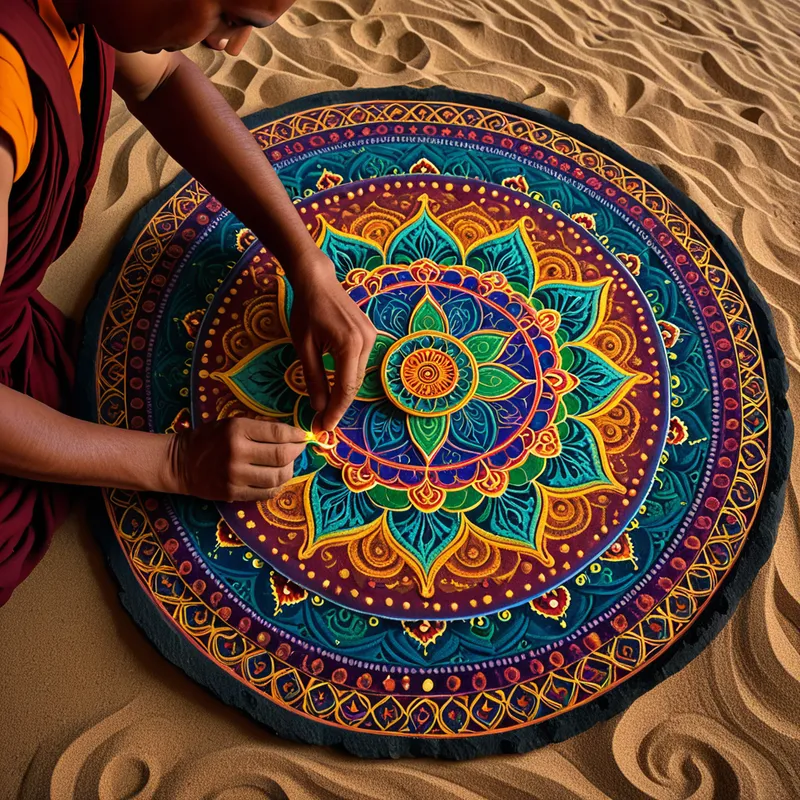
The mandala is not a single myth with a linear narrative, but a living, architectural mythos born from the esoteric traditions of Vajrayāna Buddhism, particularly as it flourished in Tibet and the Himalayan regions. Its primary function was and remains pedagogical and transformational. These cosmograms were transmitted from teacher to initiated disciple through sacred texts known as tantras.
The myth was "told" not just in words, but in sand, pigment, and meditation. Monks would spend weeks constructing exquisite dul-tson-kyil-khor (sand mandalas), their creation a moving, silent sermon on cosmology and psychology. The societal function was multifaceted: it was a map for advanced yogic practice, a tool for consecrating sacred spaces, and a public demonstration of core Buddhist tenets like impermanence, given its ritual destruction upon completion. It served as a bridge, making the abstract teachings on emptiness (śūnyatā) and compassion tangibly accessible through sublime beauty and geometric order.
Symbolic Architecture
At its core, the mandala is a symbol of the psyche's quest for integration. It is a diagram of wholeness.
The center is the Self, the totality of the psyche, which organizes the chaos of the personal unconscious and the collective archetypes into a coherent, sacred order.
The square palace within the circle represents the integration of the four functions of consciousness—thinking, feeling, sensation, and intuition—or the four elements, brought into harmony and contained by the unifying circle of the spirit. The gates are the points of conscious engagement with the world. The myriad deities are the archetypal forces within us: the peaceful ones representing sublimated, integrated energies, the wrathful ones representing the raw, often frightening power of the shadow that must be acknowledged and transformed.
The entire journey from periphery to center models the process of moving from a state of identification with the fragmented persona (the outer roles we play) to an encounter with the inner archetypal world, culminating in a conscious relationship with the central, ordering principle of the Self. It is a visual representation of individuation.
The Dreamer's Resonance
When the mandala pattern emerges in modern dreams, it rarely appears as a traditional Buddhist icon. Instead, it manifests as the psyche's innate drive toward self-healing and order during a period of fragmentation or crisis. One might dream of a spider web glistening with perfect symmetry at dawn, the blueprint of a building that is also a circuit board, or a circular dance where every movement is essential to the whole.
Somatically, this can coincide with a felt sense of centering—a literal pulling together after a period of dissociation or anxiety. Psychologically, it signals a process of consolidation. The conscious ego is overwhelmed, and the deeper Self activates an archetypal pattern of reorganization. The dream mandala is the psyche's own blueprint for reconstruction, appearing when the dreamer is unconsciously sorting through chaotic experiences, relationships, or emotions, attempting to find the still point around which they can cohere. It is the mind in the act of healing its own fractures.
Alchemical Translation
The alchemical work modeled by the mandala is the opus contra naturam—the work against nature's entropy. Our natural state, psychologically, is toward dispersion, identification with passing thoughts and emotions, and fragmentation. The mandala provides the sacred technology for the reverse process: integration.
The pilgrim's journey inward is the alchemical solve et coagula: to dissolve the hardened complexes of the ego and coagulate (re-integrate) the essence around a new, more authentic center.
The first step is drawing the protective circle—setting a conscious container for the work, whether through therapy, journaling, or dedicated self-reflection. This is the rakṣā cakra, creating a sacred space where the inner work is safe from mundane interference.
The traversal of the concentric rings is the confrontation with sub-personalities and archetypal energies (the "deities"). The wrathful forms represent the shadow's heat, the necessary nigredo or blackening of alchemy, where we face our own darkness, jealousy, and rage. The peaceful forms represent the albedo, the whitening, where these energies are understood and sublimated.
Reaching the center is the culmination: the rubedo, the reddening, the creation of the philosophical gold. This is not the inflation of becoming "enlightened," but the humble, grounded realization of one's own fundamental pattern. The final, most radical alchemy is the dissolution of the mandala itself—understanding that even this beautiful, intricate structure of the Self is provisional. One returns to the world, to the periphery, but now the center is everywhere. The transformed individual carries the integrated mandala not as a rigid structure, but as a living, breathing relationship between order and chaos, self and world. The map is erased, but the territory of the soul has been forever changed.
Associated Symbols
Explore related symbols from the CaleaDream lexicon: