Malachite Casket Myth Meaning & Symbolism
A tale of the Mountain Spirit's daughter who chooses mortal love and sacrifice over immortal power, sealed within a malachite casket.
The Tale of Malachite Casket
Listen, and hear a tale from the deep earth, from the time when the mountains were not just stone, but living breath. In the Urals, where the air bites cold and the rock holds memory, there lived the Mistress of the Copper Mountain. She was not a queen of sun and sky, but of shadow and gemstone, of veins of copper and seams of malachite that glowed with their own inner fire. Her halls were caverns of impossible beauty, where crystals sang and precious stones grew like flowers.
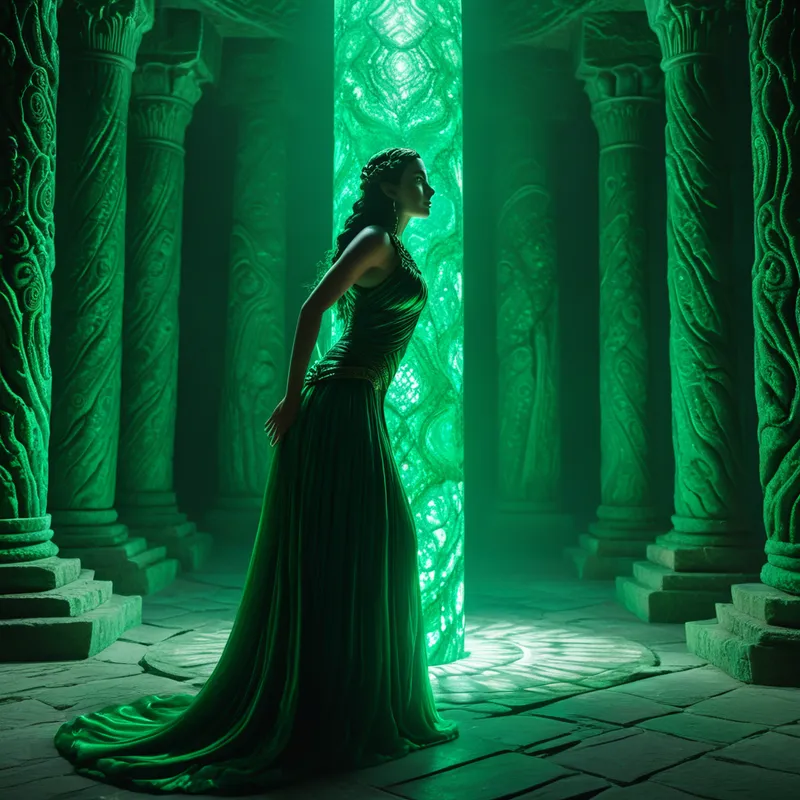
To this sovereign of the deep earth came a mortal man, a miner named Stepan. His hands were rough, his back bent from labor, but his eyes held a light that was not of his lamp. He sought not just ore, but beauty within the stone. And the Mistress saw him. She appeared to him not as a fearsome spirit, but as a woman of breathtaking, terrifying beauty—her hair the black of mine-soot, her gown the swirling green of malachite, her eyes holding the patient, cold fire of millennia. She tested him, showed him riches beyond imagining, but Stepan, though awed, remained true to his heart and his word. For his honesty, she gifted him a wife: her own daughter.
The Malachite Maiden was a creature of two worlds. Her form was of the earth, her spirit woven from the whispers of stone and the echo of the miner’s pick. Yet, in her shone a curiosity for the world above, for the fleeting warmth of the sun and the messy, vibrant pulse of mortal life. She came to Stepan, and they built a life. She brought with her a dowry of profound skill, weaving cloth of astonishing beauty from stone flax, patterns telling tales of the mountain’s heart. But a condition was set, a geas from her mother: she must never speak of her origins to the priests of the world above.
For a time, there was harmony. The earth’s wealth and the hearth’s warmth met in their home. But the world of light is jealous of the world of shadow. The local priest, a man of rigid doctrine and suspicious eye, saw the otherworldly beauty of the Maiden’s weaving and the strange, deep peace in Stepan’s house. He came with cross and condemnation, demanding to know from whence this woman came, accusing her of witchcraft. Pressed and cornered, to protect her mortal family from the priest’s wrath, the Maiden broke her mother’s command. She spoke the truth of her lineage.
The moment the words left her lips, the connection was severed. The law of the deep world was absolute. She could not stay. With a look of infinite sorrow to Stepan and the child she bore him, the Malachite Maiden turned and walked towards the solid rock of the mountain wall. It parted for her like water, and she stepped back into the heart of the earth, leaving behind only the echo of her presence and a final, profound gift for her daughter: a small, exquisitely crafted casket of solid, glowing malachite.

Cultural Origins & Context
This tale is not from a single book, but from the collective breath of the Ural miners. It was collected, polished, and set into the literary canon by the writer Pavel Bazhov in his seminal collection The Malachite Casket (1939). Bazhov was not an inventor, but a scribe of the oral tradition. He listened to the old miners, the stariki, who spoke of the Mistress not as a fairy tale, but as a very real, capricious force of the mines.
The myth functioned as a profound piece of occupational psychology. Mining in the Urals was brutal, dangerous work. The mountain was both provider and tomb. The figure of the Mistress personified this duality—she could reveal a rich vein to a worthy man or cause a tunnel to collapse on a greedy one. The myth enforced an ethical code: respect for the earth, honesty in labor, and an understanding that true wealth (both material and spiritual) comes with a price and a responsibility. It was a story that made the terrifying, impersonal darkness of the mine comprehensible, giving it a face, rules, and even a form of reverence.
Symbolic Architecture
At its core, this is a myth of the impossible marriage between realms: the eternal, mineral world of the Unconscious (the Mountain) and the temporal, organic world of the Conscious (the Village). The Malachite Maiden is the psyche’s attempt to bridge this divide. She is the anima, the soul-image, emerging from the depths in a form that can be related to—beautiful, skilled, nurturing—yet inherently bound by the laws of her origin.
The casket is the sealed psyche itself; the treasure is not inside it, but is its very substance, locked by the conditions of its existence.
The priest represents the rigid, dogmatic aspect of consciousness that cannot tolerate mystery or ambiguity. He is the literalism that demands everything be named and categorized, an energy that, when applied to the soul’s mysteries, forces a traumatic separation. The Maiden’s confession is not a betrayal, but a sacrifice made under the pressure of conscious tyranny, a soul forced to articulate its primal nature in terms the conscious mind can weaponize, thereby losing its magic.
Her return to the mountain is not a punishment, but a re-assimilation. The conscious world, with its demands and judgments, proved unable to contain her. The gift of the malachite casket to her daughter is the critical symbol. It is the heirloom of the depth, the encoded legacy of the soul’s origin, passed to the next generation of consciousness. It is not to be spent, but contemplated; its value is in its being, not its utility.

The Dreamer's Resonance
To dream of the Malachite Casket is to dream at the threshold of a profound inner negotiation. You may dream of a beautiful, nurturing presence that feels profoundly "other," who offers gifts of strange, non-human beauty (woven stone, singing crystals). There is a somatic sense of deep, earthy grounding mixed with a thrilling, uncanny awe. This is the soul-nature making itself known.
The conflict arises when a dream figure of authority—a judge, a critic, a parent, a boss—demands you explain this presence, define it, justify it. The anxiety is palpable. This is the psyche staging the core conflict: the pressure of the ego’s need for control and social conformity threatening the delicate connection to the animating spirit. The moment of "confession" in the dream often leads to a feeling of loss, of a door closing in a mountain wall, of a beloved figure walking away into a landscape that absorbs them. The dreamer is left with a sense of grief, but also often with a tangible object—a box, a stone, a key. This is the nascent casket, the symbol that remains after the direct connection recedes. The dream process is one of soul-loss under pressure, followed by the cryptic compensation of a symbolic token.

Alchemical Translation
The myth charts the opus of bringing the soul into life, and the inevitable, necessary retreat. The Malachite Maiden’s journey is the archetypal process of incarnation. The coniunctio with Stepan represents the heroic attempt to integrate a profound depth-content into daily life. For a time, it works; life is enriched, creativity flows (the stone flax weaving). This is the ego successfully relating to and housing a piece of the Self.
But the psyche is a self-regulating system. The priest, often seen merely as a villain, is also a necessary part of the psychic ecology. He is the principle of discrimination and definition run amok, but he forces a crisis of identity.
Individuation is not about permanent possession of the depths, but about learning the ritual of approach and the grace of release.
The Maiden’s return to the mountain is the nigredo following a failed albedo. It is not failure, but a deepening. The conscious mind (Stepan, the village) is not yet capable of holding the full mystery. The treasure must be re-sealed, but now in a new form: the Casket.
For the modern individual, the alchemical work is in relation to that Casket. We are the daughter who inherits it. We cannot force it open without destroying its nature. We must instead learn to live with it, to feel its weight, to admire its patterns, to wonder at its sealed nature. Our task is not to possess the anima/soul in raw form, but to honor the vessel that contains its memory and promise. The transformation is in the relationship to the mystery itself—from one of grasping possession to one of reverent, patient guardianship, awaiting the time when the key, not of force but of understanding, might be found.
Associated Symbols
Explore related symbols from the CaleaDream lexicon: