
Mawak Myth Meaning & Symbolism
A myth of the Great Bear who sacrifices his earthly form to become the guiding constellation, embodying the eternal cycle of death and spiritual rebirth.
The Tale of Mawak
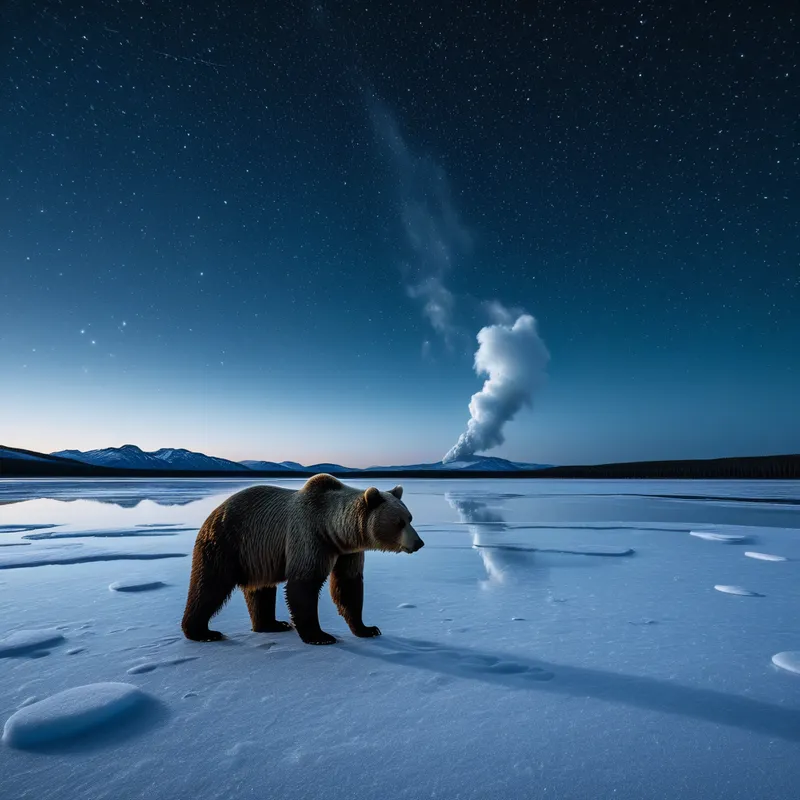
Listen. In the time before the People walked in this way, when the world was still soft with creation, there lived Mawak. He was not merely a bear of the forest, but the First Bear, the grandfather of all bears, a being of immense power and profound wisdom. His fur was the deep black of a moonless night, and in his eyes shone the patient knowledge of the oldest stones.
For generations beyond counting, Mawak watched over the People. He taught them the secrets of the woods—which roots held medicine, where the clean waters flowed, how to read the language of the wind. He was their silent guardian, a great, dark shadow moving with a rumble like distant thunder through the birch and pine. The People prospered, and a deep bond was woven between them, a covenant of mutual respect.
But a great change began to stir in the bones of the world. A creeping cold, deeper than any winter known, began to seep from the north. It was not just a season; it was a forgetting. The game grew scarce, the rivers locked in silent ice, and a shadow fell upon the hearts of the People. They grew fearful, lost. They could no longer hear the whispering of the trees or see the paths their ancestors had walked. The old ways were fading, and with them, the warmth of connection.
Mawak felt this chill in his own great spirit. He saw his people wandering, their eyes turned downward in despair, cut off from the sky and the stories written there. He knew a terrible truth: to guide them, he could no longer walk beside them on the earth. His earthly form, mighty as it was, had become a boundary. His presence, once a comfort, now kept them looking to the ground, to the immediate struggle, and not to the eternal patterns above.
With a heart heavier than the deepest snow, Mawak made his choice. He called the People to a high, sacred place where the sky touched the land. There, under the vast, dark bowl of the coming night, he spoke to them not with a growl, but with the silence of his immense being. He turned his gaze from their tear-streaked faces and looked up, up into the infinite black.
Then, he began to walk. Not across the land, but into the sky. Each step was a sacrifice, a shedding. His powerful legs dissolved into trails of shimmering light. His massive shoulders broadened into points of brilliant fire. His great, loving heart became the brightest point of all. Where the mighty bear of earth had stood, now a new constellation burned in the heavens: the seven stars we call the Great Bear.
From that night on, no matter how cold the winter, how deep the darkness, or how lost the journey, the People had only to lift their eyes. There, fixed in the northern sky, was Mawak. His new form was a map written in fire, a constant, unwavering guide. He showed them the turning of the seasons, the path through the trackless night, and reminded them that even the greatest of earthly forms may be surrendered for a higher, guiding purpose. The guardian did not abandon them; he transformed, so that they might never be truly lost again.
Cultural Origins & Context
The story of Mawak is a foundational aadizookaan of the Ojibwe people, part of the rich constellation of stories that compose their worldview. Traditionally told by elders and storytellers during the long winter nights, this myth was far more than entertainment; it was a vital instrument of education and cultural navigation. In the vast forests and lake countries of the Great Lakes region, practical survival was intimately tied to celestial knowledge. The position of the Great Bear constellation, which never sets below the horizon in northern latitudes, is a critical directional marker.
Thus, the myth encodes essential, life-preserving information within a profound spiritual narrative. It explains the why of the constellation’s existence and its sacred function. By linking the celestial guide directly to a beloved, sacrificed earthly guardian, the story fosters a relational, respectful attitude toward the cosmos. The stars are not impersonal points of light; they are a remembered being, a relative who watches over them. This myth served to orient the People in every sense: physically, across the landscape; seasonally, through the turning year; and spiritually, reminding them of the covenant between the earthly and the celestial, and the sacrifices that uphold the cosmic order.
Symbolic Architecture
At its core, the myth of Mawak is a masterful allegory for the necessity of symbolic death for spiritual rebirth. The Great Bear represents a foundational, protective power—the instinctual self, the embodied wisdom, the "old way" that has served its purpose. Yet, there comes a point when clinging to a familiar form becomes its own kind of prison, both for the self and for those who depend on it.
The most profound guidance often requires the dissolution of the form that first provided shelter.
The "great cold" is not merely winter, but a state of psychic stagnation, a disconnect from meaning and direction. Mawak’s sacrifice is not an act of annihilation, but of alchemical translation. He transmutes his physical, temporal presence into a spiritual, eternal one. His body becomes a pattern, his life force becomes a fixed light. This is the movement from the personal to the archetypal, from the historical guardian to the timeless principle of guidance.
The seven stars of the Great Bear symbolize the enduring structure that remains after such a transformation—the essential, crystalline truth that survives the dissolution of its former vessel. The myth teaches that true wisdom is not lost when its earthly carrier passes; it is liberated and elevated, becoming available to all who know how to look up.
The Dreamer's Resonance
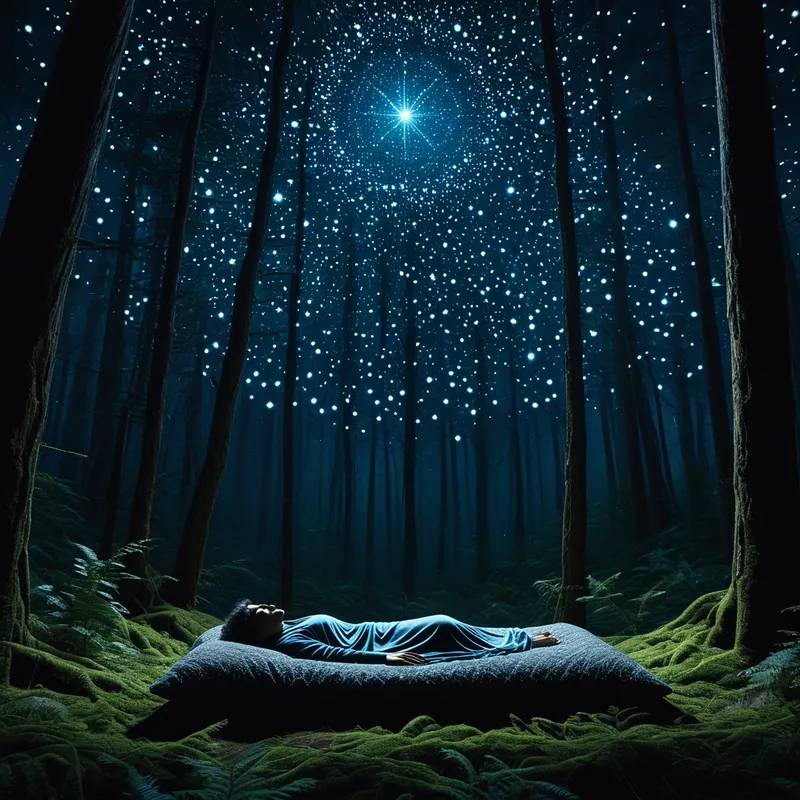
When the pattern of the Mawak myth stirs in the modern dreamer, it often signals a profound crossroads in the psyche. To dream of a powerful, guiding animal that must be released, or that transforms into light or a geometric pattern, points to a deep somatic process of psychic repositioning.
The dreamer may be experiencing the "great cold"—a feeling of existential lostness, a career that has lost its meaning, a relationship that has become a cage, or a once-nourishing identity that now feels stifling. The embodied "bear" in the dream—which could manifest as a sturdy home, a respected role, a long-held belief, or even a part of one's own body—is recognized by the unconscious as having served its purpose. The dream presents the necessity of its sacrifice. This is not a violent death, but a conscious, sorrowful, and necessary letting go. The somatic sensation is often one of weightlessness following a heavy burden, or of cold clarity after a period of foggy attachment. The dream is the psyche preparing the individual to relinquish a familiar power so that a new, more transcendent form of guidance can be internalized.
Alchemical Translation
The individuation journey modeled by Mawak is the ultimate act of psychic alchemy: turning the lead of earthly attachment into the gold of spiritual orientation. For the modern individual, this myth maps the painful but liberating process of ego sacrifice for Self-realization.
We all have our inner "Mawak"—a strength, a talent, a role, or an achievement that defines us and through which we derive security and offer help to others. This is the first, necessary stage of development. But the journey toward wholeness demands a second, more difficult stage. We must ask: Is my prized identity now keeping me—and perhaps those around me—from seeing a larger pattern? Am I clinging to an earthly form of success, love, or knowledge that prevents a higher, more guiding wisdom from emerging?
The transformation occurs when we consent to be defined not by what we hold, but by what we point toward.
The alchemical work is to consciously perform Mawak’s walk into the sky. It is to voluntarily de-integrate a central part of our constructed self, to let it dissolve in service of a greater ordering principle. This might look like leaving a prestigious job to find a true calling, ending a codependent relationship to discover inner authority, or abandoning a rigid worldview to embrace a living mystery. The result is not emptiness, but re-contextualization. The sacrificed power does not vanish; it is reconstituted as an inner constellation—a fixed, internal compass of values, integrity, and symbolic meaning that guides all subsequent earthly journeys. We no longer are the bear; we carry its stars within us, a permanent map for navigating the darkest nights of the soul.
Associated Symbols
Explore related symbols from the CaleaDream lexicon: