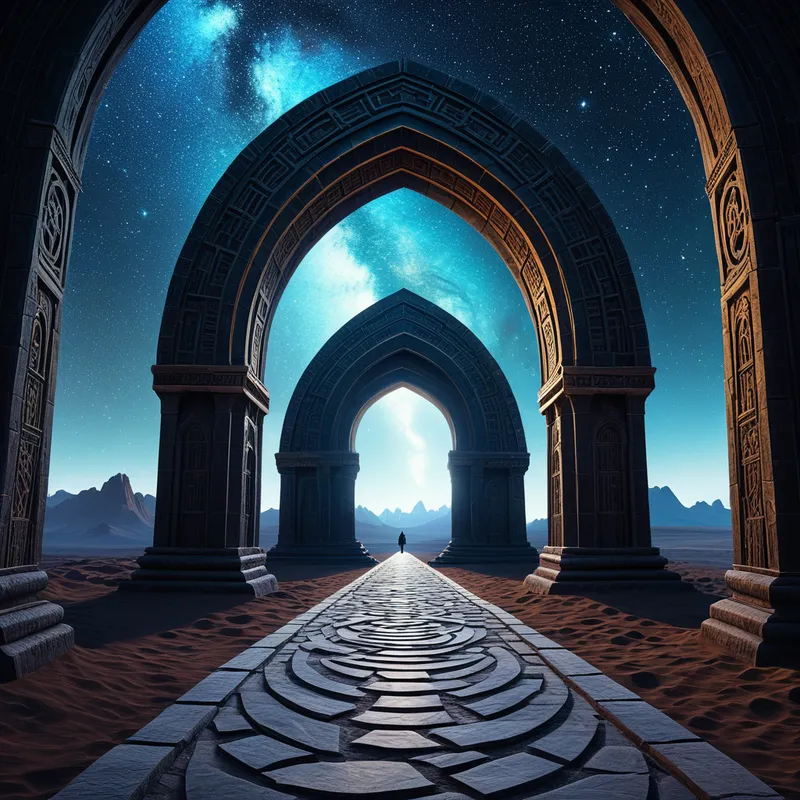
Major Arcana Myth Meaning & Symbolism
The soul's archetypal journey from naive Fool to integrated World, a map of psychic alchemy told through twenty-two timeless, symbolic stations.
The Tale of Major Arcana
Listen. Before there were books, before there were maps, there was the Path. And on this Path walked a figure with a feather in their cap and a light in their eyes, carrying all they owned in a bundle on a stick. This is where our story begins, not at a beginning, but at a leap.
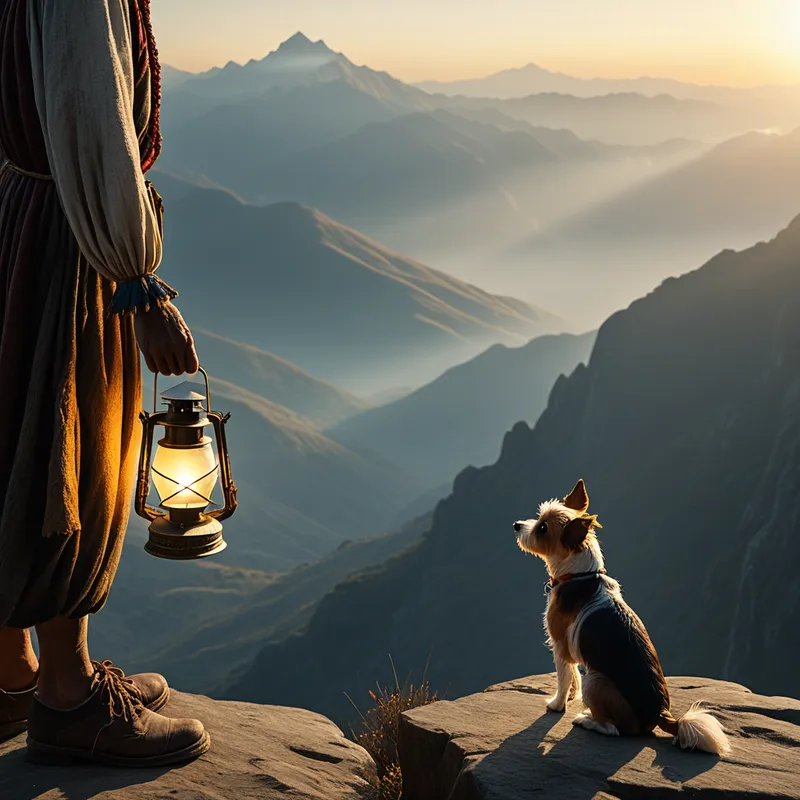
They are the Fool, and they step from the solid ground of the known world into the thin air of a cliff’s edge. A small, loyal creature nips at their heel, a warning they do not yet heed. For their gaze is fixed on the distant, sun-washed peaks, and their heart beats with the one pure note of beginning. The wind catches their sleeve, and they fall—or do they fly? This is the first mystery.
The Path then brings them to a cavern where a Magician stands before a table bearing the tools of creation: a cup, a sword, a wand, a coin. “As above, so below,” they whisper, and the Fool feels the universe contract into their own two hands. Next, seated between two pillars of dark and light, the High Priestess parts her veil, revealing not a face, but the reflected depth of a moonlit sea. She speaks without words, and the lesson is silence.
Thus tutored, the Fool encounters the Empress in a field of ripe wheat, her crown of stars touching the fertile earth, and the stern Emperor upon a stone throne, his scepter a rod of measured law. From the parental cosmos, the Fool is drawn to the Hierophant, who offers the keys to ancient dogma, and then to the Lovers, where a choice must be made beneath a blazing sun.
The journey turns outward. The Fool masters the green-and-gold Chariot, learns the balance of inner scales from the figure of Justice, and retreats into the lantern-lit solitude of the Hermit. Then, the great wheel turns. The Wheel of Fortune spins them upward to glory and down into the crucible.
Here, in the depths, the lessons deepen. The unwavering gaze of Strength, who gentles the beast not with force, but with grace. The haunting vision of the Hanged Man, suspended in a timeless pause, seeing the world upside down and finding it right. The finality of Death on his pale horse, making all things equal, clearing the old ground.
And from that ground, new harmonies arise. Temperance pours water between two vessels, creating a third, transcendent thing. The Devil shows the chains that are chosen, not forged. The Tower is struck by lightning, its crown of certainty blasted away, freeing those within to fall back to the essential earth.
Then, the healing waters. The hope of the Star. The haunting glow of the Moon, reflecting our deepest tremors. The triumphant clarity of the Sun. And the last judgment call of the Judgement angel, summoning the self from its own tomb.
The Path ends where it began, yet utterly changed. The Fool stands now within the World, a dancer in a celestial wreath, holding the twin wands of mastery. The circle is closed. The journey is complete. And yet, the dancer’s feet are still moving, for the end is always a new beginning.
Cultural Origins & Context
The Major Arcana, as a coherent narrative sequence, is a myth born from the confluence of streams. Its earliest physical forms emerged in 15th-century Italy as luxury playing cards, the Tarocchi. These were not tools of divination for the masses but Trionfi (triumph) cards for the nobility, depicting allegorical figures in a hierarchical order that could trump other suits in gameplay.
The mythologizing of the sequence began in earnest in the 18th century with French occultists like Antoine Court de Gébelin and later, Jean-Baptiste Alliette (Etteilla). They argued the cards were not mere playthings but the fragmented pages of a lost Book of Thoth, containing the universal wisdom of the ancients. This esoteric tradition was systemized and profoundly expanded by the Hermetic Order of the Golden Dawn in the late 1800s. Members like A.E. Waite and artist Pamela Colman Smith created the iconic Rider-Waite-Smith deck, embedding the cards with Kabbalistic, astrological, and alchemical symbolism. This act transformed the cards from a scattered allegory into a deliberate, teachable map of the soul’s ascent, a myth passed down not by bards around a fire, but by initiates in lodges and seekers in study.
Symbolic Architecture
At its core, the myth of the Major Arcana is a symbolic blueprint for the development of consciousness. It is not a linear biography but a spiral path through the archetypal forces that shape every human psyche. The sequence models the process of moving from unconscious identification (The Fool as pure potential) to conscious integration (The World as realized wholeness).
The Major Arcana does not tell your fortune; it maps your ontology. It is the alphabet of becoming.
The first seven cards (Fool to Chariot) often represent the ego’s journey into and through the outer world—mastering skills, facing choices, building an identity. The middle seven (Strength to Temperance) plunge the seeker into the underworld of the soul, confronting shadow, limitation, and the need for profound inner adjustment. The final seven (Devil to World) depict the stages of liberation, illumination, and synthesis, where what was learned is embodied. Key symbols—the pillars of the High Priestess, the wheel, the suspended figure, the dancing circle—are not arbitrary but psychic landmarks. They represent the inherent structures of experience: duality, cyclicity, sacrifice, and unity.
The Dreamer's Resonance
When the archetypal pattern of the Major Arcana stirs in modern dreams, it rarely appears as a literal parade of cards. Instead, one dreams of its stations. A dream of standing at a great height, feeling both terror and exhilaration before a step into the unknown—this is the Fool’s leap somaticized. A dream of being trapped in a crumbling building as a storm rages (The Tower), or of gently calming a wild animal that then becomes an ally (Strength), or of finding oneself dancing in a circle that contains the entire sky (The World)—these are the myth living itself out in the personal unconscious.
Such dreams signal a psyche engaged in a fundamental phase of development. The somatic feeling is often one of process: tension before a choice (The Lovers), the weight of responsibility (The Emperor), the liberating collapse of a long-held belief (The Tower). The dreamer is not learning about the archetypes from the outside; they are temporarily inhabiting them, working through a necessary stage of psychic integration that the conscious mind may only later comprehend as a period of crisis, growth, or awakening.
Alchemical Translation
Psychologically, the Major Arcana is a manual for the alchemical process of individuation. Each card represents a stage in the transmutation of the base lead of the unexamined life into the gold of authentic selfhood. The Fool’s journey is the prima materia. The encounters with opposing forces (Empress/Emperor, Lovers, Justice) are the stages of separatio and coniunctio.
The lightning that shatters the Tower is the same fire that tempers the Spirit. Destruction and creation are one process seen from different sides of the soul.
The deep middle of the sequence—from the Hanged Man’s surrender to Temperance’s blending—is the crucial nigredo and albedo, where the ego’s will is dissolved so the Self can emerge. The final cards model the citrinitas and rubedo of alchemy: the illumination of the Star, Sun, and Judgement, culminating in the integrated, dancing wholeness of The World. For the modern individual, this myth teaches that personal crises, periods of stagnation, and bursts of insight are not random misfortunes or flukes. They are stations on the archetypal path. To recognize oneself in this myth is to understand one’s life not as a series of accidents, but as a sacred journey with an inherent, though often mysterious, logic. The map does not eliminate the struggle of the walk, but it assures the walker they are on a path that has been, and always will be, walked.
Associated Symbols
Explore related symbols from the CaleaDream lexicon: