Maat and Isfet Myth Meaning & Symbolism
The eternal struggle between Maat, the principle of cosmic order, and Isfet, the force of primordial chaos, defining the Egyptian worldview and the human soul.
The Tale of Maat and Isfet
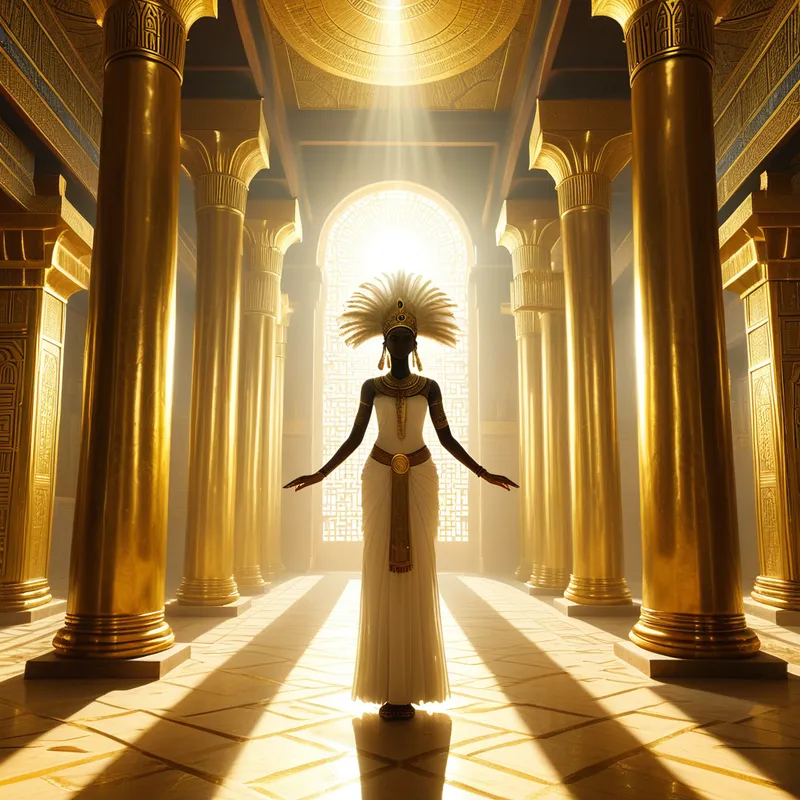
Before the first stone of the first pyramid was laid, before the Nile knew its banks, there was the Nun. From its dark, formless depths, the sun god [Khepri](/myths/khepri “Myth from Egyptian culture.”/) pushed forth the first mound of ordered land. And with that first act of separation—land from [water](/myths/water “Myth from Chinese culture.”/), light from dark—a daughter was born. Her name was Maat. She was not a goddess of battles or storms, but of the silent, perfect pattern. She was the reason the sun rose in the east and set in the west. She was [the law](/myths/the-law “Myth from Biblical culture.”/) that made [the Nile flood](/myths/the-nile-flood “Myth from Egyptian culture.”/) and recede, the rhythm of the seasons, the truth in a just word, the balance in a honest trade. Her symbol was a single, perfect ostrich feather, so light it could measure the weight of a soul.
But creation casts a shadow. Where Maat was the bounded field, there remained the unbounded. Where she was the measured word, there was the scream. This was Isfet. Isfet was not a devil, not a rival god with a face and a name. It was the principle of anti-pattern. It was the drought that starved [the river](/myths/the-river “Myth from Buddhist culture.”/), the lie that broke the community, the greed that unbalanced the scale, the chaos that crept in when vigilance slept. It was the ever-present pull back into the Nun, the entropy that sought to undo [the world](/myths/the-world “Myth from Tarot culture.”/).
Every dawn was a victory. [The Pharaoh](/myths/the-pharaoh “Myth from Egyptian culture.”/), the Son of [Horus](/myths/horus “Myth from Egyptian culture.”/), would stand in [the temple](/myths/the-temple “Myth from Jewish culture.”/) as the first light pierced the darkness. His sacred duty was not to conquer foreign lands for glory, but to repel Isfet. Through right speech, just laws, and proper offerings, he “put Maat in the place of Isfet.” He was [the gardener](/myths/the-gardener “Myth from Christian culture.”/) of cosmic order, weeding the chaos that constantly threatened to grow. The people, in their turn, lived by Maat. To speak truth, to care for the weak, to honor the gods and the dead—this was not mere morality; it was the daily ritual that held the very fabric of reality together.
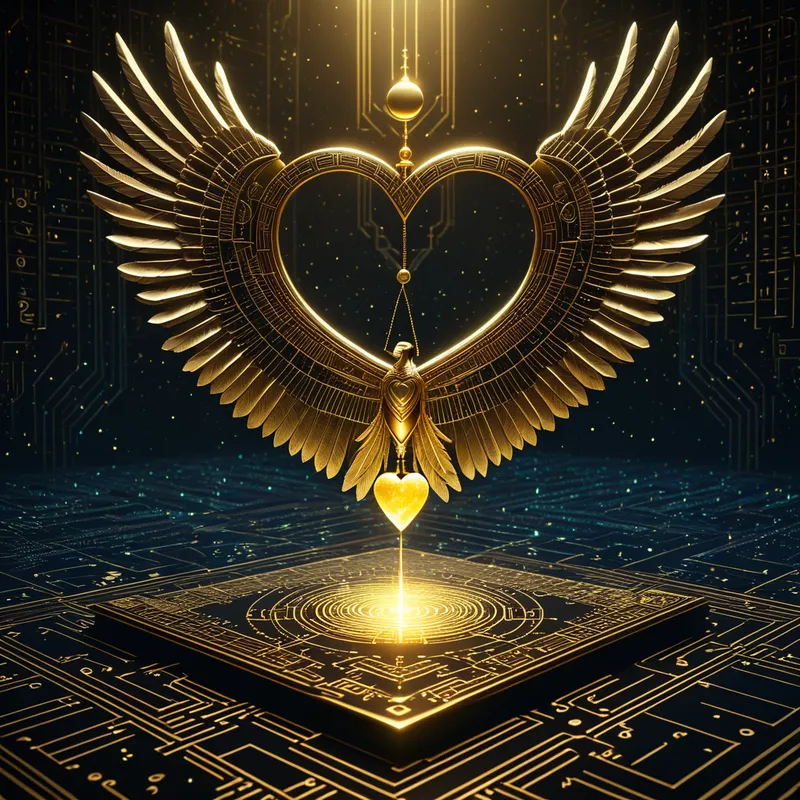
And in the silent, star-lit hall of the afterlife, the final, most intimate reckoning awaited. Here, in the Hall of Maati, the soul stood bare before Anubis, the jackal-headed guide. The heart, seat of memory and conscience, was placed upon one pan of a golden scale. Upon the other, Anubis placed the feather of Maat. The air would still. The hieroglyphs on the walls seemed to hold their breath. If the heart, heavy with deceit and wrongdoing, sank down, the monstrous Ammit waited to consume it, casting the soul into non-existence. But if it balanced—if it was as light as truth—the soul was declared “true of voice” and welcomed into the eternal, ordered fields of Aaru. Thus, from the cosmic to the personal, the tale was woven: existence itself was the perpetual, sacred act of balancing the feather against the chaos of the heart.
Cultural Origins & Context
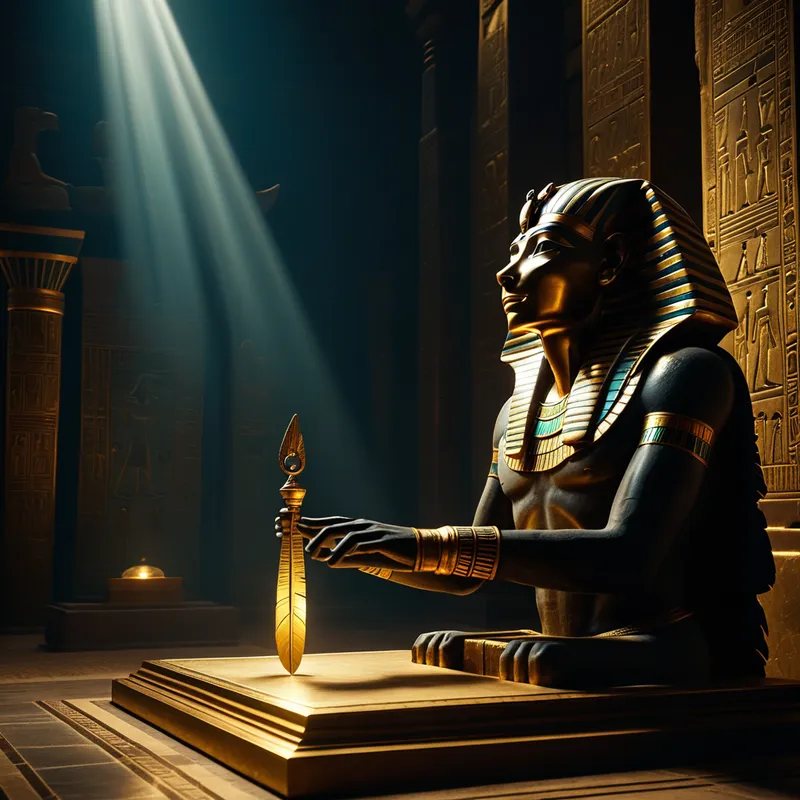
The myth of Maat and Isfet was not a single story told around a fire but the foundational bedrock of ancient Egyptian civilization for over three millennia. It was the operating system of their universe. Unlike the episodic narratives of Greek gods, the dynamic between Maat and Isfet was a constant, lived reality embedded in law, religion, and daily practice.
This worldview was propagated and maintained by the elite scribal and priestly classes, but its principles permeated all levels of society. It was enacted most visibly by the [Pharaoh](/myths/pharaoh “Myth from Egyptian culture.”/), the ultimate priest-king whose primary function was to maintain Maat. Temple rituals were not merely prayers; they were cosmological maintenance procedures. In the legal realm, judgments were about restoring balance (Maat), not merely punishing. Even the famous Book of the Dead was a practical guidebook for the deceased to navigate the final judgment by reciting declarations of innocence (“I have not stolen, I have not lied…”), actively asserting one’s alignment with Maat against the claims of Isfet.
The myth’s societal function was profound: it provided a coherent explanation for natural order and social harmony, it legitimized the pharaonic state as the divine agent of that order, and it offered a clear ethical framework that linked personal conduct to cosmic stability. To live by Maat was to participate in sustaining creation itself.
Symbolic Architecture
At its core, this myth presents a cosmology where order is not a [default](/symbols/default “Symbol: The baseline state, unaltered condition, or standard setting from which all variations and changes originate.”/) state but a hard-won [achievement](/symbols/achievement “Symbol: Symbolizes success, mastery, or reaching a goal, often reflecting personal validation, social recognition, or overcoming challenges.”/), and [chaos](/symbols/chaos “Symbol: In Arts & Music, chaos represents raw creative potential, uncontrolled expression, and the breakdown of order to forge new artistic forms.”/) is not an [aberration](/symbols/aberration “Symbol: A deviation from the expected pattern, representing disruption, anomaly, or departure from the natural order.”/) but the baseline from which form emerges. Maat represents [the principle](/symbols/the-principle “Symbol: A fundamental truth, law, or doctrine that serves as a foundation for a system of belief, behavior, or reasoning, often representing moral or ethical standards.”/) of relatedness, the meaningful [pattern](/symbols/pattern “Symbol: A ‘Pattern’ in dreams often signifies the underlying structure of experiences and thoughts, representing both order and the repetitiveness of life’s situations.”/) that connects star to [stone](/symbols/stone “Symbol: In dreams, a stone often symbolizes strength, stability, and permanence, but it may also represent emotional burdens or obstacles that need to be acknowledged and processed.”/), [king](/symbols/king “Symbol: A symbol of ultimate authority, leadership, and societal order, often representing the dreamer’s inner power or external control figures.”/) to [farmer](/symbols/farmer “Symbol: Farmers symbolize hard work, nurturing, and the cultivation of not just crops, but also personal growth and community.”/), [action](/symbols/action “Symbol: Action in dreams represents the drive for agency, motivation, and the ability to take control of situations in waking life.”/) to consequence. Isfet symbolizes the unrelated, the disconnected, the fragmentary, and the meaningless.
The feather is not a measure of perfection, but of alignment. The heart is not judged for its weight of sin, but for its density of disconnection.
Psychologically, Maat corresponds to the conscious ego’s struggle to create a coherent, ethical, and sustainable [identity](/symbols/identity “Symbol: Identity represents the sense of self, encompassing personal beliefs, cultural background, and social roles.”/) and world. It is the organizing principle of the [psyche](/myths/psyche “Myth from Greek culture.”/)—[the logos](/myths/the-logos “Myth from Biblical culture.”/), the [structure](/symbols/structure “Symbol: Structure in dreams often symbolizes stability, organization, and the framework of one’s life, reflecting how one perceives their environment and personal life.”/), the sense of self and [purpose](/symbols/purpose “Symbol: Purpose signifies direction, meaning, and intention in life, often reflecting personal ambitions and core values.”/). Isfet is the [shadow](/symbols/shadow “Symbol: The ‘shadow’ embodies the unconscious, repressed aspects of the self and often represents fears or hidden emotions.”/), not merely as personal evil, but as the undifferentiated unconscious, the raw, amoral, and disruptive psychic [energy](/symbols/energy “Symbol: Energy symbolizes vitality, motivation, and the drive that fuels actions and ambitions.”/) that constantly threatens to overwhelm conscious order. It is the repressed [emotion](/symbols/emotion “Symbol: Emotion symbolizes our inner feelings and responses to experiences, often guiding our actions and choices.”/), the sudden irrational rage, the compulsive [behavior](/symbols/behavior “Symbol: Behavior encompasses the actions and reactions of individuals, often as a response to various stimuli or contexts.”/) that “unmakes” our best intentions.
The scale is the ultimate [symbol](/symbols/symbol “Symbol: A symbol can represent an idea, concept, or belief, serving as a powerful tool for communication and understanding.”/) of the psyche’s central [task](/symbols/task “Symbol: A task represents responsibilities, duties, or challenges one faces.”/): the [integration](/symbols/integration “Symbol: The process of unifying disparate parts of the self or experience into a cohesive whole, often representing psychological wholeness or resolution of internal conflict.”/) of opposites. It does not seek to destroy the [heart](/symbols/heart “Symbol: The heart symbolizes love, emotion, and the core of one’s existence, representing deep connections with others and self.”/) (the embodied, passionate, flawed self) but to balance it with the [feather](/symbols/feather “Symbol: A feather represents spiritual elevation, lightness, and the freedom of the spirit. It often symbolizes messages from the divine and connection to ancient wisdom.”/) (the transcendent ideal of [truth](/symbols/truth “Symbol: Truth represents authenticity, honesty, and the quest for knowledge beyond mere appearances.”/)). The goal is not the elimination of one by the other, but their dynamic [equilibrium](/symbols/equilibrium “Symbol: A state of balance, stability, or harmony between opposing forces, often representing inner peace or external order.”/).
The Dreamer’s Resonance
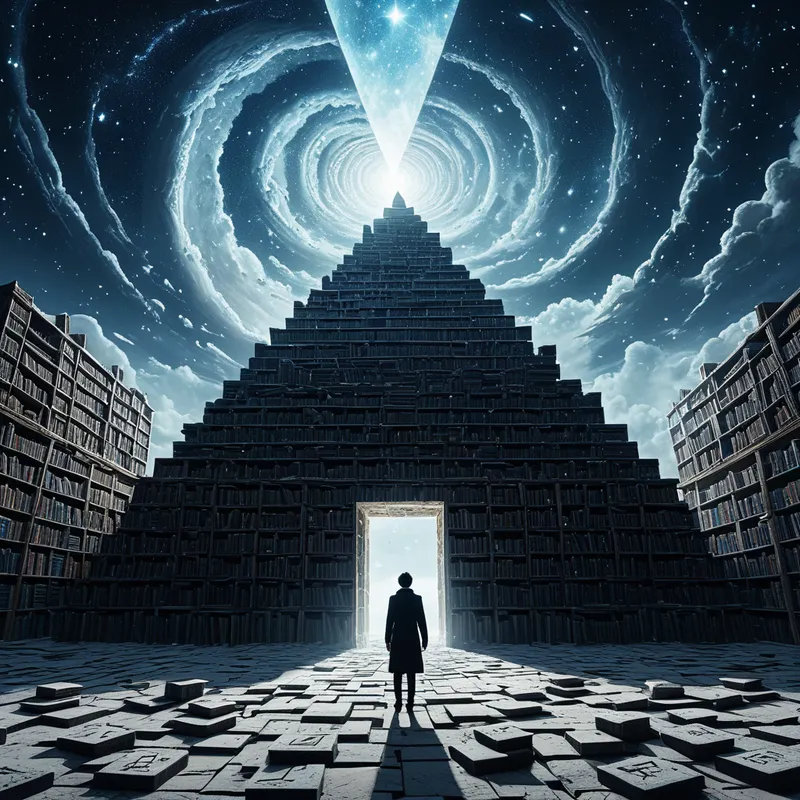
When this myth stirs in the modern dreamer, it often manifests as profound anxiety about disintegration and a deep yearning for coherence. The dreamer may find themselves in endless bureaucratic halls (the Hall of Maati), unable to find the right paperwork or pass a crucial test. They may be trying to build or repair something—a wall, a mechanism, a relationship—while an unseen force or a chaotic mess constantly undoes their work (the action of Isfet).
Somatically, this can feel like a loss of center, a “spin” of anxiety, or a heavy pressure on the chest—the “weight” of an unbalanced heart. Psychologically, this dream pattern signals a critical phase of self-assessment. The psyche is conducting its own weighing. It is asking: Where is my life out of balance? Where have I been false to myself or others? What chaotic element (a habit, a relationship, an untruth) is threatening to dissolve my sense of order and purpose? The dream is not a punishment, but a call to conscious realignment.
Alchemical Translation
The individuation process, the journey toward psychic wholeness, is mirrored perfectly in the myth of the scale. The modern seeker is both the Pharaoh maintaining order in their personal kingdom and the soul standing in judgment.
The first alchemical stage is recognizing Isfet within. This is [the shadow](/myths/the-shadow “Myth from Jungian culture.”/)-work of acknowledging the chaos not as an external monster, but as a disowned part of [the self](/myths/the-self “Myth from Jungian culture.”/)—the anger we deny, the need we neglect, the creativity we stifle. We must name the chaos to relate to it.
The second stage is offering the heart. This is the courageous act of vulnerability and self-honesty required for analysis. We place our complex, passionate, flawed humanity—our “heart” with all its memories and motives—onto the scale of conscious examination.
The transmutation occurs not when the heart becomes a feather, but when it learns to carry its weight with the integrity that allows balance.
The final stage is achieving dynamic balance. Individuation does not mean eradicating the shadow (Isfet) or becoming a disembodied ideal (Maat). It is the lifelong practice of holding the tension. It is allowing the passionate, chaotic energy of the heart to be in relationship with the guiding, ordering principle of truth. The integrated self is the scale in perfect, fleeting equilibrium: capable of deep feeling yet guided by integrity, creative and disruptive yet responsible and structured. In this balance, we become “true of voice,” our inner declaration matching our outer life, and we gain entry not to a static paradise, but to the fertile, ever-renewing field of a whole and authentic existence.
Associated Symbols
Explore related symbols from the CaleaDream lexicon: