Lycaon Myth Meaning & Symbolism
A king's blasphemous test of a god's omniscience leads to a divine curse, transforming him into the archetypal wolf and unleashing a cleansing flood.
The Tale of Lycaon
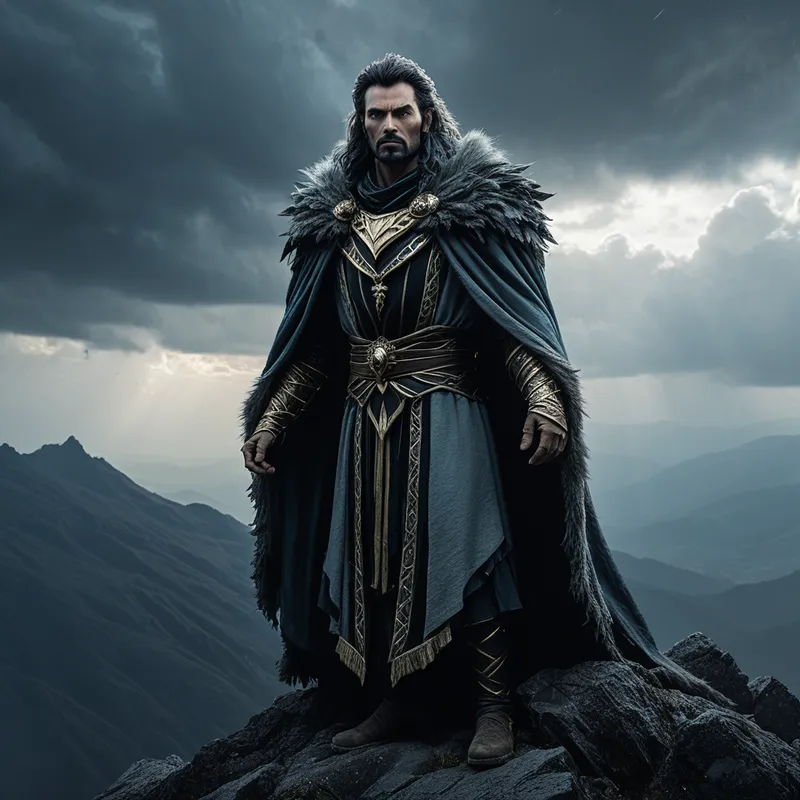
Listen, and hear the tale of a king who dared to measure the divine. In the mist-wrapped highlands of Arcadia, where the oldest stones remember, there ruled Lycaon. His name meant "Wolf," and his kingdom was a realm of raw earth and deep forests. He was a son of the soil, but his pride was a palace reaching for the clouds.
One evening, as the sun bled into the cypress groves, a traveler came to the palace gates. He appeared as a humble wayfarer, dusty and worn, yet his presence carried a stillness that hushed the very air. This was Zeus</ab title="King of the Olympian gods, god of the sky, lightning, and justice">, the Cloud-Gatherer, testing the hospitality of men. He had heard whispers from the mortal realm—whispers of impiety, of altars grown cold, and of a king in Arcadia who mocked the gods.
Lycaon received the stranger, but a serpent of doubt coiled in his heart. Could this truly be the All-Seeing One? A wicked thought took root. He would set a trap for omniscience itself. To prove the guest was merely a man, he would serve him a feast no god could stomach. In the deepest dark of night, the king ordered a horrific deed. A hostage, a young boy from a neighboring land, was slain. His flesh was butchered, roasted with herbs, and laid upon the royal table beside the lamb and the wine.
The great hall fell silent as the platter was set before the disguised god. The scent of the feast, once savory, now carried the metallic tang of corruption. Zeus looked upon the offering. In that moment, the veil of the traveler fell away. The air crackled with the scent of ozone. The hearth-fire roared into a pillar of flame, and the eyes of the god shone with the fury of a coming storm.
"Beast!" thundered the voice that shakes mountains. "You who have polluted the sacred bond between host and guest, who have defiled the very essence of life! Your test is answered. You sought to see if I was divine? Now you shall know the nature you have chosen."
With a gesture, the palace walls seemed to melt. Lycaon stumbled back, a guttural cry dying in his throat. His fine robes fused to his skin, prickling into coarse, grey fur. His royal scepter clattered to the floor as his hands twisted into paws, claws scoring the stone. His face elongated into a snarling muzzle, his crown becoming a memory beneath pointed ears. Where a king once stood, a large, terrified wolf now panted, its eyes holding the last fading glimmer of a human soul. With a howl that was both anguish and instinct, it fled into the dark forests from which its name had come.
But the god's wrath was not spent. Seeing the depth of corruption, Zeus unleashed the Deluge, washing the earth clean of Lycaon's stain. Only the pure, warned by Prometheus, would survive to begin the world anew.
Cultural Origins & Context
The myth of Lycaon is not a simple campfire story; it is a foundational etiological narrative, a story explaining origins. It comes to us primarily from the poet Ovid in his Metamorphoses, and echoes in the works of Pausanias and others. Its roots, however, dig deep into the pre-Olympian soil of Arcadia, a region the Greeks considered wild, ancient, and close to the primal forces of nature.
The tale served multiple societal functions. Firstly, it was a severe divine sanction enforcing the sacred law of xenia (guest-friendship), the bedrock of ancient Greek social order and diplomacy. To violate it was to invite cosmic retribution. Secondly, it explained the existence of werewolf lore and certain Arcadian rituals. Pausanias mentions a rite at the altar of Zeus Lycaeus ("Wolf-Zeus") on Mount Lykaion, where participants partook of a stew; one who tasted human entrails mixed in was said to transform into a wolf for nine years. The myth thus provided a chilling origin story for local cult practices, blending history, religion, and cautionary tale.
Symbolic Architecture
At its core, the myth of Lycaon is a profound allegory of recognition, transgression, and consequential transformation. Lycaon does not merely commit murder; he commits a crime of category. He seeks to collapse the sacred distance between mortal and divine, to drag the god down to a level of base, literal testing. His offering is not just impious; it is a perversion of sacrifice, turning a ritual of communion into one of contamination.
The wolf is not a punishment imposed from without, but the true inner form made manifest. The god’s wrath is merely the mirror held up to the soul.
Lycaon represents the hubris of the intellect that demands empirical proof of the numinous, attempting to quantify the qualitative. His transformation into a wolf is the ultimate symbolic justice: he who acted with the cruelty and savagery of a beast becomes that beast. The wolf symbolizes the untamed, predatory shadow—the part of the self that exists outside the laws of civilization and piety. His kingdom, Arcadia, is itself a symbol of the borderland between civilization and wilderness, a place where such transformations are psychically possible.
The ensuing flood is the necessary catharsis. The psychic pollution—the "Lycaon complex" of blasphemous doubt and moral impurity—becomes so systemic that the entire landscape of the soul must be scoured and reborn.
The Dreamer's Resonance
When the pattern of Lycaon stirs in the modern dreamer, it signals a profound confrontation with the "beast within." This is not about literal lycanthropy, but about the emergence of a feral, instinctual, or shameful aspect of the personality that feels alien and overpowering.
One might dream of being forced onto all fours, feeling one's speech become a growl in a boardroom or family gathering. This somatic experience points to a feeling of being betrayed by one's own nature, or of having one's civilized persona ("the king") shattered by a surge of raw, unprocessed emotion—rage, lust, envy, or a terrifying survival instinct. The dream may feature a test or a failed offering, symbolizing a situation where the dreamer felt their essential goodness or humanity was brutally questioned or violated, leading to a reactive "beastly" state.
The psychological process is one of brutal integration. The dreamer is experiencing what Lycaon refused: the recognition that this animal-self is not an external curse, but a disowned part of their own psyche, now demanding acknowledgment.

Alchemical Translation
The alchemical journey modeled by Lycaon's myth is the nigredo—the blackening, the putrefaction, the darkest night of the soul. It is the stage where the base material of the personality is broken down through the heat of confrontation with one's own shadow.
For the modern individual, the "Lycaon moment" occurs when one's hidden arrogance, cruelty, or impurity is exposed, often by a seemingly external authority or crisis (the "Zeus" principle of objective consciousness or fate). The resulting feeling is one of being transformed against one's will into a monster. The alchemical work is to stay with this transformation, not to flee it.
The goal is not to reverse the curse, but to understand that the wolf and the king are one substance. Individuation requires digesting the unthinkable.
The "flood" that follows is the necessary dissolution of the old, contaminated ego-structure. This is a period of depression, grief, or overwhelming emotion that washes away the defenses. The promise, as in the myth, is that from this dissolution, a new, more conscious self can emerge—represented by the survivors of the flood. The individual who integrates the Lycaon complex does not become a wolf, but gains the wolf's strengths: keen instinct, pack loyalty (to the integrated Self), and the ability to navigate the wilderness of the unconscious. They learn that true piety is not blind obedience, but the humble acknowledgment of the whole self, both the civilized host and the wild guest at the table of the soul.
Associated Symbols
Explore related symbols from the CaleaDream lexicon: