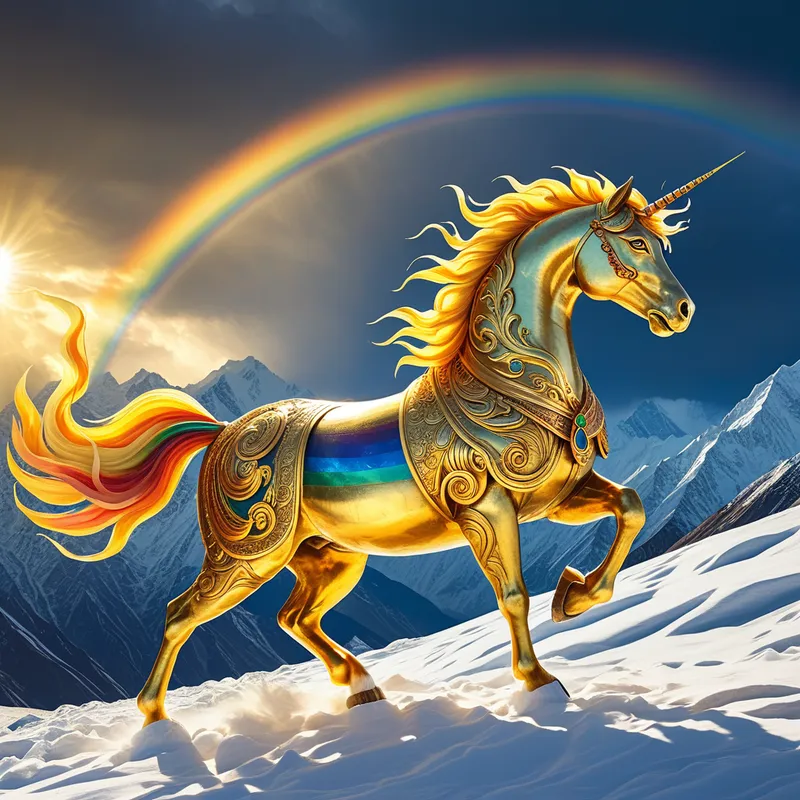
Lungta Myth Meaning & Symbolism
A sacred emblem of primordial energy, the Lungta carries the soul's aspirations across the high plateaus of consciousness and worldly fortune.
The Tale of Lungta
Listen. Before the mountains learned their names, when the sky was a raw, open wound of blue and the wind spoke in the forgotten tongue of origins, there was a force that moved through all things. It was not a god, not a beast, but the very breath of potential itself. The people of the high plateaus, their spirits worn thin by the biting air and the weight of the endless horizon, felt this force as a restless ache, a longing for elevation they could not name.
They saw it first in the storm. Not in the lightning or the thunder, but in the moment of eerie calm that followed—the way the clouds would part, and a single shaft of sunlight would pierce the gloom, illuminating the distant peaks. In that luminous silence, they began to perceive a shape. It was the shape of speed without movement, of power held in perfect poise. They called it Lungta.
The sages said the Lungta was born from the union of the five elemental wisdoms. Its mind was the clarity of space, its bones the steadfastness of earth, its blood the fluidity of water, its warmth the compassion of fire, and its very life was the vitalizing breath of wind. It did not dwell in a palace or a forest, but in the liminal space between prayer and action, between aspiration and arrival.
Yet, the Lungta was trapped. Its boundless energy was scattered, dissipated by the ignorance and negativity of the world. It raced in futile circles, a glorious force squandered. The people’s own lives mirrored this captivity—their vitality sapped, their fortunes stagnant, their prayers seeming to fall back to earth unheard.
Then came the revelation, not in a voice, but in a vision witnessed by yogis in deep meditation. They saw that the Lungta could be mounted. Not by a physical rider, but by the Three Jewels—the enlightened mind itself. When the disciplines of ethics, meditation, and wisdom were perfected, they formed a saddle of stability. Upon this saddle, the luminous jewels of Buddha, Dharma, and Sangha were placed. Only then did the wild, scattered force become a directed vehicle.
The moment the jewels settled upon its back, the Lungta ceased its frantic circling. It reared, and its neigh was the sound of a thousand mantras being born. It turned its gaze upward, toward the summit of Mount Meru. With a surge that shook the foundations of perception, it began to gallop—not across land, but up the very axis of reality. It carried the jewels, and all the pure aspirations tied to them, from the muddy plains of suffering to the radiant peaks of awakening. Its mane became the streaming banners of victory, and wherever its hooves touched the sky, rainbows blossomed and fortune took root.
Cultural Origins & Context
The myth of the Lungta is woven into the very fabric of Tibetan life, predating and then being seamlessly integrated into Vajrayana Buddhism. Its origins are shamanic, rooted in the ancient Bön tradition, where it represented the life-force or soul of an individual, community, or even the nation. With the advent of Buddhism, this potent indigenous symbol was not discarded but alchemized. It was given a Buddhist vehicle, literally and figuratively.
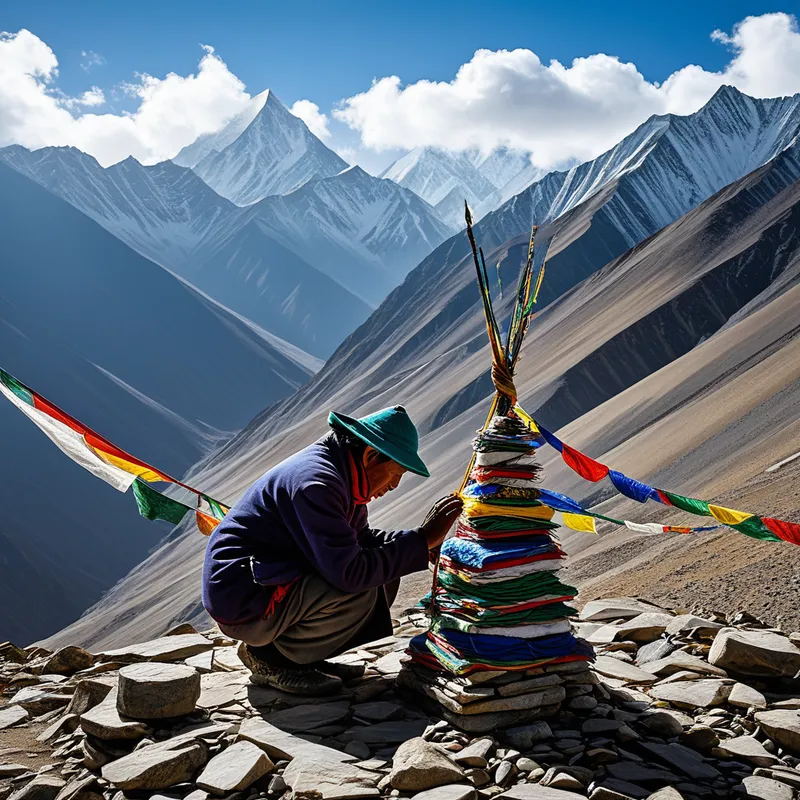
The myth was passed down not merely as a story to be told, but as a practice to be lived. It is visualized in intricate thangka paintings, invoked in rituals for prosperity and health, and launched into the world on the wings of prayer flags. These five-colored flags, planted on mountain passes, rooftops, and temples, are themselves called Lungta. As the wind—the same elemental force that gives the horse its name—snaps through the cloth, it is believed to activate the printed mantras and the image of the steed, scattering blessings and fortifying the positive energy of the environment. The myth’s societal function is thus profoundly pragmatic and spiritual: to harness the invisible currents of luck (lung) and life-force (ta) for the benefit of all beings, transforming the environment into a sacred landscape.
Symbolic Architecture
At its core, the Lungta is a master symbol of the dynamic, untamed psychic energy that underpins existence—what Jung might term libido or psychic life-force. It is the raw potential within every individual, the innate vitality that seeks expression and purpose.
The Windhorse is the soul’s own kinetic energy, awaiting the saddle of consciousness to give it direction.
The horse, across cultures, symbolizes power, mobility, and the instinctual nature. The wind qualifier elevates this from earthly to celestial, from instinct to intuition. Its initial state of scattered, trapped energy perfectly mirrors the human condition: our life-force dissipated by distraction, negative emotion, and unconscious living. The pivotal act of placing the Three Jewels upon its back is the key. This represents the integration of transcendent wisdom (Buddha), truthful path (Dharma), and supportive community (Sangha) into one’s own being. It is the moment the ego’s chaotic drives are aligned with a higher, transpersonal purpose. The subsequent ascent up Mount Meru symbolizes the journey of individuation—the conscious climb toward psychological wholeness and spiritual awakening, carrying with it not just the self, but all one’s aspirations for the world.
The Dreamer's Resonance
When the archetype of the Lungta stirs in the modern dreamer, it often signals a profound somatic and psychological process related to vital energy. One might dream of a magnificent, restless horse trapped in a confined space, or of trying to catch a horse made of mist and light. There is a palpable feeling of immense potential that is frustratingly inaccessible.
Somatically, this can correlate with feelings of chronic fatigue, anxiety (energy with no outlet), or a sense of being “stuck” in life patterns. Psychologically, the dream marks a confrontation with one’s own latent power. The dream-ego’s actions are telling: attempting to bridle the horse with fear leads to chaos; approaching it with awe and a symbolic offering (perhaps a jewel, a book, a tool) may begin the process of alliance. The gallop, if it occurs in the dream, is often accompanied by sensations of exhilarating terror and freedom—the somatic signature of repressed life-force breaking through its dams.
Alchemical Translation
The myth of the Lungta provides a precise blueprint for psychic transmutation. The first step is recognition: feeling the restless, powerful energy within that is currently wasted on trivial pursuits, worry, or conflict. This is the scattered horse.
The alchemical work begins with forging the “saddle” of discipline—meditative practice, ethical reflection, and study. This structure is not meant to break the spirit, but to provide a stable base for what comes next: the consecration. One must consciously place one’s highest values, one’s deepest truths (the Three Jewels of one’s own psyche), upon this raw energy.
Individuation is not the taming of the wild horse, but the sacred partnership where the horse’s speed and the rider’s vision become one directed movement toward the summit.
The final, glorious translation is the ascent. The integrated energy, now a vehicle, turns naturally upward. It seeks the summit—not of worldly achievement, but of conscious awareness. This is the liberation of potential. What was once luck, an external force to be begged, becomes fortune, an internal condition of aligned being. The modern individual engaged in this alchemy learns to “raise their Lungta,” transforming anxiety into alertness, scattered effort into focused power, and the longing for a better life into the actual journey toward a more authentic self. The wind that once buffeted them now fills their sails, carrying their most sacred aspirations from the realm of thought into the landscape of reality.
Associated Symbols
Explore related symbols from the CaleaDream lexicon: