Luna Myth Meaning & Symbolism
The myth of Luna, the Silver Queen, who dissolves her kingdom to preserve its essence, teaching the alchemy of surrender and true reflection.
The Tale of Luna
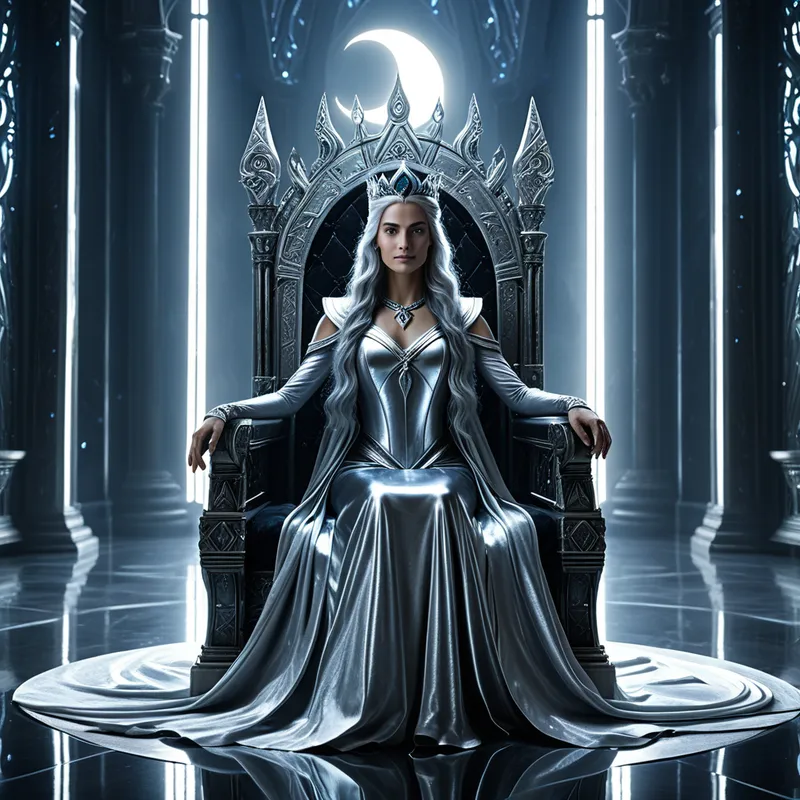
Listen, and hear the tale of the Silver Queen, she who ruled the Kingdom of Prima Materia. In the time before the First Conjunction, her domain was a land of perfect, unyielding forms. Towers of adamant pierced a starless sky. Rivers of mercury flowed in precise, geometric channels. Every thought was a crystal, every emotion a polished gem, locked in vaults of flawless silver. Luna, with her skin of liquid metal and eyes like deep wells of night, presided over this silent, static splendor. Her word was law, and her law was permanence.
But a whisper began, a sigh that was not a sound but a feeling, seeping from the very foundations of her palace. It was the sigh of the Shadow-Stuff, the formless potential that had been pressed into service to build her perfect world. It longed not for rebellion, but for flow. It dreamed of chaos. Luna felt this disturbance as a flaw in her own mirror-like composure, a single hairline fracture in the crystal of her being. She consulted the Anima Mundi, which spoke not in words, but in the sudden, terrifying liquidity of her throne. For a moment, it softened like wax.
The conflict was not with an external enemy, but with the core of her own sovereignty. To maintain her kingdom was to deny the very nature of the substance from which it was made—a substance that yearned to change, to dissolve, to become. One fateful night, under a crescent moon that bled silver light, she stood at the Well of Speculum. She saw her reflection, not as a ruler, but as a prisoner in a cage of her own design. The sigh of the Shadow-Stuff became a roar in her veins.
With a resolve that felt like dying, Luna did not command. She surrendered. She raised her hands not in decree, but in release. A single, clear tear, the first and last of her reign, fell from her silver eye. Where it struck the parapet of her highest tower, the adamant did not crack—it melted. The contagion of transformation spread, not as destruction, but as a gentle, inexorable softening. Towers slumped into glowing pools. Gemstone emotions liquefied and mingled in the newly-formed streams. The geometric gardens blurred into swirling, iridescent mist. Luna herself felt her rigid form dissolving, her substance flowing into the great, chaotic, beautiful soup of her own kingdom.
In the end, no palace remained. No throne. Where the Kingdom of Prima Materia once stood, there was only a vast, calm, and infinitely deep Argent Sea. And on its perfect, mirror-like surface, something new appeared: the faithful, ever-changing reflection of the moon, the stars, and the passing clouds—a world not of rigid forms, but of endless, truthful possibilities. Luna was gone, and yet she was everywhere, the very principle of reflection itself.
Cultural Origins & Context
The myth of Luna is not a folktale of the common people, but a core operational mythos of the Alchemical tradition, passed down in initiatory lineages and encoded in symbolic texts like the Rosarium Philosophorum. It was recited during the Nigredo phase of the Work, a period of profound psychological and material decomposition. The teller was typically the master alchemist, not to entertain, but to guide the apprentice through the terrifying necessity of surrendering their known world—their fixed ideas, their ego-structures—to the solvent of the unconscious.
Its societal function was paradoxical. In a culture that outwardly prized the ordering of base matter into gold (a metaphor for spiritual perfection), the Luna myth served as the crucial counter-narrative. It taught that before any coagulation (the making of the Philosopher's Stone), there must be a complete solutio—a dissolution. It was a cultural container for the experience of failure, despair, and the loss of identity, framing not as a catastrophe, but as the essential, if painful, first step in any true transformation. It legitimized the dark night of the soul as a sacred, necessary process.
Symbolic Architecture
Psychologically, Luna represents the ruling principle of the conscious ego in its initial, rigidified state. She is the complex of personality that has built a seemingly perfect, controlled identity—competent, polished, and defended. Her kingdom is the persona and the conscious life-structure, impressive but ultimately sterile because it excludes the dynamic, messy vitality of the unconscious.
The Silver Queen must drown in her own substance to become the sea that reflects the heavens.
The Shadow-Stuff is the repressed content of the psyche—the unruly emotions, the forgotten memories, the instinctual drives—that inevitably pressures the conscious structure from below. The Well of Speculum is the moment of self-reflection, where the ego confronts its own limitations and its own artificiality. The dissolution is not annihilation, but the ego's relinquishment of its tyrannical control, allowing a dialogue with the deeper Self. The resulting Argent Sea symbolizes the psychic state of the unus mundus—the unified world—where conscious and unconscious are no longer separate, but exist in a fluid, reflective relationship.
The Dreamer's Resonance
When this myth activates in the modern psyche, it often manifests in dreams of collapsing structures: houses falling into the earth, teeth crumbling, familiar cities being washed away by a quiet flood. There is a somatic sense of "coming undone"—a feeling of liquefaction, weakness, or profound fatigue that resists the dreamer's urge to "hold it together." One might dream of mirrors that melt, or of trying to speak but finding their voice is only silver liquid.
These dreams signal an involuntary, but necessary, psychic Nigredo. The conscious attitude has become too rigid, too identified with a role, a success, or a self-image that has outlived its purpose. The psyche is initiating a process of dissolution to break down this calcified complex. The emotional tone is typically one of deep anxiety mixed with a strange, passive awe. The dreamer is not an active hero fighting a monster, but a witness to the deconstruction of their own inner world. This is the somatic process of the ego's inflation being punctured, making space for a more authentic, fluid identity to eventually emerge.

Alchemical Translation
For the modern individual, the Luna myth models the first and most counter-intuitive step of individuation: the willing surrender of the ego's control. Our cultural programming screams for more consolidation, more achievement, more solidity. Luna's path instructs the opposite. The "alchemical translation" is the practice of active surrender.
This means consciously allowing long-held identities—"the successful one," "the responsible one," "the intelligent one"—to soften and be questioned. It involves turning toward, rather than away from, the inner "sigh" of dissatisfaction, depression, or meaninglessness, recognizing it as the Shadow-Stuff calling for integration. The act is not one of destruction, but of trust—trust that the psyche has a self-regulating intelligence. One must learn to "sit at the well" of their own reflection and have the courage to let the tear fall.
The triumph is not in building a better castle, but in becoming the ocean that can hold all castles in reflection, and then let them go.
The ultimate transmutation is from a state of being a fixed thing to engaging in a reflective process. The ego, having undergone its solutio, is reborn not as a solitary ruler, but as a faithful witness and mediator—the surface of the Argent Sea. It no longer claims to be the source of light, but becomes the capacity to accurately reflect the light of the greater Self. The individual gains resilience, not through rigidity, but through fluidity; wisdom, not through certainty, but through the depth and clarity of their reflection.
Associated Symbols
Explore related symbols from the CaleaDream lexicon: