Lu Yu Myth Meaning & Symbolism
The mythic journey of Lu Yu, an orphan raised by monks who became the sage of tea, codifying the sacred art of infusion and finding divinity in the mundane.
The Tale of Lu Yu
Listen, and hear the tale that steams from the very heart of the mountains.
In the time of the Tang, when the empire was a symphony of silk and poetry, a child was cast upon the waters of fate. He was found, they say, by the abbot Zhi Ji, nestled among the reeds of a lakeshore, with nothing but the cry of a gull and the chill of the dawn for company. The monk, whose eyes saw the Buddha-nature in all things, took the babe into the sanctuary of the Longgai Temple. They named him Lu Yu, “Feathers on the Water,” for his life began as a thing adrift, without anchor or nest.
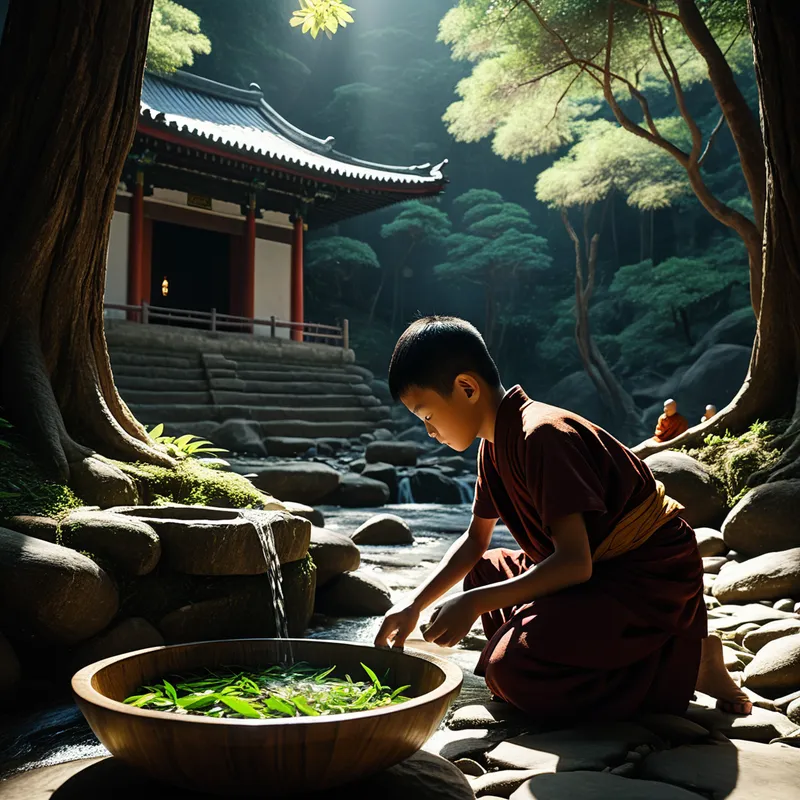
The temple was a world of chanting, incense, and discipline. The young Lu Yu was set to tasks—drawing water, sweeping courtyards, tending the temple gardens. But his spirit was not made for mere rote. It chafed against the strictures of memorizing sutras; his mind was a kettle coming to boil. He longed for the wildness beyond the temple walls, for the taste of the world, not just the contemplation of its emptiness. His rebellion was quiet but firm: he would not take the monastic vows. He would seek his scripture elsewhere.
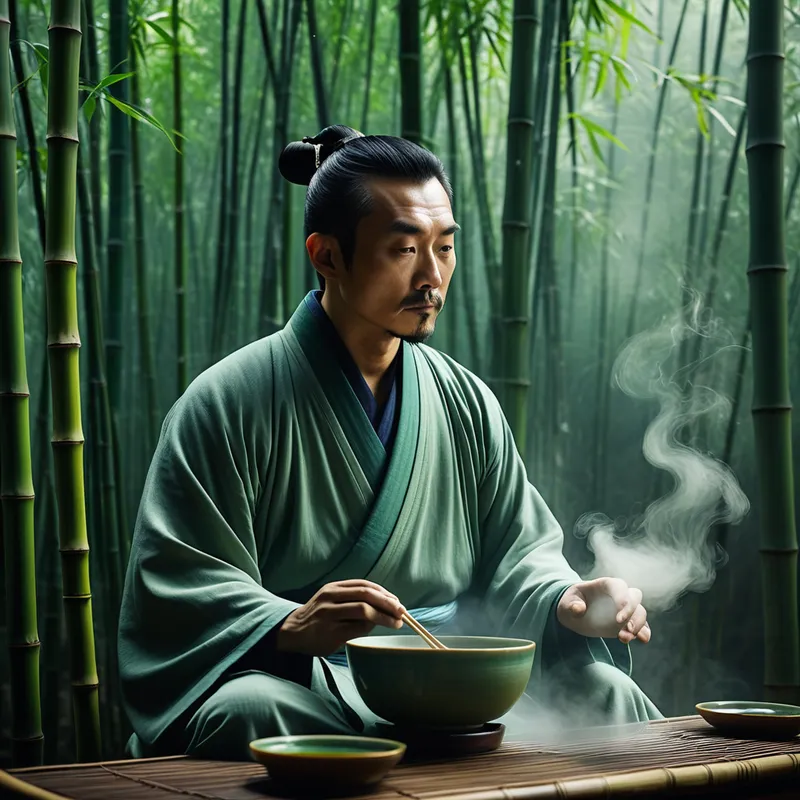
And so, he was given the ultimate task of humility: to brew tea for the monks. Day after day, year after year, he boiled water, measured leaves, and served the bitter infusion. Yet, in this act of service, his soul awoke. He did not just make tea; he began to listen to it. He noted how water from the east well sang a different song than water from the west spring. He saw how leaves plucked after the rain held a deeper sigh than those taken in the dry sun. The steam became his cloud of revelation; the color in the bowl, his map of the seasons.
Driven by this newfound devotion, he fled the temple’s certainty for the world’s vast laboratory. He wandered the empire, from the mist-shrouded cliffs of Mengding to the foggy valleys of Wuyi. He drank from a thousand streams, tasted leaves from ten thousand bushes. He conversed with hermits, farmers, and potters, learning the language of clay kettles and iron braziers. His life became a pilgrimage to the essence of a single leaf.
And from this lifetime of tasting, listening, and wandering, he poured his soul onto paper. He wrote The Classic of Tea (Chájīng). It was not merely a manual. It was a cosmology. In its chapters, the art of tea was woven with the five elements, the rhythms of the stars, and the virtues of a harmonious life. He had taken the humble task assigned to an orphan and transmuted it into a sacred way. The boy who was feathers on the water became the sage who anchored an entire culture in the depth of a single cup.
Cultural Origins & Context
The figure of Lu Yu is a unique blend of historical personage and mythic archetype. Historically, he was a Tang dynasty scholar (c. 733–804 CE) who authored the seminal Chájīng, the first definitive work systematizing the cultivation, preparation, and ritual of tea drinking. This act alone elevated a medicinal and casual beverage into a cornerstone of Chinese lǐ and Daoist natural philosophy.
The mythic narrative that grew around him—the orphan origin, the monastic upbringing, the rebellious departure, and the lifelong pilgrimage—served a crucial societal function. It emerged in a culture that venerated scholarly achievement but was deeply structured by family lineage and social station. Lu Yu’s story democratized wisdom. It proclaimed that profound understanding could spring from the lowest origins, that true mastery was not inherited but earned through direct, sensory communion with the world. His myth was carried by poets, scholars, and later, by every tea master who saw in the ritual not just etiquette, but a path to refinement. He became the patron saint of artisans, proving that devotion to a single, simple craft could lead to the highest cultural and spiritual authority.
Symbolic Architecture
At its core, the myth of Lu Yu is an allegory for the birth of consciousness from the waters of the unconscious. He is the archetypal foundling, symbolizing the nascent Self, orphaned from its primal origins and set adrift. The monastic temple represents the structured, collective consciousness—the world of inherited dogma and rigid forms.
The first rebellion is not against a person, but against a prescribed life. It is the ego saying, "This skin of meaning does not fit me."
His refusal to take vows is the essential first act of individuation: the conscious ego differentiating itself from the collective. The assigned task of tea-making is genius. It represents the mandated mundane—the repetitive, humble duty that society (or the psyche) imposes to keep the rebellious spirit in check. Yet, in the alchemical vessel of Lu Yu’s attention, the mundane becomes numinous. The water, fire, leaf, and bowl—the raw elements of his task—become the four pillars of his personal universe.
His wanderings symbolize the necessary periplus, the journey away from the center to gather the scattered fragments of knowledge and experience. His ultimate creation, The Classic of Tea, symbolizes the creation of a personal cosmology. He does not reject the temple’s order; he creates a new, more authentic order born from direct experience. He translates the raw, bitter "leaf" of his orphaned life into the refined, fragrant "wisdom" of a sage.

The Dreamer's Resonance
When this myth stirs in the modern unconscious, it often manifests in dreams of humble, repetitive tasks that suddenly reveal hidden, vast significance. You may dream of polishing a single stone until it becomes a mirror, or of sorting through endless archives to find one sentence that illuminates everything. The somatic feeling is one of initial frustration or boredom giving way to a thrilling, focused intensity.
Psychologically, this signals a process where the ego is being asked to submit to a seemingly minor or servile aspect of life—a relationship dynamic, a creative block, a daily grind. The psyche is insisting, through the Lu Yu pattern, that the path to mastery and self-realization lies through that very obligation, not in escaping it. The conflict is between the desire for a grand, predefined destiny (the monastic vows) and the call to find the sacred in your assigned, perhaps unloved, corner of the world. The dream is a directive: attend to the brew in front of you with absolute devotion; your entire destiny is steeping within it.

Alchemical Translation
The individuation process modeled by Lu Yu is not one of explosive heroism, but of slow, deliberate infusion. It is the alchemy of attention transforming duty into devotion, and devotion into doctrine.
The first stage is Acceptance of the Foundling State: acknowledging the parts of oneself that feel orphaned, unrooted, or adrift in life’s currents. This is not a weakness, but the raw material.
The second is Rebellious Submission: consciously choosing to engage deeply with the "task" you have been given—be it a job, a family role, an artistic medium, or an inner wound—while inwardly reserving the right to interpret it through your own unique lens. You stay at the kettle, but you begin to listen to the song of the water.
The third is the Pilgrimage of Particulars: leaving the safety of generalized knowledge to seek your own direct, sensory education. This is the research phase of the soul, gathering the specific "waters" and "leaves" that resonate with your individual constitution.
The final creation is not a product for the world, but a complete system of meaning for the self. You write your own Chájīng.
The ultimate stage is Codification of Personal Law: synthesizing your gathered experiences into an internal framework, a personal "classic" that guides your life. This is the sage stage, where what was once a bitter obligation has been wholly transmuted into a source of wisdom, warmth, and nourishment for yourself and, ultimately, for others. You become the source of the infusion, having fully become one with the leaf, the water, the fire, and the cup.
Associated Symbols
Explore related symbols from the CaleaDream lexicon: