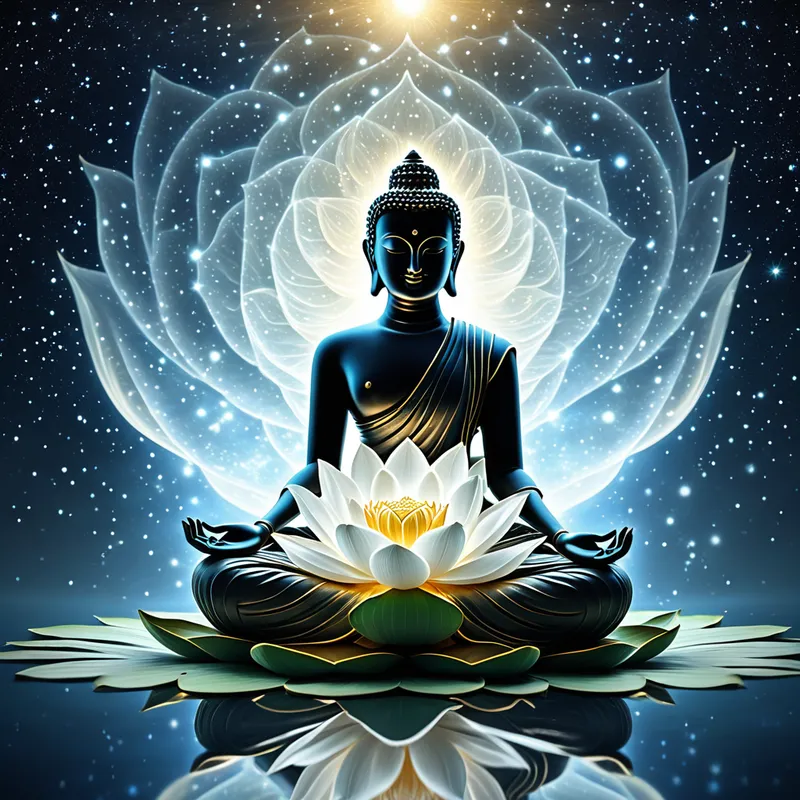
Lotus Throne Myth Meaning & Symbolism
The mythic origin of the Buddha's seat, a throne born from cosmic purity, symbolizing the unshakable enlightenment that rises from the mud of suffering.
The Tale of Lotus Throne
Before the first teaching was spoken, before the wheel of dukkha was set in motion, there was a moment of perfect, poised potential. The air beneath the Bodhi tree was thick, not with humidity, but with the weight of a cosmos holding its breath.
For six long years, the ascetic Siddhartha Gautama had walked the razor’s edge of existence. He had starved his body, stilled his breath, and wrestled with every demon of the mind. His flesh clung to his bones like a worn garment; his resolve was a diamond buried in ash. On this night, the final night, he knew he would not rise again until he had pierced the veil of all illusion or perished in the attempt.
He moved to take his seat, but the earth itself recoiled. The ground, witness to countless ages of greed, hatred, and delusion, trembled and declared itself unworthy to support one who sought the deathless. The grasses withered; the stones turned to dust. A profound silence fell, a vacuum of expectation.
Then, from the unseen depths, a murmur arose. It was not a sound for the ears, but a vibration felt in the marrow of the world. From the black, fertile mud of the lake nearby—a mud fed by decay, by runoff, by the compost of a thousand lifetimes—a stirring began. Not a violent upheaval, but a gentle, inexorable push. A green shoot, tender yet impossibly strong, pierced the water’s dark mirror.
It grew not as a tree grows, seeking the sun, but as a promise unfolds. Its stem, a column of jade, rose straight and true, cleaving the murky water. And at its apex, a bud, closed tighter than a fist, began to pulse with an inner light. The murk of the lake, the realm of the unseen and the unresolved, became its foundation, its womb.
The bud swelled. Then, with a sigh that was the universe exhaling, it opened. Petal by pristine petal, a lotus of impossible size and perfection unfurled. Its color was the white of a new moon, edged with the gold of a dawn not yet broken. It was not merely a flower; it was an architecture of purity, a pavilion born from filth. The mud had given it life, but not a speck of mud clung to its glory.
With a grace that held the stillness of eternity, the weary prince walked across the water and lowered himself onto this radiant seat. The moment his form touched the center of the blossom, the lotus throne solidified. It was no longer merely organic matter; it became the axis of the world, the immovable platform of Nirvana. Here, rooted in the mud of samsara, yet utterly untouched by it, he would face the final onslaught of Mara and awaken as the Buddha. The throne was his witness, his fortress, and the first truth of his teaching made manifest.

Cultural Origins & Context
The myth of the Lotus Throne is not a single, codified story from a specific sutra, but a profound archetypal image woven into the fabric of Buddhist art, liturgy, and cosmology from its earliest days. Its visual representation is ubiquitous: every statue of the Buddha or a Bodhisattva seated upon a lotus pedestal (padmasana) is a silent retelling of this myth. It finds narrative elaboration in texts like the Lalitavistara Sūtra, which chronicles the life of the Buddha.
This was a myth told by artists before it was fully articulated by scribes. Sculptors at Ajanta and Nalanda carved it into stone; painters rendered it in mineral pigments on cave walls. Its societal function was multifaceted: for the devotee, it visually reinforced the transcendent purity and authority of the enlightened being. It served as a devotional focal point, a reminder that the Buddha’s awakening was an event of cosmic significance, supported by the very nature of reality. For the monastic, it was a meditative support—a symbol of the goal itself. To visualize the throne was to contemplate the paradoxical nature of enlightenment: utterly engaged with the world of suffering, yet completely free from its stains.
Symbolic Architecture
The Lotus Throne is a master symbol of non-duality and alchemical transformation. Its architecture is built on a foundational paradox.
The throne is not in spite of the mud; it is because of the mud. The nourishing filth is the necessary condition for the radiant bloom.
The mud represents the phenomenal world—samsara—with all its suffering (dukkha), confusion, and raw, chaotic potential. It is our lived experience: our trauma, our desires, our neuroses, our embodied existence. The stem is the path, the spiritual practice (Dharma), that traverses the murky depths of the unconscious and the challenges of life. It is the discipline that connects the base material to the transcendent.
The blossom is enlightenment (Bodhi). It is consciousness perfected: pristine, luminous, and fully opened to the true nature of reality. Its unfolding represents the awakening of wisdom and compassion. Crucially, the flower is open, signifying the outward radiation of these qualities for the benefit of all beings. The throne, therefore, symbolizes the unshakable ground of being that is discovered when one fully integrates, rather than rejects, the totality of one’s experience. It is the seat of sovereign selfhood, founded on insight.
The Dreamer's Resonance
When the image of a lotus throne arises in a modern dream, it rarely appears as a religious icon. Instead, it manifests as a profound somatic and psychological signal of an emerging inner stability born from difficult integration.
The dreamer may find themselves sitting on an ordinary object—a chair, a rock, a stair—that begins to transform, growing organic, luminous patterns, becoming both more grounded and more ethereal. There is often a sense of rightness and profound calm associated with this seat, even if the surrounding dream landscape is chaotic (the "mud"). This signals the psyche mid-process: the ego is beginning to find a new, more authentic foundation. The throne-dream often follows or accompanies a period of intense "mud-work"—therapy, grief, confronting a shadow aspect, or navigating a life crisis. The dream is the psyche’s affirmation: "You are integrating this. A new, resilient structure is forming from this very material." It can feel like a deep, bodily knowing of support where previously there was only collapse or anxiety.

Alchemical Translation
The myth of the Lotus Throne provides the ultimate blueprint for the process of individuation—the psychic transmutation of the lead of personal suffering into the gold of authentic selfhood.
The first alchemical stage, the nigredo, is represented by the murky water and mud. This is the necessary descent: the confrontation with one’s shadow, the dissolution of outdated identities, the immersion in depression, anger, or loss. One must consciously "sit in the mud," to feel its nutrient-rich darkness without fleeing into spiritual bypass or denial.
The throne is not an escape from the mud; it is the full, conscious relationship with it that transforms its nature.
The albedo, the whitening, is the rise of the stem and the budding lotus. This is the emergence of insight from the unconscious, the first clear visions of a new way of being. It is the commitment to the path of self-knowledge (therapy, meditation, creative expression) that begins to structure the chaotic material.
The final stage, the rubedo or reddening—here transmuted into the gold-tinged white of the lotus—is the full flowering. This is the establishment of the ego in service to the larger Self. One becomes sovereign on a throne built from one’s own lived experience. The conflicts, traumas, and failures are not erased; they are the very substance of the throne’s foundation. The enlightened individual, like the lotus, draws nourishment from the mud but is no longer defined by it. They attain an unshakable inner authority and compassion, seated firmly in the reality of a world they are now equipped to engage with, transform, and love.
Associated Symbols
Explore related symbols from the CaleaDream lexicon: