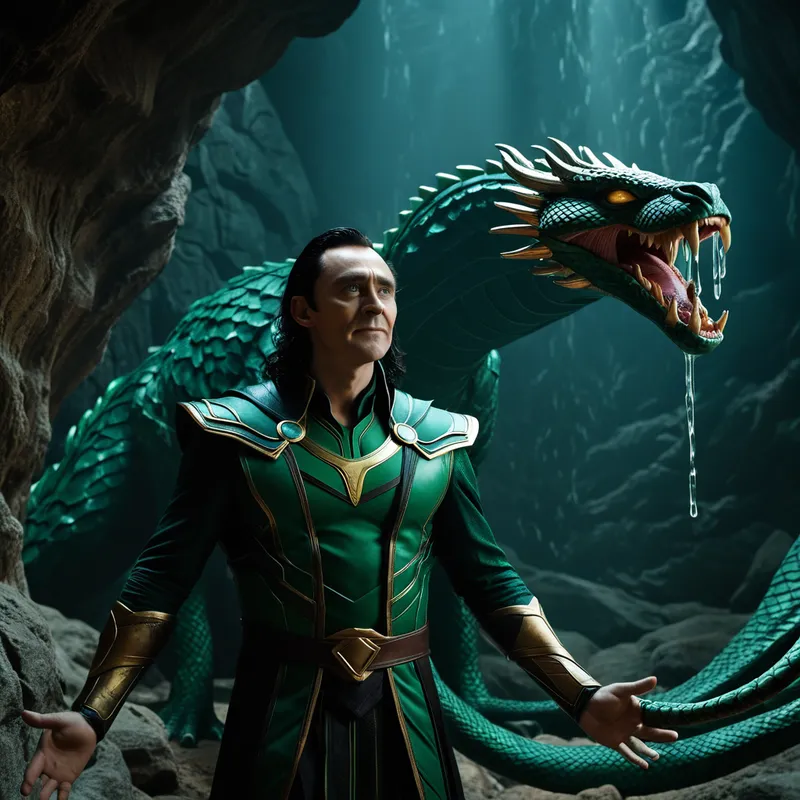
Loki's Thorn Myth Meaning & Symbolism
The story of the gods binding Loki with his son's entrails, a myth of inescapable consequence and the painful price of unbridled chaos.
The Tale of Loki's Thorn
Hear now the tale of the final binding, the price of a world’s grief. The mead-halls of Asgard were silent, their timbers still echoing with a mourning cry that would never fade. For Baldr the Shining was gone, cast down by a dart of mistletoe, his light extinguished by a trickster’s cruel design. The shadow that fell was long and cold.
The one who orchestrated the unthinkable, Loki, fled the wrath of the gods. He built a house by a waterfall with four doors, so he might watch all quarters, and there he shape-shifted into a salmon, thinking to slip away on the currents of fate. But the net of Odin’s sight is finely woven. They caught him, the gods, and dragged him from his watery refuge.
There would be no swift death. Justice, in those ancient days, was a craft, a terrible art. They took him to a barren cave, a hollow place in the bones of the earth. And they brought forth his own sons, Fenrir the wolf and Jörmungandr the serpent, and from them they wrought his chains. From the sinews of the wolf, they made cords stronger than any forge-iron. But it was the third son, Narfi or Váli (the tales whisper both names), who paid the ultimate price. The gods turned this son into a wolf, or slew him with his brother’s guts—the stories are dark and tangled in their grief. From his entrails, they fashioned the final, unbreakable bonds.
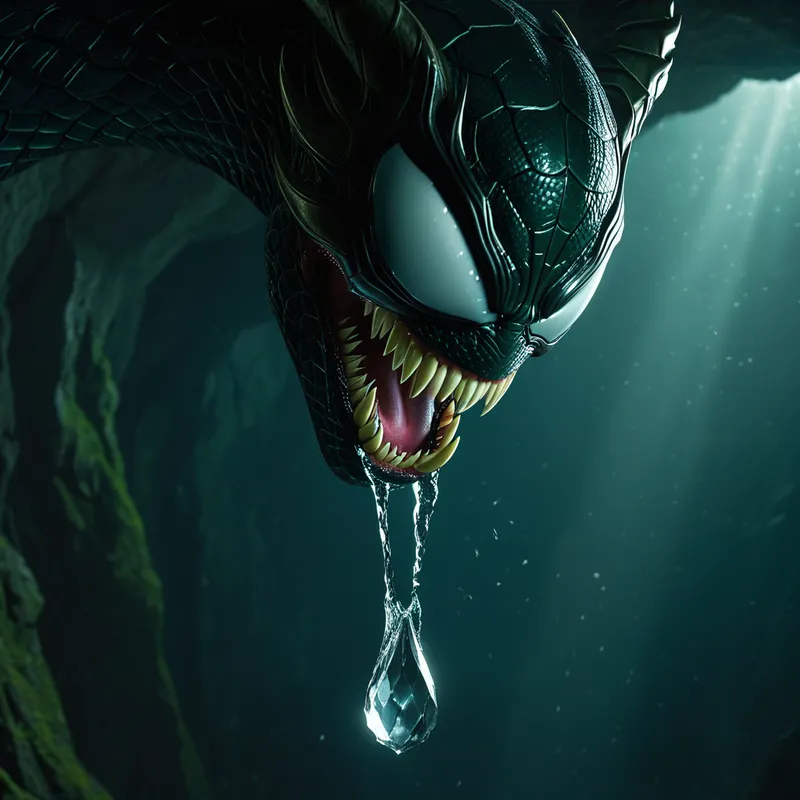
They laid Loki on three sharp slabs of stone. They took the cords of sinew, the bonds of gut, and they bound him: one across his shoulders, one across his loins, one behind his knees, pulling tendon and ligament taut against unyielding rock. The bonds bit deep, becoming like iron. And above his tormented face, they set Sigyn, his loyal wife, with a simple bowl. Above her, they fastened a great serpent, its maw gaping. Drop by burning drop, the serpent’s venom fell.
Sigyn the faithful holds her bowl, catching each searing drop. But when the bowl fills and she must turn to empty it, the venom falls directly onto Loki’s face. Then the bound god convulses in such agony that the whole earth shakes—men call it an earthquake. And there he lies, bound by the substance of his own lineage, until the world’s end. This is the myth of Loki’s binding, of the thorn made from his own flesh and blood, driven into the side of the world itself.
Cultural Origins & Context
This stark myth comes to us from the Poetic Edda, specifically in the poem Lokasenna (Loki’s Flyting) and its prose aftermath, and is elaborated in the Prose Edda. It is not a story of heroism, but of consequence. It was likely a skaldic tale, told not to glorify the gods, but to illustrate the absolute and terrifying law of cause and effect that underpinned the Norse worldview. The binding of Loki served as a necessary mythic act to restore a semblance of order after the ultimate transgression: the murder of Baldr, the symbol of all that was good and harmonious.
Its societal function was profound. In a culture navigating a harsh, unforgiving landscape, the myth reinforced the idea that actions have inescapable repercussions, that chaos, however clever, must ultimately be contained for the community to survive. It also presented a complex view of justice—not merely punitive, but poetic and transformative, using the perpetrator’s own essence as the instrument of restraint. The story was passed down in halls, a dark counterpoint to tales of valor, a reminder that the bonds of kinship and consequence are the strongest chains of all.
Symbolic Architecture
The myth is a masterclass in symbolic logic. Loki represents the unintegrated shadow, the trickster archetype in its most destructive aspect: the intellect and cunning divorced from empathy, the principle of chaos that unravels order without care for the cost. Baldr’s death is the murder of innocence, purity, and conscious goodness by the unconscious, amoral psyche.
The binding is the critical act. Loki is not destroyed by an external force, but bound by the transformed substance of his own progeny—his own creations, his own legacy.
The shadow is not defeated by the light, but contained by the material of its own making. Our deepest binds are woven from the consequences of our own actions.
The entrails symbolize raw, visceral connection and life-force turned against itself. The three stones may represent the three levels of the world (Asgard, Midgard, Hel) or the threefold nature of the punishment (physical, psychic, cosmic). Sigyn, holding the bowl, is the enduring, suffering aspect of the conscious mind that attempts to manage the perpetual drip of poison—the ongoing, corrosive guilt and regret. Her inevitable failure to catch every drop is the moment the repressed pain breaks through, causing the convulsion (the earthquake) that disrupts the entire psychic system.
The Dreamer's Resonance
When this myth stirs in modern dreams, it speaks of a profound process of confrontation and containment. To dream of being bound, especially by organic, sinewy material or in a cavern, often signals a confrontation with one’s own "shadow material." The dreamer may be experiencing the inescapable consequences of past actions, lies, or self-serving chaos that has harmed others or parts of themselves.
The venom-dripping serpent represents the toxic, repetitive thought pattern or memory that perpetually threatens to overwhelm. The faithful figure with the bowl (Sigyn) might appear as a repetitive, draining task in the dream, or as a part of the self that is exhausted from constant vigilance against this poison. The somatic experience upon waking may be one of constriction in the chest or shoulders, a literal feeling of being bound. This dream pattern indicates that the psyche is actively, if painfully, attempting to hold a destructive pattern in check, to bind it so that the rest of the inner world can function. It is the painful but necessary stage before integration.
Alchemical Translation
The alchemical process mirrored here is the nigredo—the blackening, the confrontation with the primal, chaotic matter of the soul. Loki’s flight and capture represent the ego’s attempt to avoid this dark work, to shape-shift and escape responsibility. The binding is the crucial, voluntary act of containment (the vas or vessel in alchemy). One does not battle the shadow to victory; one constructs a vessel strong enough to hold it.
Individuation requires not the slaying of the trickster, but his binding. Only when chaos is held in conscious tension can it be transmuted.
The bonds made from his son’s entrails signify that the vessel must be forged from the very substance of one’s own life, one’s own history and relationships. The poison is the corrosive aqua vitae in its destructive aspect, the painful truth that burns away illusion. Sigyn’s endless task is the ego’s labor of consciousness, catching and processing this truth drop by painful drop.
For the modern individual, the "Alchemical Translation" of Loki’s Thorn is this: lasting transformation begins when we stop running from the chaos we have sown. We must consent to be bound by the consequences, to feel the full weight of our actions. In that agonizing but sacred containment—in the cave of deep introspection—the perpetual drip of poison becomes the agent of a slow, terrible, and ultimately transformative initiation. The convulsions that shake our world are the birth pangs of a new, more accountable consciousness, forged in the recognition that our greatest chains and our potential freedom are spun from the same thread.
Associated Symbols
Explore related symbols from the CaleaDream lexicon: