Loki's Binding Myth Meaning & Symbolism
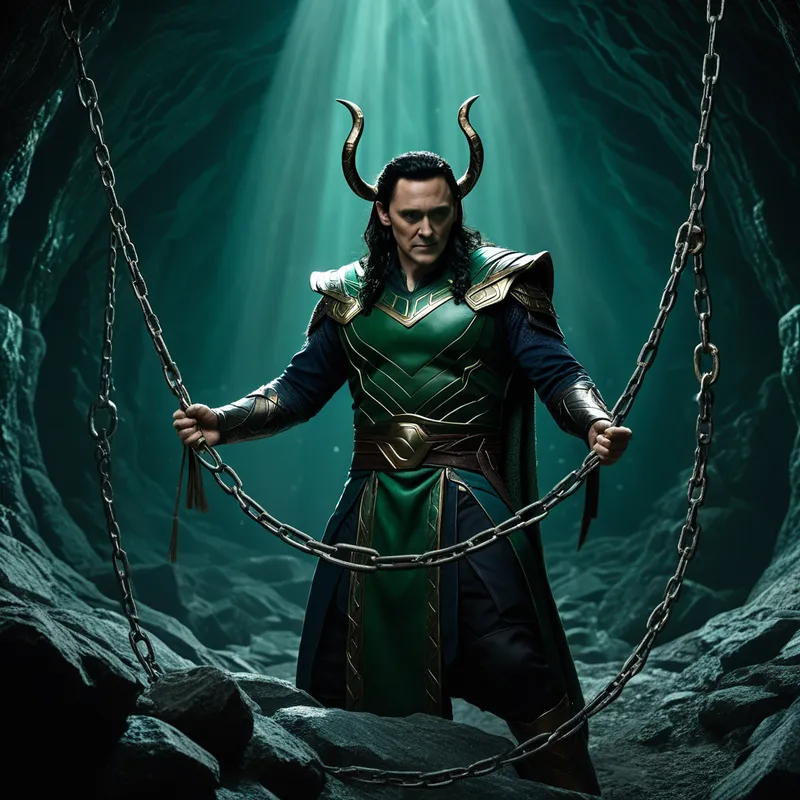
The trickster god Loki, architect of Baldr's death, is bound beneath the earth by the gods as punishment, a prisoner of his own unleashed chaos.
The Tale of Loki's Binding
Listen, and hear the tale of the last binding, the final price paid for a laughter that turned to ash. The air in Asgard was still, heavy with a grief that no wind could lift. The bright god Baldr was gone, slain by a dart of mistletoe guided by a blind god’s hand, and all knew the architect of this doom. It was Loki, who had woven the scheme with a serpent’s cunning.
He fled the wrath of the Æsir, his silver tongue useless now. To a high mountain he ran, and there built a house with four doors, so he could watch all quarters. By day, he was a salmon in the waterfall of Franangrsfors, thinking with a fish’s thoughts. But by the firelight, he wove a net, for his mind ever turned to traps and escapes. The gods found his house empty, but Odin, whose eye sees all, saw the net. They wove one like it and cast it into the stream.
Loki the salmon leaped over it once, twice, but on the third cast, he was caught. His grip was slippery, his form fluid, but Thor’s hands were iron. They dragged him to a cavern deep and bare, a hollow place beneath the roots of the world. Here, justice would be woven not from law, but from loss.
They took his sons, Váli and Fenrir, and wrought a terrible magic. From one they made a wolf, wild and raging. From the other, they took the sinews, still warm and living. These they fashioned into bonds—Gleipnir was its name—a cord slender as a silk ribbon but stronger than any iron forged. They dragged Loki to three flat stones, and with a coldness that matched his own heart, they bound him. One bond under his shoulders, another under his loins, the third behind his knees. The bonds bit deep, fusing with the stone.
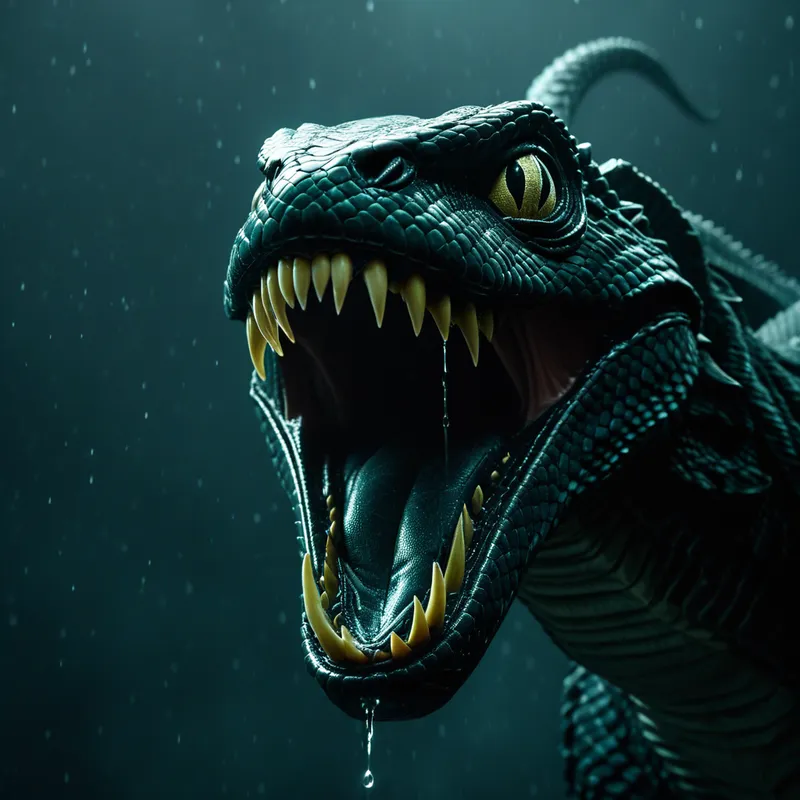
But this was not the end of his torment. Above him, they set Sigyn, his faithful wife. And above her, they fastened a great serpent, its maw dripping a searing venom. Sigyn stands, bowl in hand, catching the slow, relentless drip. But when the bowl fills and she must turn to empty it, the venom falls. It strikes Loki’s face, and his convulsions are so violent that the whole earth shakes. Thus he lies, bound by the guts of his own child, until the world’s end draws nigh.
Cultural Origins & Context
This myth, preserved primarily in the Prose Edda of Snorri Sturluson, is not a fireside fable for children. It is a foundational narrative of consequence, recited in a culture that understood the world as a precarious balance held against encroaching chaos. The skalds who told it were speaking to a society living on the edge of a vast, untamed wilderness, where a single act of treachery within a kin-group could unravel the social fabric as surely as Loki’s deeds unraveled the peace of the gods.
The binding serves a critical societal function: it mythically enacts the containment of anti-social forces. Loki represents the breaking of frith, the sacred peace and trust that binds a community. His punishment is a communal act by the Æsir, re-establishing a boundary. The myth teaches that the chaotic, inventive, and self-serving impulse—while a source of change and even progress—must ultimately be subordinated to the collective survival, lest it destroy all. It is a dark mirror to the binding of the wolf Fenrir; where the wolf is a force of pure, external destruction, Loki is the corruption from within.
Symbolic Architecture
Loki is the archetypal shadow of the pantheon. He is the unintegrated trickster, the intellect devoid of loyalty, the catalyst that forces transformation through crisis. His binding is not merely a punishment, but a symbolic necessity.
The unbound shadow does not integrate; it possesses. It must be confronted, named, and its energy contained before it can be transformed.
The bonds themselves, fashioned from his son’s entrails, are a profound symbol of poetic justice, or wyrd. The consequences of his actions literally become the instrument of his restraint. He is imprisoned by the very lineage of chaos he set in motion. The three stones signify a fixing in place, a removal from the dynamic flow of life and interaction. The venom represents the corrosive, painful feedback of a repressed complex—the psychic poison that drips relentlessly when consciousness (Sigyn) turns away. Her loyal vigil is the ego’s attempt to manage the pain of the bound shadow, a temporary and exhausting solution.
The Dreamer's Resonance
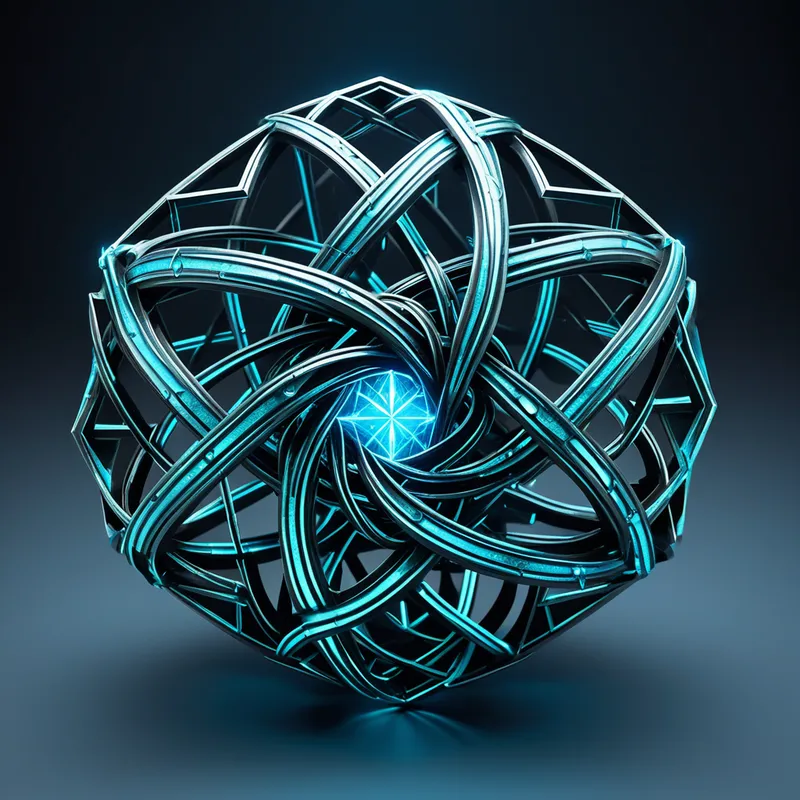
When this myth stirs in the modern dreamer, it often manifests as dreams of profound constraint. One may dream of being paralyzed, bound by invisible cords, or trapped in a small, dark space beneath the floorboards of one’s own house. The somatic feeling is one of suffocation and frantic, futile struggle.
Psychologically, this signals a critical point in shadow-work. The dreamer has likely identified a destructive pattern within themselves—a “Lokian” trait of sabotage, deceit, or chaotic outbursts—and the psyche is enacting its binding. The convulsions in the dream are not just panic; they are the violent protests of a personality aspect being forcibly restrained by the will of the conscious self (the collective Æsir). It is a painful but necessary stage. The dream asks: What part of you have you finally had to chain down for the sake of your own integrity and the stability of your inner world? The accompanying grief and shaking are part of the process.
Alchemical Translation
The individuation process modeled here is not one of heroic integration, but of necessary imprisonment. Not all aspects of the psyche are ready to be made conscious and whole. Some must be contained.
The alchemical vessel is not always for blending; sometimes it is a prison for the volatile element until the rest of the work is complete.
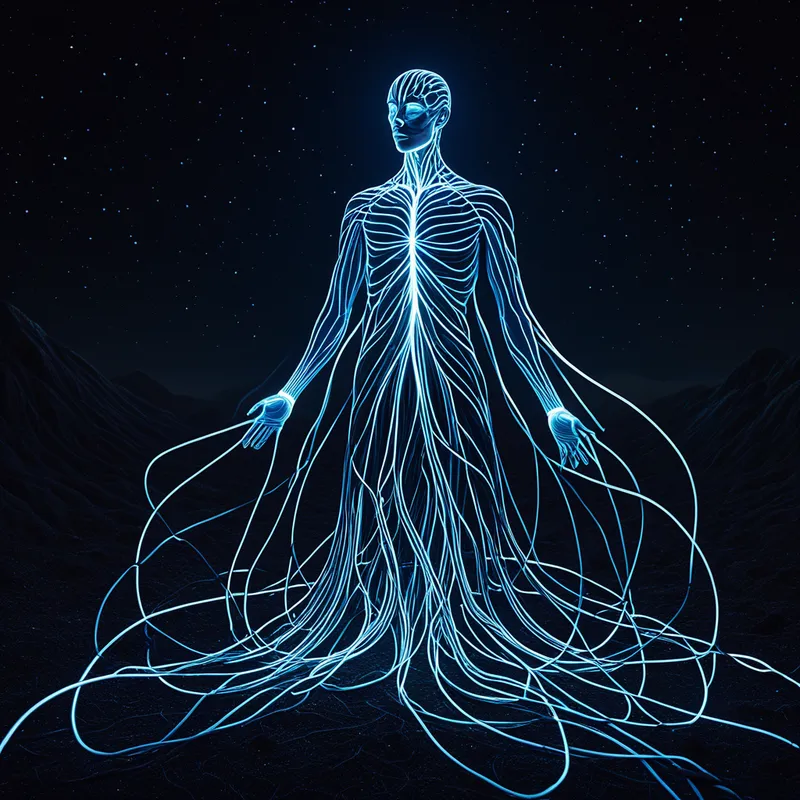
The modern individual undergoing this “Loki’s Binding” phase is learning to forge their own Gleipnir—not from cruelty, but from consequence. They take the sinews of their own painful actions (the hurt they have caused, the chaos spawned) and fashion them into a conscious limit. They bind the reactive trickster within to the bedrock of their values. This is not a denial of the shadow’s energy—Loki still writhes, he is not dead—but its placement under observation.
Sigyn’s role is crucial in the translation. She represents the compassionate consciousness that stays with the bound pain, mitigating its worst effects. It is the part of us that says, “I will not abandon this wounded, destructive part of myself, even as I restrain it.” The process is agonizingly cyclical (the filling and emptying of the bowl), speaking to the ongoing work of maintenance. The final goal is not Loki’s eternal torment, but his eventual release at Ragnarök. In the psyche’s great cycle, the contained shadow, having been fully witnessed in its bondage, may one day be transformed and unleashed in a new, perhaps necessary, form. But first, it must be bound.
Associated Symbols
Explore related symbols from the CaleaDream lexicon: