Loadstone of Magnesia Myth Meaning & Symbolism
A tale of a magical stone from Magnesia that draws iron, embodying the primal force of attraction and the soul's pull toward its destiny.
The Tale of Loadstone of Magnesia
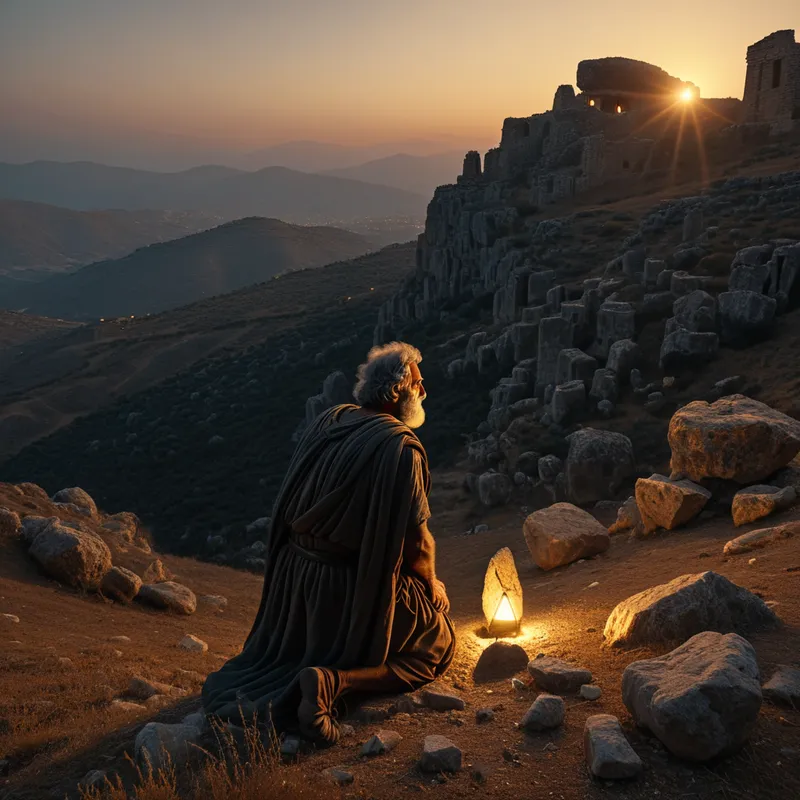
Hear now a whisper from the bones of the earth, a story not of gods clashing on high, but of a secret sleeping in the soil. In the rugged, sun-baked land of Magnesia, where the mountains shrug their stony shoulders and the wind carries the scent of thyme and iron, there lived a shepherd. His name is lost to the ages, for he was but a man—calloused hands, a face lined by the sun, a soul attuned to the complaints of his flock and the language of the stones.
One evening, as the sun bled into the west and long shadows stretched like grasping fingers, he sought a lost lamb. His staff, tipped with iron to ward off wolves, tapped a steady rhythm against the flinty ground. He climbed a barren hill, a place the old ones avoided, speaking of strange hums in the earth. There, half-buried in the red dirt, he saw it: a stone unlike any other. It was dark, dense, and smooth as a river-polished skull, yet it seemed to drink the fading light rather than reflect it.
As he leaned on his staff to catch his breath, a strange thing occurred. The iron tip of his staff twitched. It pulled, as if a hidden hand were tugging it downward toward the stone. The shepherd’s breath caught. He lifted the staff, and the iron followed, straining against the wood, pointing like a finger of fate to the dark rock. He knelt, his heart a drum in the silence. With a trembling hand, he scooped up a handful of loose iron nails from his repair pouch and let them fall. They did not scatter. They flew, a sudden, silent swarm, and clung to the stone’s surface in a bristling, metallic beard.
Awe, cold and profound, washed over him. Here was no caprice of Zeus or trick of Hermes. This was a law written in the very flesh of the world, a silent command. The stone called, and the iron obeyed. It was a marriage without ceremony, a binding without chain. He did not take the stone, for some truths are too heavy to carry. He marked the place, and returned to his people not with a trophy, but with a mystery. He spoke of the stone that hungers for iron, the still center that commands motion, the anchor in the earth that pulls the works of man into its silent embrace. The Loadstone of Magnesia entered the world’s memory not with a roar, but with the soft, inevitable click of metal finding its heart.
Cultural Origins & Context
The tale of the Loadstone is not an epic of the Titanomachy; it is a natural philosophy wrapped in narrative. Its origins are humble, emerging from the observations of miners, shepherds, and early philosophers in regions like Magnesia, known for its magnetic ore (magnes lithos, "Magnesian stone"). It was passed down not by bards in royal halls, but in workshops and market squares, a curious anecdote that spoke of a hidden order in nature.
Early thinkers like Thales of Miletus pondered it, seeing in its attraction evidence of a world-soul, of matter possessing a kind of life and desire. For a culture whose cosmology was animated by personalities—gods who loved, raged, and schemed—the Loadstone presented a fascinating paradox: a force that behaved with the inevitability of a divine decree, yet was embedded in mute, physical stone. Its societal function was foundational. It was a primal puzzle piece, a concrete mystery that challenged the boundary between the animate and inanimate, pushing Greek thought from pure mythopoeia toward the first tremors of scientific inquiry. It asked, "If this stone can desire, what else sleeps in the world's heart?"
Symbolic Architecture
At its core, the Loadstone myth symbolizes the irreducible principle of Attraction. It is the archetypal pattern of the Lover, not in its romantic sense, but in its fundamental drive toward connection, union, and the recognition of essential affinity.
The stone does not choose; it is a choice. Its nature is its destiny, and its destiny is to pull its own essence from the chaos of the world.
Psychologically, the Loadstone represents the immutable core of the Self, the Self-archetype. It is that within us which is fixed, dense with purpose, and magnetically ordered. The scattered iron—tools, nails, fragments—symbolizes the disparate, often unconscious, aspects of our psyche: our skills, our wounds, our latent potentials (our shadow and our anima/animus). The myth dramatizes the moment when the conscious ego (the shepherd) stumbles upon this central power and witnesses its autonomous, organizing force. The iron is not destroyed; it is re-ordered, brought into a new and meaningful relationship with the central, gravitational truth.
The Dreamer's Resonance
When this myth stirs in the modern dreamer, it often manifests as dreams of powerful, inexplicable attraction or repulsion. One might dream of a specific object, person, or place that exerts a literal physical pull. Alternatively, the dream may feature metal objects moving of their own accord, or a central, dark, dense mass around which the dream's events helplessly orbit.
Somatically, this can correlate with a feeling of being "pulled" in a certain direction in life, a compelling vocation, or an inescapable fascination. Psychologically, it signals a process of psychic integration. The unconscious is activating the Loadstone function: the core Self is beginning to assert its magnetic order. The "iron filings" of forgotten memories, neglected talents, or repressed emotions are now in motion, drawn toward consciousness. It can feel disorienting, even frightening—as the shepherd felt—because it reveals a will within the psyche that is not our conscious will. We are not doing; we are being organized by a deeper law of our own nature.

Alchemical Translation
In the alchemical journey of individuation, the Loadstone models the stage of Coagulatio—the condensation and fixing of spirit into a durable, centered form. The initial, chaotic massa confusa of the personality (the scattered iron) is subjected to the influence of the philosopher's stone, which in this myth is literalized.
The work is not to become the iron, striving and straining. The work is to discover the Loadstone within—to become the unmoved center that commands the field.
For the modern individual, the "struggle" is one of surrender and recognition. First, we must wander our own "hills of Magnesia"—the arid, neglected landscapes of our inner world—until we stumble upon our core truth. This truth is often heavy, dense, and unglamorous. The triumph is the moment we stop trying to force our lives into shape and instead allow our essential nature to pull the necessary parts of our experience toward it. We transmute chaos into order not by effort, but by essence. A calling finds us. Relationships that resonate with our deepest self are drawn in; those that do not fall away. We cease being the shepherd frantically searching and become, in part, the stone: the grounded, magnetic pole around which a meaningful life can faithfully arrange itself.
Associated Symbols
Explore related symbols from the CaleaDream lexicon: