Lir's Children Myth Meaning & Symbolism
Four royal children are transformed into swans by a jealous stepmother, enduring nine centuries of exile on the wild Irish sea before a final, bittersweet release.
The Tale of Lir's Children
Hear now a story not of earth, but of the liminal space between wave and shore, of a sorrow so deep it shaped the very song of the sea. In the time when the Tuatha Dé Danann still walked the green hills, there lived a great lord of the sea, Lir of the Sidhe. His heart was a vast, cold ocean until he loved, and from that love came four radiant children: Fionnuala, Aodh, Fiachra, and Conn. Their laughter was the sound of sunlight on water, and their father’s palace at Sídh Fionnachaidh was warmed by it.
But the wheel of fate turns on a spindle of grief. Their mother, Lir’s beloved, faded like sea-foam on the sand. In time, as was the custom, Lir wed her sister, Aoife. At first, she was a gentle stepmother, but a venomous seed took root in her heart—a bitter jealousy for the love Lir poured upon his children, a love she felt was stolen from her. It grew in the dark, fed by whispers of comparison, until it blossomed into a monstrous resolve.
One autumn day, under the guise of a visit to their grandfather, Bodhbh Dearg, Aoife led the children to the shores of Loch Dairbhreach. The water lay still and dark. Her words, once sweet, turned to spells. She raised a druid’s wand of dark rowan, and her voice cracked the stillness. “For the love your father bears you, which is my poison, you shall not know the world of men. By my power, you shall take the shape of the wild swan!”
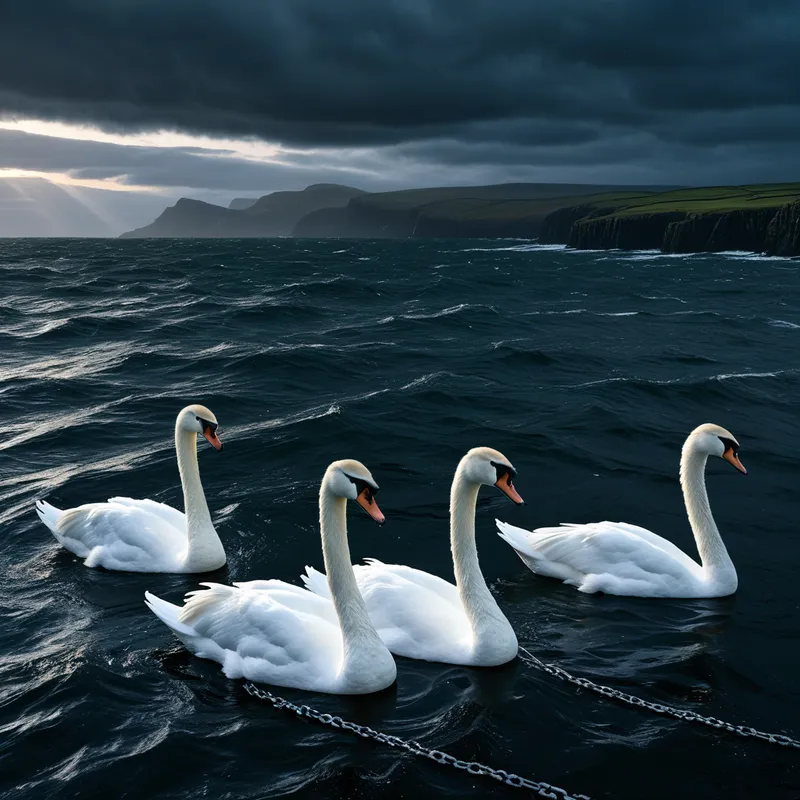
A wind of pure enchantment tore through them. Bones lightened, skin prickled and burst into white feathers. Their cries of terror became the haunting, mournful calls of swans. Yet, in a final twist of cruel mercy—or perhaps a flicker of her conscience not yet fully extinguished—Aoife decreed they would keep their human minds, their speech, and their song, which would be sweeter than any music in the world. Their exile was to last nine hundred years: three hundred on this lonely lake, three hundred on the stormy Sea of Moyle, and three hundred on the wild waters off the western isles. And so they were bound, not just by spell, but by a chain of silver, linking them wing to wing, heart to heart.
Thus began their long suffering. On Loch Dairbhreach, they sang songs of such piercing beauty that all who heard were stricken with a sweet melancholy. Then came the harder centuries on the Sea of Moyle, a place of bitter cold and lashing storms, where they clung to each other, the silver chain their only tether against the abyss. They witnessed the slow turning of ages, the coming of new peoples, the fading of their own. Finally, to the western sea, where the sound of Christian bells first drifted over the water—a sound of a world that had forgotten them.
Their release came only when the spell’s term was done, and a holy man, hearing their human speech from swan’s throats, blessed them. The white feathers fell away like snow, revealing not the children of old, but ancient, withered beings, trembling on the shore. They were baptized, and as the holy water touched their brows, their long-tormented spirits broke free at last, leaving their aged bodies to crumble into dust. They were buried together, as they had lived, facing the eternal sea.
Cultural Origins & Context
This profound tale is preserved in the medieval Irish text Lebor na hUidre and later in the Annals of the Four Masters, as part of the Mythological Cycle. It is a story of the Tuatha Dé Danann, the god-like precursors to humanity in Ireland. Unlike many myths that center on heroic combat, this is a story of profound emotional and psychological endurance.
It functioned as more than entertainment. For a culture deeply connected to landscape, it explained the haunting beauty of swan song and the melancholy of certain lonely places. It served as a narrative vessel for exploring themes of profound injustice, the endurance of familial bonds under unimaginable strain, and the interface between the old pagan world and the new Christian order, marked here not by conflict but by a bittersweet release. The bard who recited this story was invoking a deep, collective grief and resilience, teaching that some sorrows are so vast they must be measured in centuries, and that love can persist even through total metamorphosis.
Symbolic Architecture
At its core, the myth is a map of traumatic transformation and the psyche’s exile. The children represent the innocent, creative, and connected parts of the self. Aoife is not merely a villain, but the embodiment of the shadow aspect of the feminine—the jealous, possessive, and destructive potential within the familial or societal complex that cannot tolerate the pure love directed elsewhere.
The silver chain is the most potent symbol: it is both the curse of shared trauma and the lifeline of shared consciousness. It binds them to their fate, but also to each other; it is the tangible manifestation of their unbreakable sibling bond, the psychic tether that prevents them from being utterly lost in the formless sea of madness.
Their transformation into swans is an archetypal image of psychic dissociation. They are removed from their human realm, their proper form, yet retain their core identity (their minds and speech). They become creatures of the limen, the threshold between worlds—neither fully divine nor mortal, neither human nor beast. The three stages of exile (lake, strait, open ocean) mirror the deepening stages of a soul’s journey through grief: initial shock and local sorrow, a period of being battered by the core pain (the harsh Sea of Moyle), and finally a vast, open, and lonely integration where one is completely adrift from the original shore of self.
The Dreamer's Resonance
When this myth stirs in the modern dreamer, it often signals a profound process of involuntary transformation. To dream of being a swan, especially a swan that can speak or thinks as a human, points to a feeling of being trapped in a role, situation, or body (metaphorically) that is not one’s own, imposed by another’s will (a parental complex, a societal expectation, a past trauma).
Dreaming of a chain, particularly one that connects you to others, may reflect a complex where your fate is inextricably and perhaps painfully linked to family members or a group. The setting is crucial: dreaming of a calm lake turning stormy may indicate the onset of this psychic exile. Dreaming of the vast, empty ocean speaks to a later stage of feeling utterly disconnected from one’s origins and identity, yet enduring. The somatic sensation is often one of coldness, buoyancy without control, and a deep, mournful longing—a literal Sehnsucht for a home that no longer exists.
Alchemical Translation
The alchemical journey of Lir’s children is one of the opus performed not in a flask, but in the crucible of time and saltwater. Their story models the individuation process forced upon the psyche by a shattering trauma.
The first stage, nigredo, is the act of transformation itself—the brutal, darkening spell that destroys their former life. The nine hundred years of exile are the long, slow albedo. The silver chain is the guiding thread of consciousness through this endless purification. They are washed by the sea, bleached by the sun and sorrow, their song becoming the purified expression of their enduring essence amidst suffering.
Their final transformation back—not to youth, but to ancient, worn bodies—is the citrinitas, the dawning recognition of the spirit. The baptism and immediate death represent the rubedo: a final, transcendent release. The psychic complex is not “solved” by returning to the way things were—that is impossible. It is dissolved through a sacred recognition, allowing the trapped energy (the children’s spirits) to be freed from the calcified patterns of suffering (their ancient bodies).
For the modern individual, the myth teaches that some transformations are irreversible. The goal is not to regain the lost, innocent self, but to endure the exile with consciousness intact, connected to whatever “chain” of love or memory preserves our core. The ultimate release comes from blessing the experience itself—from integrating the story of the swan with the memory of the child—and allowing the spirit, weathered and wise, to finally depart the scene of its long torment.
Associated Symbols
Explore related symbols from the CaleaDream lexicon: