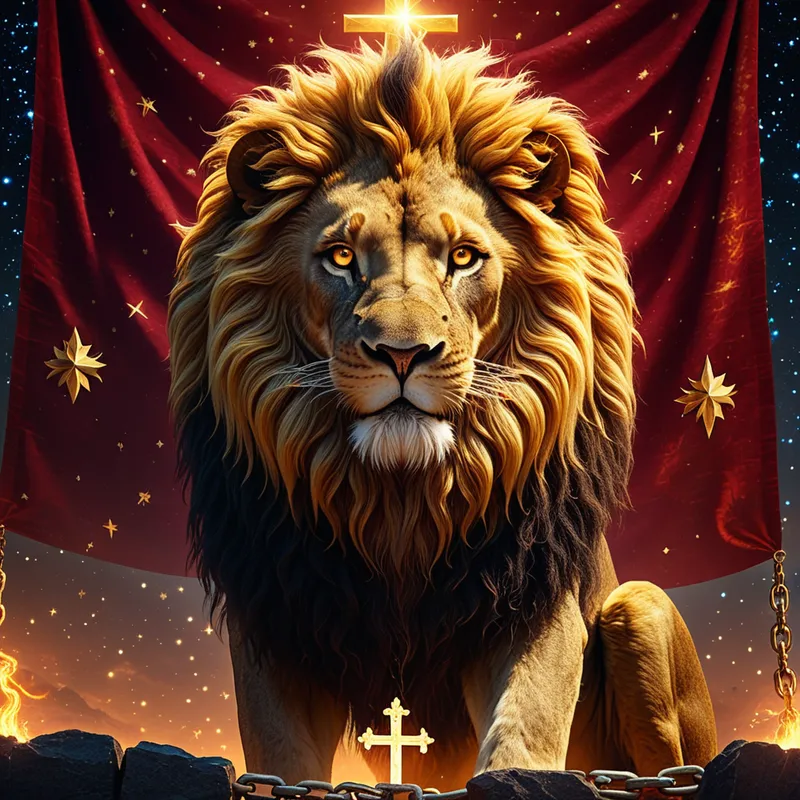
Lion of Judah Myth Meaning & Symbolism
A prophecy of a conquering king from the tribe of Judah, symbolizing divine authority, righteous judgment, and the integration of power and love.
The Tale of the Lion of Judah
Hear now a tale not carved in stone, but written on the heart. It begins in the deep, resonant dark before time was measured, in the tent of a dying patriarch. The air is thick with the scent of oil lamps and impending death. Jacob, called Israel, a man whose life was a wrestling match with God and man, gathers his twelve sons around him. His voice is a dry riverbed, yet it carries the force of prophecy.
He turns his clouded gaze to his fourth son, Judah. "You are a lion's cub, my son," he rasps, the words taking shape like smoke in the still air. "You return from the prey, my son. Like a lion he crouches and lies down, like a lioness—who dares to rouse him?" The brothers lean in, feeling the weight of the words settle upon Judah’s shoulders like a mantle. "The scepter will not depart from Judah, nor the ruler's staff from between his feet, until he to whom it belongs shall come and the obedience of the nations shall be his." In that tent, the seed is planted. A king will come. Not just any king, but the king, springing from this lion's line. The prophecy sleeps for centuries, coiled in the scrolls of the prophets, a dormant roar.
Centuries flow like sand. The tribe of Judah rises, falls, is exiled, returns. The promise becomes a whispered hope, a desperate prayer in the shadow of empire. Then, on a lonely isle called Patmos, a man named John, seared by vision and exile, sees the culmination. He weeps, for no one in heaven or on earth is found worthy to open a scroll sealed with seven seals—the scroll of destiny itself. But an elder speaks, his voice like many waters: "Do not weep! See, the Lamb of God, looking as if it had been slain, is standing at the center of the throne."
And then, the revelation that ties the ages together: "He is worthy… the Lion of the tribe of Judah, the Root of David, has triumphed." The vision collapses predator and prey, power and sacrifice, into one breathtaking figure. The awaited Lion is the slain Lamb. The conquering roar is the silent offering. The one who holds the scepter is the one who bore the cross. The prophecy from the patriarch's tent finds its shocking, glorious resolution not in an army, but in a sacrifice; not in a roar of domination, but in the silent victory of love.
Cultural Origins & Context
This mythic thread is woven from two distinct but divinely connected strands of ancient Hebrew scripture. Its origin is the patriarchal blessing in the Book of Genesis (49:9-10), a foundational text for the identity of the twelve tribes of Israel. Here, the lion symbol is tribal, denoting Judah's preeminence in leadership and martial strength. This was not mere poetry but political theology, justifying the Davidic monarchy that would later arise from Judah's line.
The myth lay dormant, simmering in the national consciousness during exile and foreign occupation. It was kept alive by scribes, priests, and later, apocalyptic writers who yearned for a messianic figure to restore national sovereignty. The function was one of identity and hope: We are the people of the lion-king. Our current humiliation is not our end.
The radical transformation occurred in the early Christian community, who, reading their scriptures through the lens of Jesus's life, death, and reported resurrection, performed a profound hermeneutical act. They took this symbol of earthly, tribal kingship and applied it to a crucified rabbi. The authors of the Book of Revelation (5:5), writing to persecuted communities under Roman rule, fused the Genesis lion with the suffering servant imagery from Isaiah and the Paschal Lamb. This was subversive theology. The myth's function shifted from legitimizing a temporal dynasty to offering a cosmic hope: true power, the ultimate victory over sin and death, was achieved through apparent weakness and self-giving love. It was told in clandestine gatherings and written in cryptic apocalypses to strengthen the faithful, asserting that their persecuted leader was, in fact, the long-awaited Lion-King of the universe.
Symbolic Architecture
The Lion of Judah is a master symbol of integrated opposites, a coniunctio oppositorum at the heart of Christian mystical thought.
The Lion is the raw, unapologetic power of the Self; the Lamb is its boundless, vulnerable compassion. In their union, sovereignty finds its true purpose.
Psychologically, the Lion represents the archetype of rightful authority, courage, and fierce integrity. It is the energy of healthy boundaries, the roar that says "this is my domain, my truth, my responsibility." It is the power of the ego when it aligns with the deeper, guiding center of the Self. Conversely, the Lamb symbolizes innocence, surrender, and transformative suffering. It is the capacity to be vulnerable, to be acted upon, to offer oneself without guile.
The myth's genius is its insistence that these are not sequential (first conquer like a lion, then sacrifice like a lamb) but fundamentally identical in their essence. The Lion's triumph is the Lamb's sacrifice. This shatters conventional power dynamics.
To hold the scepter is to bear the wound. The ultimate authority is rooted not in domination, but in the conscious acceptance of one's own vulnerability and the cost of love.
The symbol thus becomes a blueprint for integrated power: power that protects rather than oppresses, authority that serves rather than subjugates, strength that is expressed through mercy. It calls for the reconciliation of the inner warrior and the inner victim, the ruler and the servant.
The Dreamer's Resonance
When the Lion of Judah pads into the modern dreamscape, it rarely appears as a biblical illustration. Its arrival signals a critical juncture in the dreamer's relationship with personal power and moral authority.
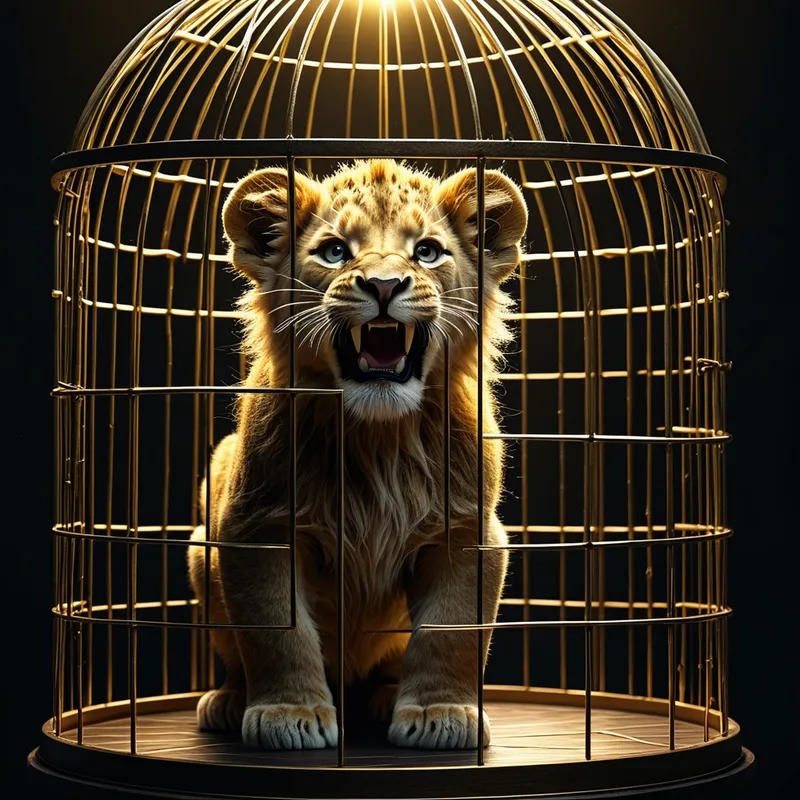
One may dream of a lion that is caged, sickly, or silent, reflecting a profound disconnection from one's innate strength and leadership potential. The individual may be living in a state of passive compliance, their inner "roar"—their capacity to set boundaries, declare truth, or take a stand—muzzled by fear or conditioning. Conversely, dreaming of a raging, destructive lion can point to power that has become tyrannical, untempered by compassion or wisdom—the shadow side of the ruler archetype running amok in one's life, perhaps in the form of unchecked anger, controlling behavior, or ruthless ambition.
The most potent dreams involve a transformation or a revelation: a meek animal transforming into a lion, or discovering a lion sleeping peacefully within one's own chest. These dreams mark the somatic and psychological process of reclaiming sovereignty. The psyche is laboring to integrate split-off aspects of power and vulnerability. It is the process of finding one's authentic voice (the roar), establishing rightful boundaries (the lion's domain), and doing so from a place of integrated conviction rather than reactive aggression. The dream is an invitation to stop fleeing from one's own strength or wielding it without conscience, and to begin the difficult, sacred work of unifying the lion and the lamb within.
Alchemical Translation
The journey of the Lion of Judah is the alchemical opus of individuation for the soul seeking wholeness. It models the process of psychic transmutation where base instincts are refined into golden consciousness.
The initial state is one of separation. The lion (raw power, ambition, will) and the lamb (vulnerability, empathy, connection) exist in conflict or alternation within the individual. One may identify solely with one pole, repressing the other into the shadow. The "sealed scroll" represents the unlived life, the destiny one feels called to but cannot access, because it requires the full, integrated Self to open it.
The nigredo, or blackening, is the necessary confrontation with the shadow of each pole. This is the humiliation of the lion's pride—facing one's weakness, failures, and the ways one's power has been corrupt or cowardly. It is also the sacrifice of the lamb's innocence—accepting one's capacity for darkness, the painful but necessary loss of naivete. The crucifixion scene is the ultimate symbol of this stage: the total surrender of the ego's projects to a higher, unknown order.
The alchemical fire is not for destruction, but for revelation. It burns away the dross of identification, leaving only the essential gold of being.
The albedo, or whitening, is the revelation on Patmos: the slain Lamb is the triumphant Lion. In psychological terms, this is the moment of insight where one sees that true strength was forged in vulnerability, and that compassionate surrender was the ultimate act of courage. The opposites are seen as two sides of the same coin.
Finally, the rubedo, or reddening, is the integration. The individual embodies the united symbol. They can roar a clear "no" to injustice from a place of love, and offer a compassionate "yes" from a place of unshakable inner fortitude. Their authority is authentic, rooted in self-knowledge and service. They hold the scepter because they have borne the cross. They rule their inner kingdom—their thoughts, emotions, and actions—with the fierce tenderness of the Lion-Lamb, having completed the sacred circuit from tribal prophecy to cosmic, personal wholeness.
Associated Symbols
Explore related symbols from the CaleaDream lexicon: