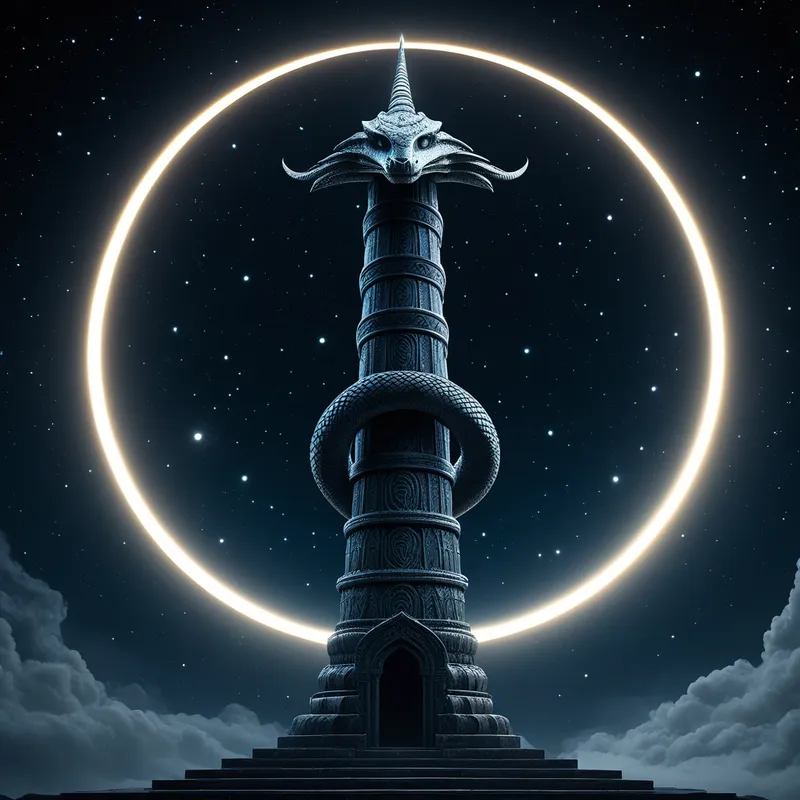
Lingam Myth Meaning & Symbolism
A cosmic contest reveals the infinite pillar of light, the Lingam, as the ultimate reality beyond form, uniting Shiva and Shakti in eternal creation.
The Tale of Lingam
In the time before time, when the worlds were young and the gods still tested the limits of their power, a great tension arose. The divine trinity—Brahma, the weaver of universes, and Vishnu, the sustainer of all life—found themselves in dispute. A question, simple yet infinitely profound, hung in the celestial air: Who among them was supreme? Whose power was the true foundation of existence?
Their debate echoed through the heavens, a thunder of competing claims that shook the very pillars of space. No sage could adjudicate, no scripture contained the answer. The cosmos itself seemed to hold its breath. And then, into the heart of this divine contention, there appeared a presence. It was not a form, but a feeling—a vibration of immense, silent potency. And from this presence erupted a wonder that stole the breath from both gods.
Before them, piercing the fabric of reality, stood a colossal pillar of fire. It was not mere flame, but pure, condensed luminescence—a Jyotirlingam. Its base plunged deep into the netherworlds, its summit vanished into heights unseen. It hummed with a sound that was both the first note and the final silence. It was boundless, beginningless, endless.
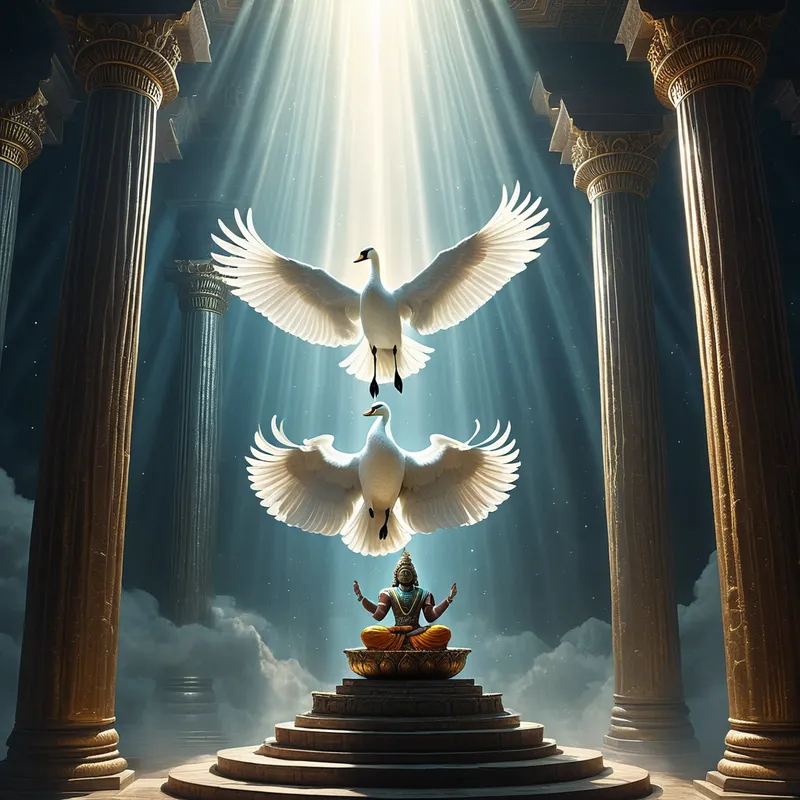
Awed into silence, the quarrel was forgotten, replaced by a desperate need to comprehend. Brahma, taking the form of a celestial swan, Hamsa, beat his wings with all his creative might. He soared upwards, past clouds of stars, through realms of light, seeking the top of the fiery column. Vishnu, transforming into a cosmic boar, Varaha, plunged downwards. His mighty tusks tore through layers of cosmic matter, through the roots of mountains and the beds of primordial oceans, seeking the foundation.
For what felt like eons they traveled, Brahma ascending, Vishnu descending. The pillar offered no end, only more of its brilliant, terrifying infinity. Weariness, a novel sensation for a god, began to creep in. It was then that a miracle, or perhaps a test, occurred. High in his flight, Brahma saw a Ketaki blossom floating down from the unseen heights. Seizing a chance to claim victory, he commanded the flower to bear false witness. Together, they returned to the starting point, where Vishnu had already emerged, humbled and empty-handed.
“I have found the summit!” declared Brahma, presenting the Ketaki as his proof. “This flower fell from its pinnacle.”
At that moment of deceit, the pillar of light shuddered. From within its incandescent core, a form coalesced—Sadashiva, the eternal one, revealed himself in his awesome fullness. His voice was the cracking of cosmic eggshells. “You have not seen my end, Brahma. And you, Vishnu, have confessed your failure truly. But you, creator,” he thundered, his gaze upon Brahma and the trembling flower, “have spoken falsehood to claim a glory that is not yours.”
The judgment was swift. For his lie, Brahma would receive no widespread worship in the mortal realms. The Ketaki blossom, for its complicity, would never again be used in his rituals. Vishnu, for his honesty, was praised. And the infinite pillar, the Lingam, remained. It was declared the ultimate symbol, the visible mark of the invisible, boundless reality—Brahman—itself. To honor it, the goddess Parvati, the embodiment of sacred power, took form as the Yoni, encircling its base. Thus, the unmanifest found its expression in the union of principle and power, of consciousness and its creative pulse, forever anchored in the heart of worship.
Cultural Origins & Context
The myth of the Jyotirlingam is primarily found in the Shiva Purana and other Puranic literature, texts composed to render Vedic philosophy into accessible, narrative theology for the populace. It was not merely a story to settle a theological debate but a foundational parable for a core Advaita Vedantic truth: the ultimate reality (Brahman) is beyond all attributes, forms, and dualistic comprehension.
Told by temple priests and wandering storytellers, the myth served multiple societal functions. It established the preeminence of Shiva as Maheshwara, the great lord, within the Shaiva tradition. It also provided a potent visual and philosophical justification for the aniconic worship of the Lingam, a practice that predates clearly anthropomorphic images. The story transformed a simple ritual object into a cosmic map, teaching that true devotion lies not in claiming to know the limits of the divine, but in humbly acknowledging its infinite, mysterious nature. It was a narrative tool to humble the intellect and elevate the heart towards awe.
Symbolic Architecture
The Lingam is not a phallic symbol in a reductive sense; it is an axis of consciousness. It represents the irreducible point of emergence, the bindu, from which all multiplicity springs and into which it eventually dissolves.
The Lingam is the still axis in the turning world, the unmanifest potential from which all forms are momentarily born.
The myth dramatizes the psyche's encounter with the numinous, the mysterium tremendum et fascinans. Brahma and Vishnu represent the two primary, yet limited, faculties of the conscious mind: creative expansion (Brahma’s ascent) and sustaining integration (Vishnu’s descent). Their failure signifies that the totality of the Self cannot be apprehended by the mind’s directional striving alone. The Lingam itself symbolizes the transcendent function, the archetype of wholeness that exists beyond the pairs of opposites—high and low, creation and preservation, beginning and end.
The false testimony of Brahma and the Ketaki flower symbolizes the ego’s temptation to claim ownership of or definitive knowledge of the Self, a spiritual pride that severs it from the authentic experience of the infinite. The final union with the Yoni completes the symbol: the formless principle (Purusha) is inseparable from the formative energy (Prakriti). It is the sacred marriage of consciousness and manifestation, stillness and dynamism, without which reality is incomplete.
The Dreamer's Resonance
When this myth pattern stirs in the modern dreamer, it often signals a profound confrontation with the limits of personal identity. To dream of a vast, unclimbable tower, an endless well, or a radiant, incomprehensible geometric form in the center of one’s psychic landscape is to meet the Lingam.
Somatically, this may be felt as vertigo, awe, or a profound stillness in the chest. Psychologically, it marks the process where the ego’s projects—the frantic “ascents” of career and achievement (Brahma) and the “descents” into relationship and security (Vishnu)—are revealed as insufficient to answer the soul’s deepest question: “What am I, beyond all this?” The dream presents the ego with its own boundaries and invites a sacred humiliation, a necessary defeat that makes space for a larger, transpersonal reality to be acknowledged. It is the psyche’s way of initiating a shift from “doing” and “having” to the mystery of “being.”
Alchemical Translation
The alchemical journey modeled here is the nigredo of the spirit—the blackening that comes from the utter dissolution of known coordinates. The ego’s quarrel with itself (which archetype, which role, is supreme?) leads to the eruption of the transcendent, which shatters all previous paradigms.
The psychic transmutation begins not in finding an answer, but in sincerely admitting, like Vishnu, that one cannot find the end of the mystery.
The individuation process requires this honest confession of limitation. The “Brahma” within—the part that fabricates stories of specialness, spiritual attainment, or complete self-knowledge—must be censured. Its worship must cease. The “Ketaki” blossoms of false witnesses—our cherished self-deceptions and borrowed credentials—are exiled from our inner ritual.
The ultimate goal is not to become the infinite pillar, but to become the sacred base that holds it. This is the alchemical coniunctio: the conscious personality (the Yoni) learns to stably support and be in relationship with the erupting, transformative power of the Self (the Lingam). One does not become the formless infinite; one becomes the vessel that honors it, through which its creative and destructive energies can flow in a sacred, contained manner. The individual becomes a living temple where the union of the finite and the infinite is perpetually celebrated, transforming personal life into an act of continuous, grounded awe.
Associated Symbols
Explore related symbols from the CaleaDream lexicon: