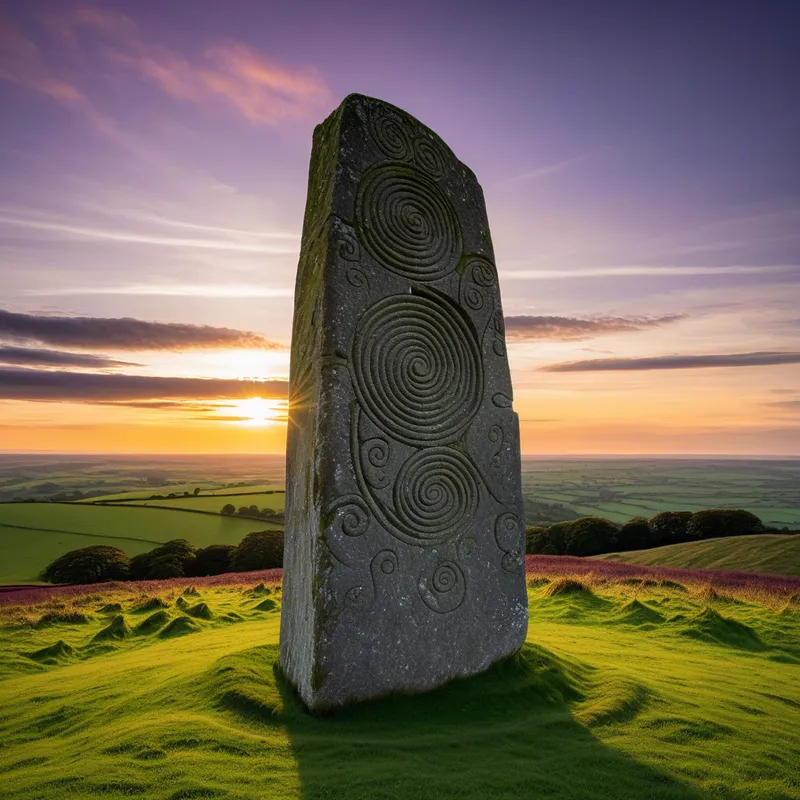
Lia Fáil Myth Meaning & Symbolism
The myth of the Stone of Destiny, a sacred rock that roars to proclaim the rightful king, embodying sovereignty, truth, and the voice of the land itself.
The Tale of Lia Fáil
Listen, and let the mists of Tír na nÓg part. In the days when the world was younger and the veil between the worlds was thin, the Tuatha Dé Danann came to Ériu. They were a people of deep magic, bearing with them four great treasures from their four legendary cities. From Falias came the first and most solemn: the Lia Fáil.
It was a stone of grey destiny, set upon the sacred hill of Teamhair, the navel of the land. It was not merely a rock, but a sleeping witness, a silent judge. The air around it tasted of ozone and old earth. The Dagda himself decreed its purpose: this stone would hold the soul of the land, and through it, the land would speak.
The first to approach was a prince of the Milesians, the mortal race who would come to share the island. He stood before the stone, the eyes of the Druids upon him, the weight of a people’s hope on his shoulders. The morning dew soaked his boots. He placed his foot upon the cold, unyielding surface. Silence. A crow cawed in the distance. The stone was mute. He was not the one.
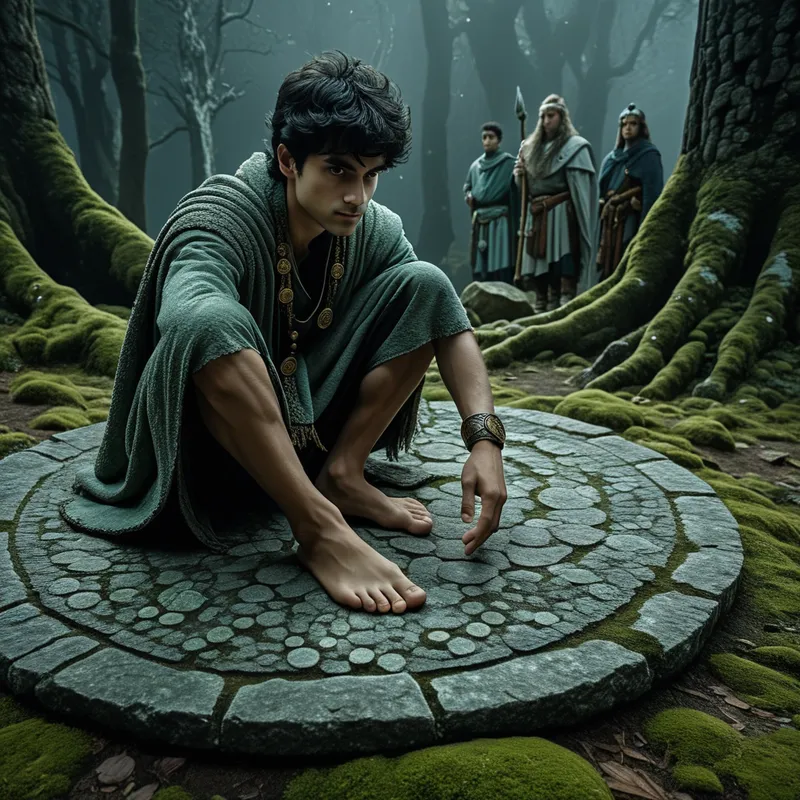
Years passed, and kings came and went, each undergoing the same silent trial. The stone remained a stoic, speechless pillar, and the kingdom knew no true Flaitheas. Then came a youth, not the strongest nor the most boastful, but with a quiet light in his eyes. He had been tested by dreams and wandering. As he climbed the hill, a strange stillness fell. No wind stirred the grass. He removed his shoe, feeling the damp soil between his toes. With a breath that misted in the chill air, he placed his bare foot upon the Lia Fáil.
For a heartbeat, nothing. Then, a vibration began, deep within the earth, rising through the stone into his very bones. A sound followed, not from the air but from the world itself—a low, resonant roar that shook the roots of the hawthorns and echoed in the hollow hills. It was a roar of recognition, of union. The land had found its king. The stone had spoken its truth, and in that moment, the prince was no longer just a man; he was the vessel for the spirit of the land, the true Ard Rí. Sovereignty was not taken, but received.
Cultural Origins & Context
The myth of the Lia Fáil is embedded in the Mythological Cycle and the lore of the Hill of Tara. It was not a mere folktale but a foundational political and sacred narrative. Passed down by the fili (poet-seers) and druids, its function was societal and cosmological. It served as the divine mandate for kingship in early Ireland, where a ruler was not an absolute autocrat but a partner in a sacred contract with the land itself, personified as the goddess Ériu or Sovereignty.
The king’s truth, his fír flathemon, was what kept the land fertile and the people prosperous. The Stone’s cry was the audible sign of this truth being in alignment. This myth was performed and re-enacted during inauguration rituals, grounding abstract concepts of legitimacy in a tangible, sensory experience. It taught that true authority comes not from force or lineage alone, but from a mysterious, authentic consonance between the individual’s character and the needs of the collective soul of the people and place.
Symbolic Architecture
At its core, the Lia Fáil is an axis mundi, a point where heaven, earth, and the Otherworld meet. It is the still point around which the wheel of kingship turns. Symbolically, it represents Objective Truth. It is the unmoving, unwavering standard against which the subjective self is measured.
The stone does not judge by the glitter of a crown or the sharpness of a sword, but by the resonance of the heart with the deep song of the world.
The stone’s silence for the unworthy king symbolizes a life lived out of alignment with one’s own deep nature or destiny—a hollow reign, however grand its trappings. Its roar for the true king is the moment of Consecration, where the personal will is subsumed into, and simultaneously empowered by, a transpersonal purpose. The king’s bare foot on the stone signifies vulnerability, humility, and direct, unmediated contact with the foundational reality (the "rock bottom" truth of oneself and one’s situation). The resulting roar is the eruption of this realized potential into the world—the birth of authentic, grounded power.
The Dreamer's Resonance
When this myth stirs in the modern psyche, it often manifests in dreams of testing, validation, or profound encounters with stone or earth. You may dream of touching a wall, a monument, or a strange rock in a landscape, and feeling it grow warm, vibrate, or emit sound. Alternatively, you may dream of failing a silent test, of standing before a tribunal or a machine that remains ominously quiet.
Somatically, this points to a process of Somatic Authentication. The psyche is asking the body to be the "stone"—the ground of truth. The dreamer is in a life phase where an inner authority must be established. Are they living a life that is truly their own, or one built on others’ expectations? The anxiety in the dream is the friction between the persona (the would-be king in fine robes) and the Self (the silent, demanding stone). The roaring affirmation, if it comes, is not an ego-inflation, but a deep, bodily knowing of alignment—a feeling of "this is my ground, this is my truth." It is the unconscious confirming a difficult but necessary choice, a path, or an identity.
Alchemical Translation
The alchemical journey modeled by the Lia Fáil is that of Individuation as Inauguration. The modern individual is both the aspiring prince and the silent stone. The first stage, Nigredo, is the stone’s silence—the dark night of the soul where all former identities, ambitions, and borrowed authority prove hollow. One stands barefoot on the cold reality of one’s own life, and hears nothing. This is a necessary dissolution.
The second stage, Albedo, is the purification of motive. It is the removal of the "shoe"—the defenses, pretensions, and insulations that prevent direct contact with the core Self (the stone). It demands brutal honesty and humility.
The king is not made by the crown, but by the willingness to stand naked before the unyielding truth of what is.
The final stage, Rubedo, is the roaring union. When the ego’s agenda is surrendered, the deeper, transpersonal Self (the spirit of the land, the objective psyche) can speak through the individual. The "roar" is the red, living energy of a life lived in authenticity. One’s work, relationships, and creative output become infused with this authority, not as domination over others, but as a sure-footed capacity to act from a place of profound inner congruence. You are no longer ruling a kingdom "out there"; you are the sovereign of your own integrated psyche, and your life becomes the territory where that sovereignty brings order and fertility. The stone’s voice becomes your own.
Associated Symbols
Explore related symbols from the CaleaDream lexicon: