Laylat al-Qadr Myth Meaning & Symbolism
A single night of cosmic significance when the divine word descends, rewriting fate and illuminating the world from a hidden mountain cave.
The Tale of Laylat al-Qadr
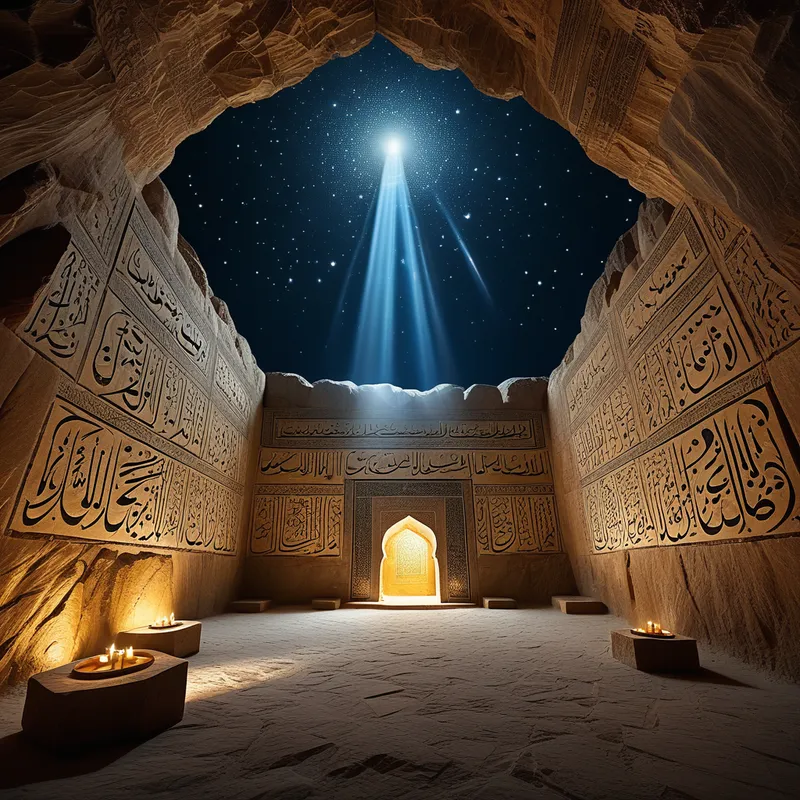
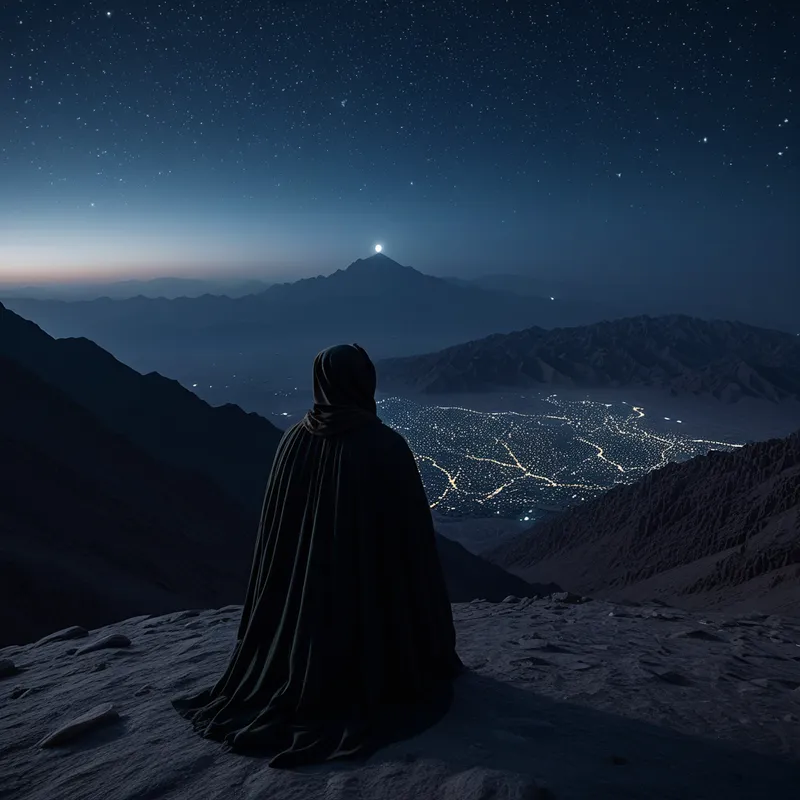
Listen, and let the veils of the ordinary world grow thin. The tale begins not with a bang, but with a profound and pregnant silence, in the stark, stony embrace of a mountain called Hira. For years, a man named Muhammad retreated there, his soul a vessel emptied of the world’s clamor, seeking a truth that whispered just beyond the edge of hearing. He was a man of the desert, yet he sought a different water—a water for the spirit, in a cave that was a womb of stone.
Then came the Night. Not a night like any other, though to the sleeping city of Mecca below, the stars held their usual stations. This was Laylat al-Qadr—the Night of Power, the Night of Decree. The very fabric of time grew soft, and eternity pressed close against the membrane of the world. In that cave, in the deepest watch, the silence shattered.
It began not with a vision, but with a presence—an overwhelming, awe-full presence that filled the narrow space. Then, a command, thunderous in its clarity, spoken directly into the core of his being: "Iqra’!" ("Recite!"). The man, gripped by a terror both primordial and sublime, could only stammer his inability. The command came again, a pressure upon his very soul. And then, a third time, with a finality that brooked no denial. And in that moment, the seal broke.
Words—not his own, not of any human tongue he knew—cascaded into him, through him. They were a light that was also a sound, a meaning that was also a force. They were the first verses of what would become the Quran: "Recite in the name of your Lord who created—Created man from a clinging substance. Recite, and your Lord is the most Generous—Who taught by the pen—Taught man that which he knew not."
The messenger, Jibril, was the conduit of this impossible tide. Muhammad, trembling, bore the weight of a cosmos condensed into speech. He fled the cave, the words burning inside him, and on the mountain path, the figure of Jibril filled the horizon, declaring him the Messenger of God. The world had been irrevocably altered. A single night, hidden within the last ten of the month of Ramadan, had become the axis upon which history would turn. In it, the divine script for creation, the al-Lawh al-Mahfuz, touched the earthly realm, and the destiny of humanity was rewritten with a new clarity.
Cultural Origins & Context
This is not a myth of a distant, forgotten age, but the foundational event of a living tradition. The narrative of Laylat al-Qadr is meticulously preserved within the Quran itself, in Surah al-Qadr, which states its value is greater than a thousand months. It is the heart of Islamic sacred history, marking the inception of the final prophecy. Passed down through generations of scholars, storytellers, and believers, it is recounted not as allegory but as transcendent history—a moment when the Infinite communicated directly with the finite.
Its societal function is multifaceted. It sanctifies time itself, creating a yearly portal—the last ten nights of Ramadan—during which believers engage in intense prayer, vigil (Qiyam), and remembrance, seeking to encounter a fraction of that original night’s blessing (barakah). It grounds religious authority in a specific, transformative experience. Most profoundly, it democratizes access to the divine. While the grand revelation was for the Prophet, the night itself recurs annually, offering every individual a chance for personal revelation, forgiveness, and the rewriting of their own spiritual destiny.
Symbolic Architecture
The myth is a masterclass in symbolic potency. The Cave represents the temenos, the sacred enclosed space of the psyche where the ego’s noise is silenced for the Self to speak. It is the womb of rebirth. The Night symbolizes the unconscious, the fertile darkness from which all conscious knowing (‘ilm) must emerge. Laylat al-Qadr is the depth of the collective unconscious suddenly illuminated.
The command "Iqra’!" is not an invitation to literacy, but an archetypal imperative to conscious awareness. It is the psyche demanding to be read, deciphered, and articulated.
The Descent of the Quran symbolizes the irruption of objective, transpersonal knowledge into the subjective, personal mind. It is the Logos, the structuring principle of reality, making itself known. The figure of Jibril is the archetypal psychopomp, the mediator between realms who delivers the content of the Self. The "better than a thousand months" signifies the collapse of linear, quantitative time into a moment of qualitative eternity—what Jung called the nunc stans, the eternal now, where transformative wholeness is achieved.
The Dreamer's Resonance
When this myth pattern stirs in the modern dreamer, it signals a profound psychic event. To dream of being in a confined, safe space (a room, a closet, a cave) that is suddenly flooded with an overwhelming, non-threatening light or sound indicates the imminent arrival of crucial Self-knowledge. The dreamer may feel a terrifying awe, a sense of being chosen or burdened by a truth they must carry.
Dreams of finding a book with glowing text, or of hearing a clear, authoritative voice delivering a message in an unknown yet perfectly understood language, are direct echoes of Laylat al-Qadr. Somatically, the dreamer may awaken with a feeling of expansion, clarity, or a quiet, resonant peace, as if their internal compass has been recalibrated by a celestial force. This is the psyche’s own "night of decree," where old, fateful patterns are dissolved and new directives for living emerge from the core.
Alchemical Translation
The alchemical process modeled here is the reception of the lapis, the philosopher’s stone. The long, arduous retreats in the cave (the nigredo, the blackening, the dissolution of worldly identity) prepare the vessel. The terrifying encounter with the angelic presence is the albedo, the whitening, the shocking purification by a spirit far greater than the ego.
The revelation itself is the rubedo, the reddening—the infusion of the mortal vessel with the fiery, living spirit of meaning. The individual is transmuted from a seeker of truth into a vessel of truth.
For the modern individual, this translates to the courage for deep introspection—entering one’s own "cave" through meditation, therapy, or creative solitude. It is the willingness to be silent until the deeper voice speaks. The "Iqra’!" command becomes the demand to articulate one’s own authentic nature, to "read" the text of one’s soul and live by its decrees. The triumph is not becoming a prophet, but achieving a moment of inner alignment so complete that one’s personal destiny feels authored by a wiser, greater hand within. The night of power, then, is any moment when the conscious mind humbly steps aside, and the eternal, guiding Self takes the pen.
Associated Symbols
Explore related symbols from the CaleaDream lexicon: