Layla and Majnun Myth Meaning & Symbolism
A legendary tale of a poet driven mad by an impossible love, transforming earthly desire into a spiritual union that transcends all worldly bonds.
The Tale of Layla and Majnun
Let the sands of Najd whisper a story not of kingdoms won, but of a kingdom lost—the kingdom of the human heart. In the scorching cradle of the Arabian desert, where tribal honor was law and lineage was armor, there bloomed a love so potent it became a curse, and a curse so deep it became a sacred vow.
His name was Qays, son of a noble chieftain, a youth of piercing intellect and fiery verse. Her name was Layla, meaning "night," a girl whose beauty was said to eclipse the moon. They met as children, studying together, and in that shared space of learning, a seed was planted. As they grew, the seed became a sapling, and the sapling a towering, inescapable tree whose roots entwined their very souls. Qays could speak of nothing but Layla. He composed poems in her name, shouting them to the dunes, to the sky, to anyone who would listen. They called him Majnun—the Madman, the one possessed by jinn.
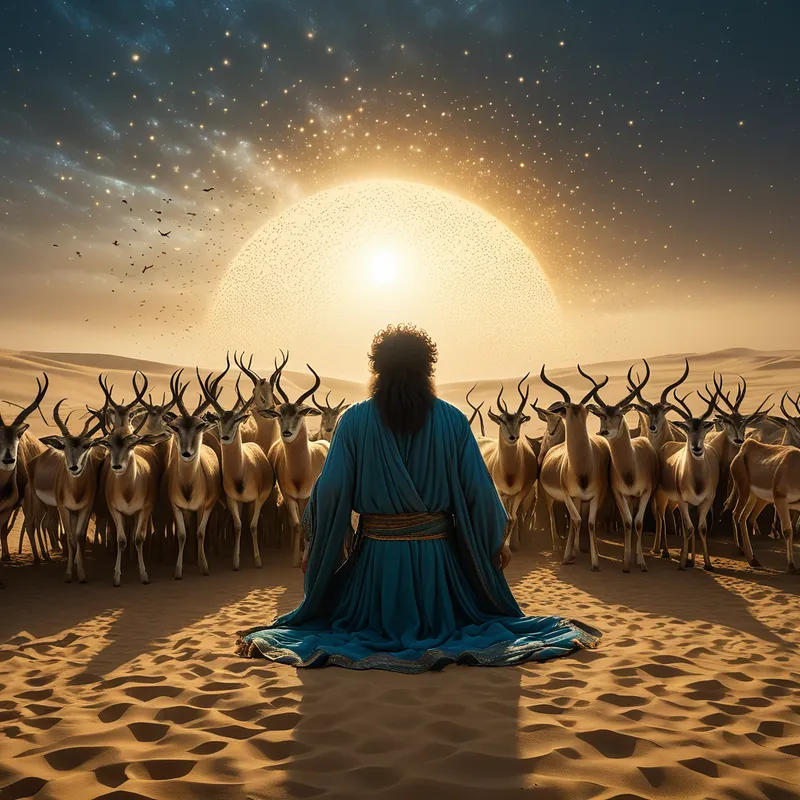
When he asked for her hand, the request was not a proposal but a declaration of war against the old order. Layla’s father refused, aghast. To give his daughter to a madman who had made their private love a public spectacle? It was unthinkable. The refusal did not quell the fire; it poured oil upon it. Majnun fled the company of men, casting off his fine clothes. The desert became his sanctuary and his prison. He wandered among the rocks and the scorpions, composing odes to his beloved, finding more kinship in the wild beasts—who he said understood the purity of his love—than in his own kind.
Layla, bound by the iron chains of duty and honor, was given in marriage to another, a wealthy merchant named Ward. She became a queen in a gilded cage, her heart a tomb for a living love. She heard tales of her mad poet, of how he slept among the wolves and conversed with the gazelles, and each tale was a knife twisting in her soul.
Years bled into the desert sand. Majnun’s father, broken-hearted, died. Layla’s husband, perhaps sensing the ghost that lived between them, also passed. Yet even freedom could not unite them. When they finally stood at a trembling distance, a vast emptiness between them, they saw not the children they had been, but the living myths they had become. Their love had grown too vast for mere mortal union. To touch would be to reduce the infinite to the finite. Layla, her spirit eroded by a lifetime of silent longing, faded from the world, dying of a broken heart that had been broken for decades.
When Majnun was brought to her grave, he circled it three, five, seven times. Then he lay down, pressed his face against the earth, and spoke his final verses to the dust that now held his Layla. He did not rise again. They found him there, his journey complete, his soul finally flown to the only place where it could be with her—not in the world of forms, but in the formless world of essence. The desert, it is said, wept a single, rare rain.
Cultural Origins & Context
The story of Layla and Majnun is a cultural palimpsest. Its earliest roots are in 7th-century Arabic Bedouin oral poetry, based on possibly historical figures. However, it was in the Persianate world—particularly through the immortal quill of the 12th-century poet Nizami Ganjavi—that the tale was elevated from a tragic romance to a sublime spiritual allegory. Nizami wove it into his Khamsa, infusing the raw desert passion with the mystical language of Sufism.
Passed down through coffee houses, royal courts, and Sufi lodges, the story functioned on multiple levels. On the surface, it was a quintessential tale of star-crossed lovers, reinforcing social codes about honor and passion's dangers. On a deeper level, it served as a sanctioned vessel for exploring ecstatic, transcendent experience. In a culture with strict religious norms, Majnun’s "madness" provided a cloak for discussing the annihilation of the ego (fana) and the intoxicating, all-consuming love for the Divine. Layla became not just a woman, but a symbol of the Divine Beloved, eternally sought by the soul (Majnun).
Symbolic Architecture
At its core, the myth is not about love thwarted, but about love transformed. Every character and event is a symbol in a psychic drama.
Majnun represents the human soul or ego that becomes fixated on an object of desire—initially, the earthly Layla. His "madness" is the necessary disintegration of the ordinary, rational, socially-conditioned self. His retreat to the desert is the journey into the unconscious, where the complexes (the wild beasts) must be faced and integrated. He does not conquer the desert; he becomes it, shedding his identity to become pure, undirected longing.
The lover's madness is the sane world's diagnosis for a consciousness that has broken its contract with convention to seek a higher truth.
Layla is the anima and the Divine Object. She is the soul-image, the ultimate "Other" that feels separate and unattainable, pulling the ego beyond itself. Her marriage to another signifies the soul's captivity by worldly concerns and persona (the social mask). Her death is the crucial dissolution of the literal, physical object of desire, forcing the love to become purely internal and spiritual.
The desert is the unconscious and the alchemical nigredo. It is a place of austerity, stripping away, and confrontation with the shadow (the wild animals Majnun befriends). It is in this barrenness that the true, non-physical union is forged.

The Dreamer's Resonance
When this myth stirs in the modern dreamer, it signals a profound encounter with the dynamics of obsessive love and spiritual yearning. To dream of an unattainable beloved, of wandering a vast, empty landscape in search of something lost, is to feel the Majnun archetype activate.
Somatically, this may feel like a constant, low-grade heartache, a restless energy in the chest, or a sense of being "out in the cold" emotionally and psychologically. The dreamer is likely in a state of possession, where a single desire or complex has taken the helm of the psyche. The psychological process is one of painful differentiation: the ego is being forced to separate from its literal, often projected, object of desire (a person, a status, an achievement) and to begin the harder work of understanding what that object represents internally. The dream is the psyche's way of enacting the exile, forcing a confrontation with the barren but fertile ground of one's own inner wilderness.
Alchemical Translation
The journey of Majnun is a precise map of psychic transmutation, or individuation. It begins with the inflation of love, which swiftly leads to the nigredo of madness and exile. This is not a failure, but the necessary first stage.
In the desert (the unconscious work), Majnun undergoes a slow albedo. He purifies his love from possession and expectation. He learns the language of the instinctual world (integrating the shadow). His love for Layla ceases to be a demand and becomes a state of being—a constant, directed orientation of his entire self.
Individuation is not about attaining the beloved, but about becoming the one who is capable of that specific, transformative love.
Layla’s death is the pivotal rubedo. It is the death of the literal, the death of the hope for conventional fulfillment. This forces the final and most critical transmutation: the internalization of the beloved. The union no longer seeks expression in the outer world because it has been achieved in the inner world. The grave becomes the wedding chamber. The ego, having been utterly dissolved in its longing (Majnun’s death), discovers its true identity not as a separate self, but as a participant in a timeless, archetypal union. For the modern individual, this translates to the realization that our deepest yearnings are not solved by obtaining, but by becoming. The goal is not to reach the horizon, but to understand that we are, and always have been, the very ground over which the horizon is perceived.
Associated Symbols
Explore related symbols from the CaleaDream lexicon: