Last Supper Myth Meaning & Symbolism
On the eve of sacrifice, a teacher shares a final meal, transforming bread and wine into an eternal covenant amidst the shadow of betrayal.
The Tale of Last Supper
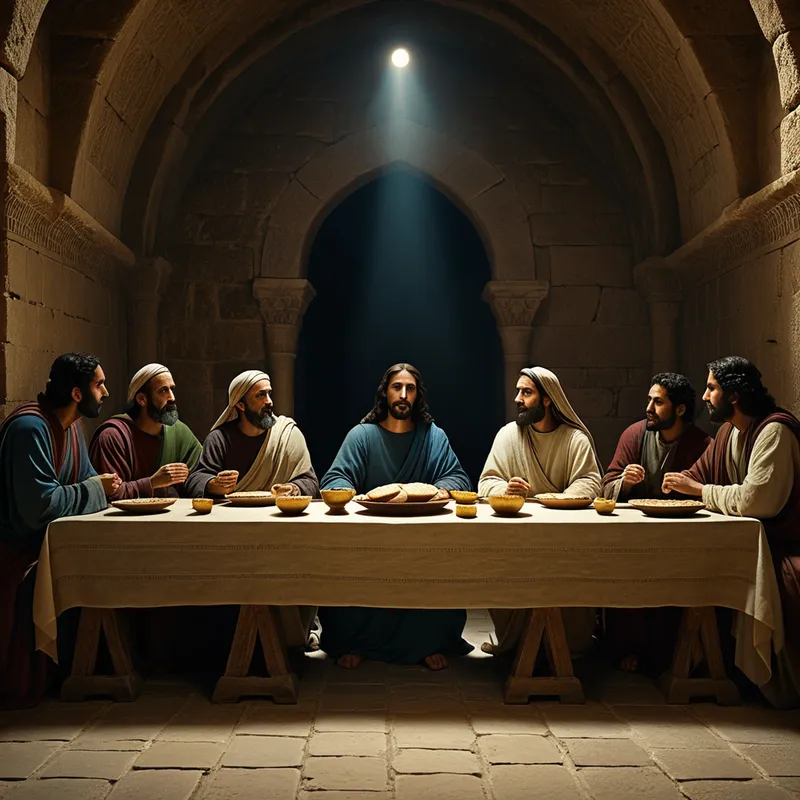
The air in the upper room was thick with the scent of roasted lamb, bitter herbs, and the oil of the lamps that fought back the gathering Jerusalem night. It was the feast of Passover, a night remembering liberation from an ancient bondage. Yet, a new and heavier bondage pressed upon the hearts of the thirteen men gathered.
At the center sat Yeshua, his face a landscape of profound sorrow and unshakable resolve. The usual warmth of his teaching was tempered by a gravity that silenced even the most boisterous of his companions. The weight of a knowing hung in the room, a secret too terrible to utter, yet too present to ignore.
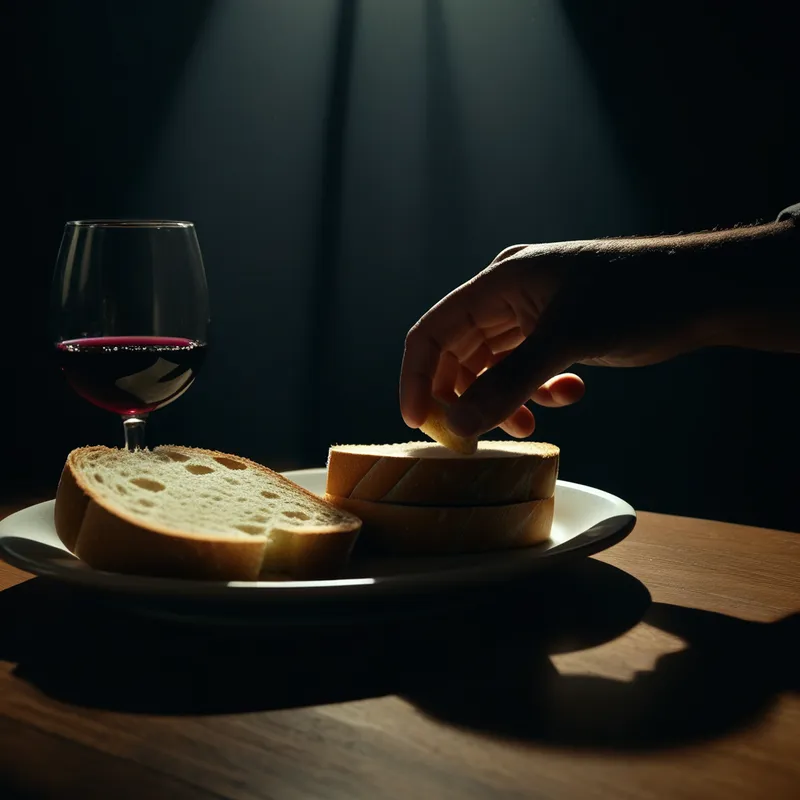
As they reclined at the low table, he took the unleavened bread, the matzah of affliction. He gave thanks, his voice a low rumble that stilled the clatter of cups. Then he broke it. The sound—a sharp, clean crack—echoed in the silent room. “Take and eat,” he said, his eyes holding each of them. “This is my body, given for you.” The words were not metaphor; they were a sacred alchemy, transforming the simple bread into a vessel of his imminent sacrifice. The men ate, the taste of the dry bread now carrying the metallic tang of destiny.
Then he took the cup, the wine dark as blood in the lamplight. He gave thanks again and offered it to them. “Drink from it, all of you,” he instructed. “This is my blood of the covenant, which is poured out for many for the forgiveness of sins.” As the cup passed from hand to hand, a covenant was sealed not in ink, but in shared wine and shared fate. It was a promise written in the future-tense of suffering.
And then, the shadow in the room took form. “Truly I tell you,” Yeshua said, his gaze piercing the dim light, “one of you will betray me.” A wave of shock and grief broke over the table. “Surely not I, Rabbi?” each man whispered in turn. The one called Yehuda Ish-Kariot asked with the others, the coin purse at his side heavy with silver. “You have said so,” Yeshua replied, his words a confirmation, not an accusation. He offered Yehuda a morsel of bread dipped in wine—a final gesture of intimate fellowship, even as the wheel of betrayal was set irrevocably in motion.
With a hymn, they left the room and walked out into the cool night, towards the Mount of Olives. The feast was ended. The sacrifice had begun.
Cultural Origins & Context
The story of the Last Supper is embedded in the heart of the Christian narrative, primarily recorded in the four Gospels. Its power is amplified by its deliberate setting during Passover, the foundational Jewish myth of liberation from slavery. By placing this new covenant within the old, the storytellers declared a new exodus—not from physical Pharaohs, but from the bondage of sin and death.
Originally an oral tradition passed among early communities of believers, it was a foundational story recited during their own ritual meals. These gatherings, often in secret, were not merely memorials; they were participations. To tell the story was to re-inhabit that upper room, to feel the tension, and to partake in the mystery. The myth served a dual societal function: it established a core ritual (the Eucharist or Communion) that defined the community, and it provided a theological framework for understanding a traumatic, world-shattering event—the execution of their teacher.
Symbolic Architecture
At its core, the Last Supper is a myth of paradoxical transformation. It occurs at the precise threshold between life and death, fellowship and betrayal, the old covenant and the new. It is the moment where the archetypal pattern of the dying-and-rising god is consciously enacted and given meaning by the god-figure himself.
The bread is broken not as an end, but as a distribution of essence. The wine is poured out not as a loss, but as a saturation of the world with a new covenant.
The central symbols are acts of ingestion. The body and blood, represented by bread and wine, are internalized. This symbolizes the ultimate integration of the sacred into the human condition. The sacrifice is not something merely observed; it is something consumed and made part of the individual. Yehuda represents the inescapable shadow within the circle of the self. He is not an external monster, but the trusted companion who carries the capacity for betrayal. His presence ensures the myth is not a simple tale of good versus evil, but a profound tragedy about the cost of destiny and the complexity of the human heart.
The Dreamer's Resonance
When this myth stirs in the modern psyche, it often surfaces in dreams of final meals, shared cups with hidden poison, or being in a gathering where a profound truth is known but unspoken. To dream of the Last Supper pattern is to be at a psychic threshold.
Somatically, one might feel a deep tension in the gut or chest—the “heavy bread” of a fateful decision or the “bitter wine” of a necessary sacrifice. Psychologically, the dreamer is navigating their own “night before.” It is the process of consciously accepting an ending: the death of an old identity, the betrayal of a long-held belief, or the sacrifice of a comfort for the sake of a deeper truth. The dream asks: What covenant are you being asked to seal? What part of yourself feels like the betrayer, yet is essential to the journey? The gathering in the dream represents aspects of the self, and the central figure is the emerging consciousness that must integrate them all before moving into the dark night of transformation.

Alchemical Translation
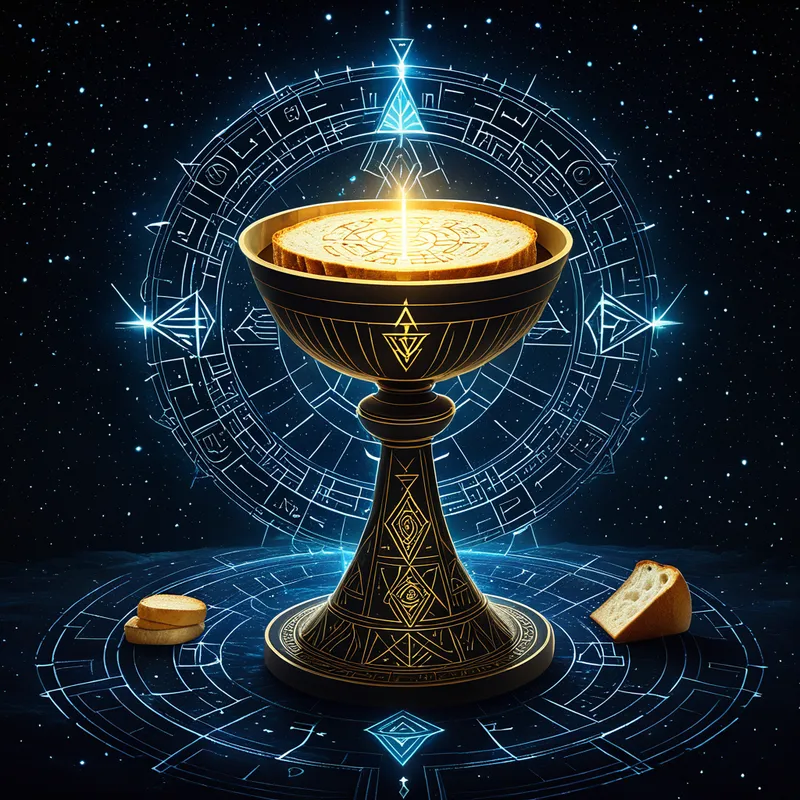
The alchemy of the Last Supper is the transmutation of the literal into the symbolic, and the personal into the universal. For the individual on the path of individuation, this myth models the crucial step of conscious suffering and sacred meaning-making.
First, the nigredo, the blackening: the conscious acknowledgment of the impending “death”—the betrayal, the failure, the ending. Yeshua does not flee this knowledge; he brings it to the table. In our lives, this is the act of sitting with our despair without denial, inviting our shadows to the meal.
The act of breaking and sharing is the alchemical solve—dissolving the solid, singular ego (“my body, my life”) so it can be redistributed as nourishing spirit.
Then, the sacred meal itself is the albedo, the whitening: the creation of a new, spiritual substance from the raw material of one’s fate. By naming the bread as his body and the wine as his blood, he performs an act of psychic alchemy. He translates his imminent physical destruction into an eternal, spiritual nutrient. For us, this is the process of taking a personal tragedy or limitation and consciously reframing it as a source of meaning, compassion, or connection—making our wounds into a covenant with life itself.
Finally, the covenant is the rubedo, the reddening: the achievement of the philosopher’s stone. The new, durable self is not a fortified ego, but a participatory presence. One becomes like the bread and wine: a substance meant to be broken and poured out, yet in that very act, becoming the connective tissue of a more profound, collective humanity. The individual life is sacrificed to the symbolic life, achieving a form of immortality not in duration, but in significance.
Associated Symbols
Explore related symbols from the CaleaDream lexicon: