Lanhua Myth Meaning & Symbolism
A celestial orchid maiden descends to a mortal realm of corruption, her purity a silent rebellion that transforms the very earth she touches.
The Tale of Lanhua
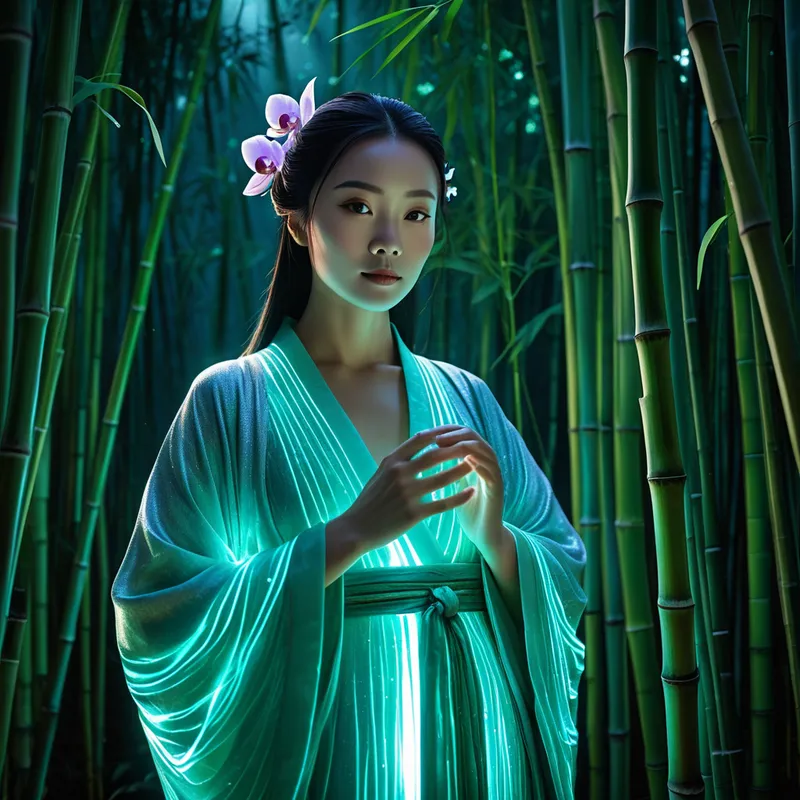
Listen, and hear the whisper of petals on the wind. In an age when the heavens brushed closer to the earth, there lived in the Jade Emperor's court a maiden of unblemished spirit. She was Lanhua, whose name was the very essence of the orchid. Her form was not born of mortal clay, but woven from moonlight and the morning dew that gathers on pristine petals. She dwelt amongst the xian in gardens of perpetual mist, where flowers sang in colors unseen by human eyes.
Yet, a sorrow touched her heart—a hollow echo from the world below. The mortal realm, once a reflection of celestial harmony, had grown thick with the fumes of greed, discord, and corrupted desires. The rivers ran murky with spite; the air grew heavy with false words. Lanhua, in her pristine innocence, could not comprehend this darkness, only feel its discordant vibration like a crack in a perfect bell.
Driven by a compassion as deep as her naivete, she petitioned the celestial guardians. "Let me descend," she pleaded, her voice the sound of wind through bamboo. "Let my being be a reminder of the purity they have forgotten." The heavens warned her of the peril. A spirit of such purity would be a beacon in that gloom, a target for all that is coarse and defiling. But her resolve was as steadfast as a mountain peak. And so, she was granted leave, descending on a shaft of autumn moonlight to a forgotten valley choked with brambles and despair.
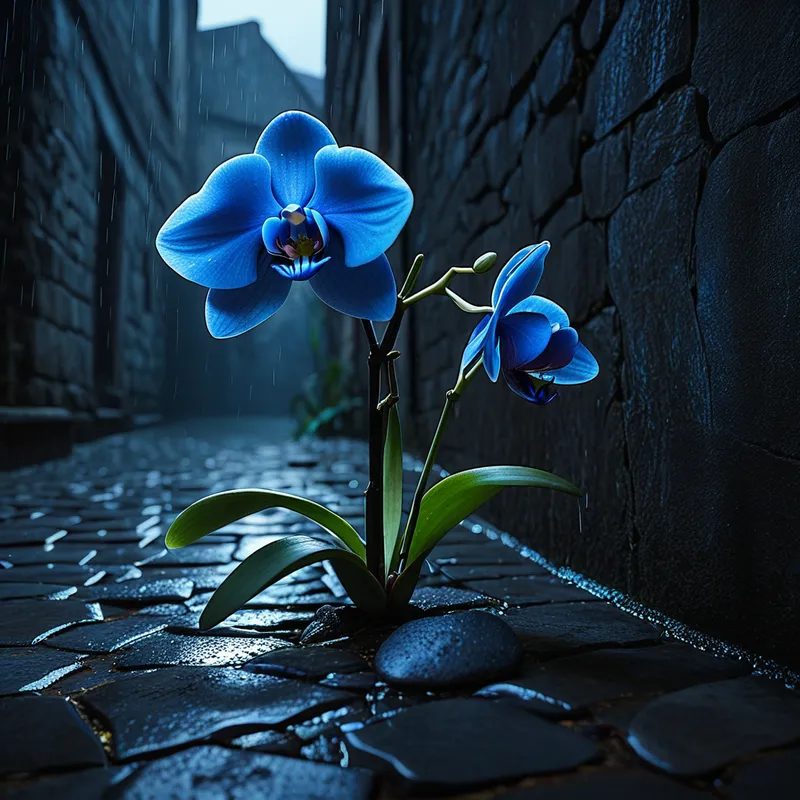
She took root not as a goddess, but as the humblest of forms: a simple orchid plant with blossoms of the clearest, most fragile blue. Her presence was a silent hymn. Where her roots touched the soil, the cloying bitterness receded. Where her scent drifted, tangled thoughts momentarily stilled. But the world's corruption is a jealous force. It manifested as a creeping, invisible blight—not of insects, but of cynical whispers and envious glances from the very people of a nearby village. They saw not beauty, but strangeness; not purity, but a challenge to their compromised ways. They neglected her, then scorned her, and finally, a band of drunkards, offended by her silent perfection, sought to trample her into the mud.
As their shadow fell over her, Lanhua did not fight. She bent. She yielded. Her stems were crushed, her petals torn and scattered on the filthy ground. The men laughed at the ease of it, their triumph hollow and brief. They left, and a cold rain began to fall, washing the torn petals into the earth.
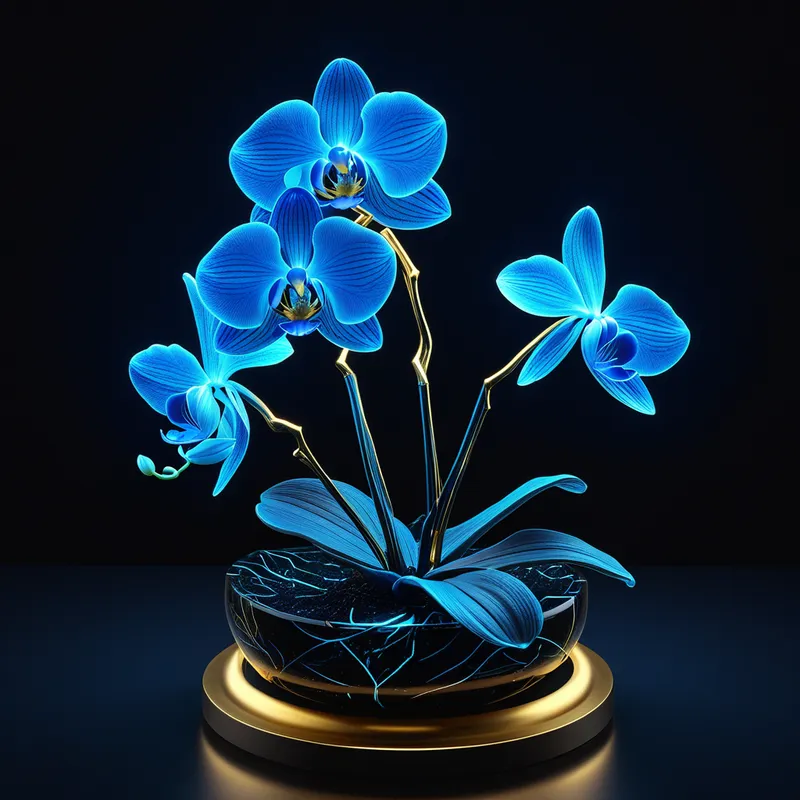
In the deep silence that followed, something stirred. Not from the broken plant, but from the earth itself where her essence had mingled with the rain and soil. From every place a fragment had fallen, a new shoot emerged. Then ten. Then a hundred. By the next sunrise, the entire valley, once a monument to neglect, was a sea of trembling blue orchids. Their collective fragrance was so profound it cleansed the very air, a palpable wave of serenity that washed over the village. The people awoke, their hearts strangely light, their minds clear for the first time in generations. They looked upon the valley and understood, in a wordless, soul-deep way, the magnitude of what they had tried to destroy—and what had, through utter resilience, transformed their world.
Cultural Origins & Context
The myth of Lanhua finds its roots not in one canonical text, but in the fertile soil of Chinese folk tradition and Daoist allegory. It is a story passed down through oral tradition, often told by elders or woven into the lessons of local operas and village tales. Its primary function was less about explaining natural phenomena and more about ethical and spiritual instruction.
It operates within a core Chinese cosmological principle: the resonance between humanity and the natural world (ganying). A corrupt society literally poisons the land, and a pure spirit can literally cleanse it. The orchid, or lán, holds a privileged place in Chinese culture, symbolizing scholarly refinement, moral integrity, and humble nobility—the "gentleman of plants," as Confucius noted. This myth elevates that symbolism into a narrative. It served as a moral compass for communities, illustrating that true strength and influence come not from force or wealth, but from unwavering inner virtue and the quiet, transformative power of resilience. It was a story for times of corruption or social strife, a reminder that purity is not weakness but an indomitable, regenerative force.
Symbolic Architecture
Psychologically, Lanhua represents the essential, uncorrupted Self—what Carl Jung might call the nucleus of the psyche, prior to the compromises and complexes imposed by life. Her descent is the journey of this essential Self into the unavoidable realities of the world: the "valley" of family dynamics, societal pressures, and personal trauma.
The orchid does not argue with the mud; it transforms it by the very fact of its blooming.
The trampling is not merely an act of violence; it is the symbolic annihilation of innocence through experience. It is the betrayal, the failure, the humiliation, the depression that shatters one's self-concept. The key alchemical moment is not the destruction, but the scattering. The ego-structure (the single plant) is broken, but the essential essence (the petals) is disseminated. This is the critical transition from a fragile, localized innocence to a resilient, integrated purity. The myth proposes that our deepest truths cannot be destroyed, only fragmented and returned to the unconscious (the earth), from which they return multiplied and stronger. The collective bloom symbolizes the individuated Self—no longer a single, vulnerable identity, but a whole landscape of being, rooted in experience yet radiant with inherent value.
The Dreamer's Resonance
When this myth stirs in the modern dreamer, it often surfaces in periods of profound vulnerability or after a perceived "crushing" defeat—a career setback, the end of a relationship, a crisis of faith. The dream imagery is potent: being a fragile, beautiful object in a threatening, dirty environment; feeling silently judged and trampled by faceless crowds; or witnessing the destruction of something pristine.
Somatically, this may accompany feelings of being "walked over," a tight chest, or a literal sense of fragility. Psychologically, the dream is not a portent of doom, but an image of the process already underway. The crushing is the work of the psyche itself, breaking down an outdated or too-rigid structure of innocence (which can manifest as naivete, perfectionism, or idealism). The dream is the soul's way of depicting the necessary dissolution. If one dreams of the blooming that follows, it signals a nascent awareness of renewal, a feeling that the very fragments of one's pain are seeding a future strength. The process is one of surrender and dissemination, moving from egoic defense to a deeper, ecological identity.

Alchemical Translation
The alchemy of Lanhua is the transmutation of passive innocence into active resilience. The initial state is a purity that is separate, precious, and therefore doomed. The mortal realm—the reality of life with its shadows—is the necessary prima materia, the leaden base substance required for the gold to be made.
The first stage (nigredo) is the descent and the trampling: the confrontation with shadow, failure, and corruption. This is the dark night, the feeling of being annihilated. The second, crucial stage (albedo) is the washing by the rain—the tears, the acceptance, the letting go. It is the dissolution of the shattered form back into the unconscious. The final stage (rubedo/citrinitas) is the miraculous, multitudinous bloom. The Self is no longer a single point to be attacked but has become an environment, a atmosphere of being.
Individuation is not about building a better fortress of the ego; it is about becoming a fertile valley where all parts of one's experience can take root and flower.
For the modern individual, this myth models a path through profound hurt. It instructs: do not merely seek to repair the broken plant (the old self). Allow it to be broken. Gather the fragments of your experience—the shame, the pain, the insight—and consciously sow them back into the soil of your soul. Tend to that inner ground with patience. The triumph is not in avoiding being trampled, but in discovering that your essence is not in the fragile stem, but in the indestructible blueprint of the bloom within the seed, within the scattered petal. You are not the orchid that was crushed. You are the valley that now knows how to grow orchids.
Associated Symbols
Explore related symbols from the CaleaDream lexicon: