Lan Myth Meaning & Symbolism
The myth of Lan, a celestial being exiled to earth, who embodies the quiet power of integrity, resilience, and finding one's true fragrance in solitude.
The Tale of Lan
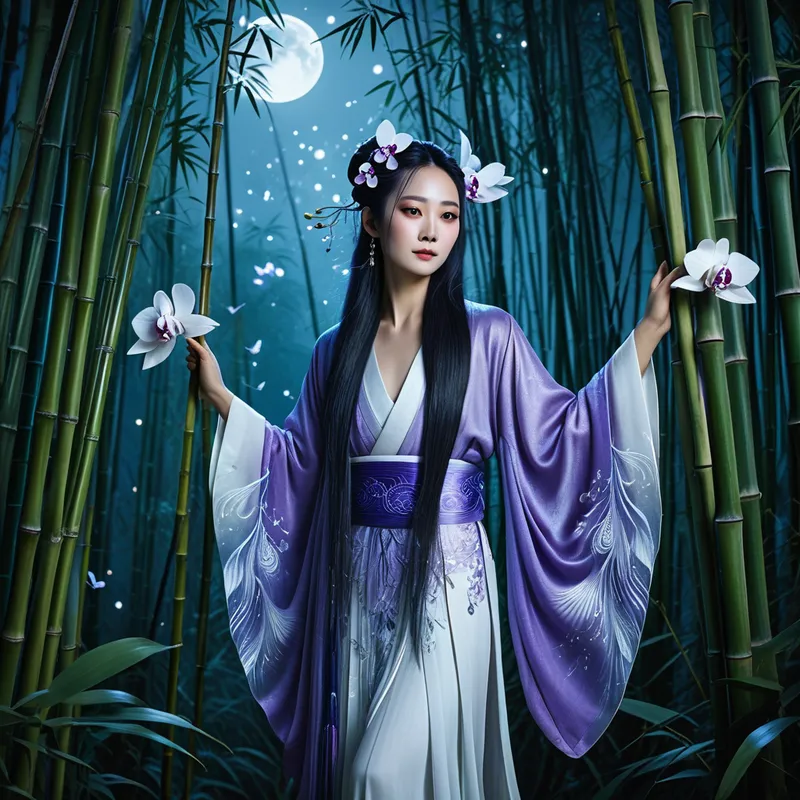
Listen, and hear the tale whispered on the wind through the bamboo, carried on the scent that arrives before the rain. In the time when the Jade Emperor's court shone with a cold, perfect light, there lived a being of subtle grace named Lan. She was not a goddess of thunder or war, but of the quiet things: the faint fragrance on a still night, the elegant curve of a leaf, the integrity that holds fast without fanfare.
Her crime was one of essence, not action. In a court obsessed with hierarchy and visible power, Lan’s virtue was too pure, her spirit too authentic. She spoke truths that were gentle yet unyielding, like the roots of an ancient tree finding their way through stone. This silent integrity was a mirror that reflected the court’s vanity, and for this, she was accused of fostering discord. The sentence was exile—not to a fiery pit, but to the mortal realm, the world of dust and decay.
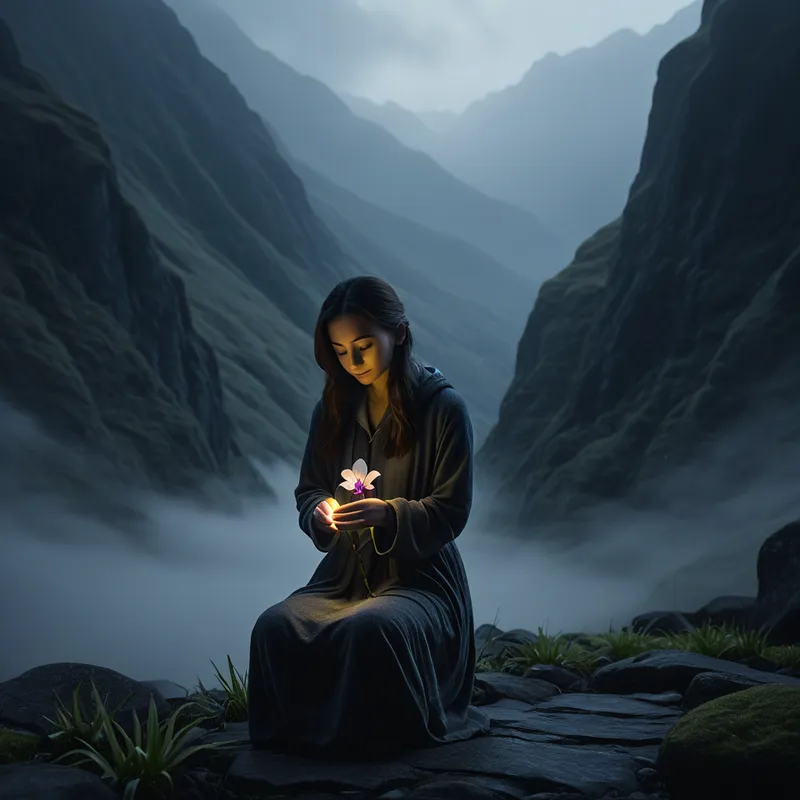
She fell like a single petal, descending through layers of cloud and memory, until she came to rest in a forgotten valley, a place of shadows and silence. The earth was hard, the light scarce. Here, the celestial rules meant nothing. The wind was sharp, the soil indifferent. At first, her spirit dimmed, wrapped in the grey cloak of loneliness. She wandered, a ghost of her former self, her once-radiant form fading into the landscape.
But in the deep quiet, away from the judging eyes, something began to stir. The very austerity of the valley became her teacher. She observed the moss clinging to the north side of rocks, the way water patiently carved its path. She felt not with her celestial senses, but with a new, raw awareness born of the earth itself. One evening, as a cold mist settled, a profound weariness overcame her. It was not a despairing fatigue, but the exhaustion that comes at the end of resistance. She knelt on the stony ground, and from her fingertips, from her breath mingling with the damp air, something new emerged.
It was not a grand tree or a blazing flower. It was a slender stem, with leaves of deep green humility. And from it, a bloom—small, intricate, of a color between twilight and dawn. It held a fragrance so subtle one had to be still to perceive it; a scent that spoke of hidden depths, of beauty that does not shout but invites. It was the first orchid. In that moment, Lan did not simply find a home; she became the principle she embodied. The exile was complete, and in its completion, the true work began.
Cultural Origins & Context
The figure of Lan is woven from threads of Daoist philosophy, scholar-official culture, and the deep symbolic language of penjing and nature appreciation. She is less a singular deity from a canonical text like the Shan Hai Jing and more a personification of an ideal that crystallized over centuries. Her story is the myth of the orchid itself, elevated by Confucian scholars who saw in the plant a mirror for the junzi—the noble person.
The orchid blooms in secluded valleys, its fragrance unnoticed unless sought. This became the perfect metaphor for the virtuous individual who cultivates integrity (de) regardless of recognition or social position. The myth was passed down not in epic poems recited by bards, but in ink paintings, on porcelain, and in the quiet conversations of literati in their garden studios. It was a myth for the refined, the contemplative, and the politically marginalized—a coded narrative of maintaining one's essence in times of corruption or exile. Its societal function was to provide a spiritual and aesthetic template for resilience, affirming that true worth is internal and often flourishes most authentically away from the center of power.
Symbolic Architecture
Psychologically, the myth of Lan is a profound map of individuation through exile. The celestial court represents the collective consciousness—the rigid, often oppressive norms of society, family, or the ego's own perfectionistic standards. Lan’s "crime" is her innate selfhood, which the collective cannot tolerate because it challenges its homogeneity.
Exile is not merely a punishment; it is the necessary descent of the spirit into the terrain of the soul, where the collective rules do not apply.
The forgotten valley is the unconscious, the shadowlands. It is not a place of punishment, but of incubation. The initial fading represents the ego's dissolution, the painful but necessary stripping away of old identities and external validations. The blooming of the orchid is the emergence of the true Self—not the celestial persona, but an authentic integration born from engagement with the darkness and the "soil" of one's own unexplored depths. The subtle fragrance symbolizes the influence of the individuated person: it does not dominate or coerce, but transforms the atmosphere quietly, affecting only those who are receptive and present.

The Dreamer's Resonance
When this myth stirs in the modern dreamer, it often manifests as dreams of isolation in beautiful, wild places. You may dream of being in a deep forest, a canyon, or an empty, elegant house. There is a poignant loneliness, but it is frequently coupled with a strange sense of rightness or potential. You might find a delicate, glowing plant growing in an unlikely place—on your windowsill, in the center of a vacant lot, or even in the palm of your hand.
Somatically, this dream pattern correlates with a process of withdrawal and consolidation. The psyche is initiating a necessary retreat from the exhausting demands of the "celestial court" of your daily life—be it a job, a social circle, or internal pressures. The feeling of fading or being unseen is not a depression to be pathologized, but a somatic signal that energy is being pulled inward for a crucial act of internal re-formation. The dream is an affirmation that this retreat is sacred ground. The appearance of the orchid, however small, is the dream's way of showing you the first tender evidence of a new quality of being trying to root itself in your life.
Alchemical Translation
The alchemical journey modeled by Lan is the opus contra naturam in its most refined form: the work against the collective nature, in service of one's own essential nature. The process begins with the separatio—the painful but fateful exile from familiar structures. This is followed by the nigredo, the blackening: the loneliness, the confusion, the feeling of being lost in the valley of the soul.
The transmutation occurs not in the fight to return, but in the surrender to the conditions of the descent. The base material—the experience of exile itself—is the prima materia.
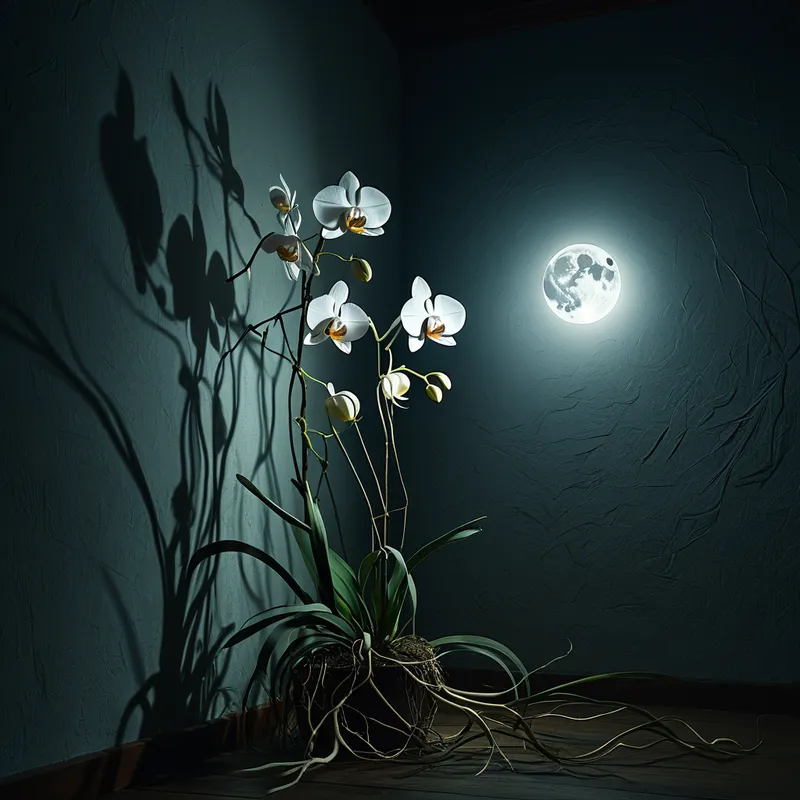
The key operation is solutio—dissolution. Lan does not build a fortress; she allows herself to be permeated by the valley's conditions (the mist, the stone, the silence). From this dissolution comes coagulatio: a new form coalesces, not from willpower, but from essence interacting with environment. The orchid is the lapis philosophorum, the philosopher's stone of this myth. It represents the achieved individuation: a resilient, beautiful, and authentic life-expression that is perfectly adapted to its unique niche. For the modern individual, the myth teaches that our deepest wounds (exile, rejection, feeling out of place) are the very cracks through which our most authentic self can emerge and bloom. The goal is not to reclaim a lost heavenly status, but to become fully, fragrantly earthly—to find the celestial within the terrestrial.
Associated Symbols
Explore related symbols from the CaleaDream lexicon: