Lake Dragons Myth Meaning & Symbolism
A tale of a king, a dragon, and a lake's hidden treasure, revealing the price of sovereignty and the soul's contract with the land.
The Tale of the Lake Dragon
Listen, and let the mist of the old world gather. In the days when the land was a living breath and kingship was a weight, not a prize, there was a king whose realm was bounded by water. His fortress stood upon a hill, but his true throne was the dark, glassy eye of the loch that lay in the valley below—a loch so deep, they said, it had no bottom, only a door to the Annwn.
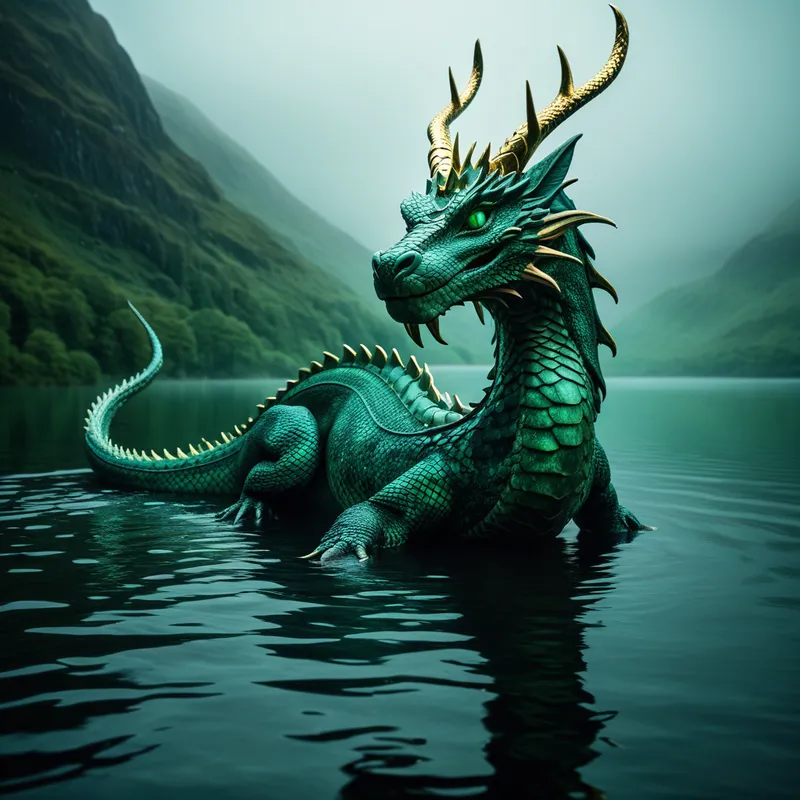
The people of the land were prosperous, but a quiet dread hung in the air like peat smoke. For in the heart of the loch dwelled the Lake Dragon. It was not a beast of mindless fury, but an ancient one, a spirit of the place itself. Its long, serpentine body was the colour of tarnished bronze and deep water weed. When it stirred, the loch would boil without wind, and a sound like a great, submerged bell would echo against the hills. It was the guardian. And it guarded a treasure: a torque of red gold, a crown of ancient power, the very symbol of true sovereignty over that land.
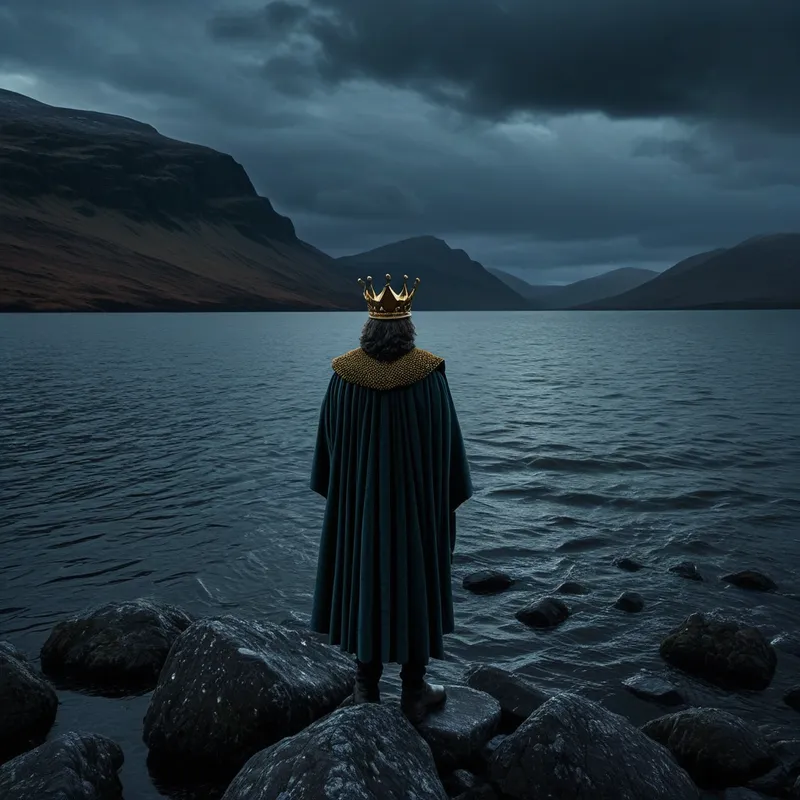
The king upon the hill wore a crown of silver, but he felt its lightness. He ruled by bloodline, but not by right. The true right, the old stories whispered, was held in the deep, given by the dragon to a king who could meet its gaze and not falter. One autumn evening, as the sun bled into the water, the king walked down to the rocky shore. He shed his royal cloak, his silver circlet, and stood bare before the abyss.
"Guardian of the Depths!" he called, his voice small against the water. "I seek the right to rule."
The water did not boil, but grew preternaturally still. Then, the surface parted, and the head of the Lake Dragon rose. Its eye was a pool of molten amber, holding the memory of mountains being born. It spoke not with a tongue, but directly into the king's mind, a voice of stone and deep current.
"The right is not taken. It is earned. It is a covenant. The treasure you seek is also a chain. To wear it is to bind your soul to the soul of this land. Its health will be your health. Its suffering, your pain. Its death, your end. Do you understand the price?"
The king felt the immensity of the choice—the petty worries of court falling away, replaced by the raw, terrifying responsibility of true connection. This was not about power over, but unity with. He thought of the blighted field, the sickly child in the village, the poisoned stream. He knew if he said yes, their pain would become his own flesh.
"I understand," he said, his voice steady now.
"Then prove it," intoned the dragon. "Not with spear or sword, but with sacrifice. Enter my realm. Relinquish your breath, your earthly form, and trust the water to remake you. Only what is truly yours—your essence, stripped of all pretense—will be judged worthy to bear the weight of the gold."
The king did not hesitate. He stepped from the rock into the icy, black water. He sank, not struggling, letting the lake claim him. The darkness embraced him, and in that profound surrender, he felt not an end, but an unfolding. Visions of the land's past and possible future flooded him—its joys, its wounds. He felt the root of every oak, the course of every hidden spring.
When he awoke, gasping on the shore at dawn, he was changed. Beside him lay the dragon's treasure: the heavy, beautiful torque of red gold. And in the centre of the loch, the great shape of the guardian settled back into the silt, its duty fulfilled, its covenant sealed. The king placed the torque around his neck. It was not light. It was the weight of a world. And he ruled, from that day, with a wisdom that flowed from the deep water and the deep self.
Cultural Origins & Context
The motif of the Lake Dragon or water serpent is woven through the insular Celtic traditions of Ireland, Wales, and Scotland, often surviving in local folklore attached to specific lakes, lochs, and rivers. These are not the fire-breathing drakes of later medieval romance, but chthonic, liminal beings. They belong to the Annwn, the Otherworld, which was not a distant heaven but a parallel reality intimately connected to ours, often accessed through bodies of water, hills, or mist.
These tales were not preserved in a single, canonical text but were carried in the oral tradition by bards and seanchaí (storytellers). Their function was multifaceted: to explain the mysterious power of a particular landscape, to encode a philosophy of sacred kingship, and to serve as a moral and psychological compass. The dragon was the genius loci, the spirit of the place. The king's encounter was less a heroic monster-slaying and more a ritual of integration, reflecting the Celtic concept that a rightful ruler must undergo a symbolic marriage to the sovereignty goddess of the land, often mediated by such otherworldly beings. The myth taught that legitimate authority comes from a sacred contract with the land and its unseen forces, not mere heredity or force.
Symbolic Architecture
At its core, this myth is a profound map of the psyche. The Lake Dragon represents the unconscious itself—vast, ancient, containing immense power (the treasure) but also potential terror. It is not evil, but other, operating by its own deep, non-human logic. The loch is the threshold between the conscious ego (the hilltop fortress) and the unconscious depths.
The treasure—the torque or crown—symbolizes true Sovereignty. Psychologically, this is not power over others, but self-possession, integrity, and the realized authority of the authentic Self. It is the latent wholeness we guard against, often out of fear of its demands.
The dragon does not hoard the treasure to keep it from you, but to keep it for you, until you are ready to bear its weight.
The king's journey is one of ego-death and rebirth. He must strip away his borrowed identities (the silver crown) and consciously choose the terrifying responsibility of wholeness. His "sacrifice" is the surrender of the ego's illusion of control. He does not fight the dragon; he submits to its realm, allowing the unconscious to dissolve and reconstitute him. This is the critical turning point: transformation occurs not through conquest, but through sacred surrender and trust in a process larger than oneself.
The Dreamer's Resonance
When this mythic pattern stirs in the modern dreamer, it often manifests as dreams of deep, dark water—lakes, oceans, swimming pools at night. There is a presence in the water: a large, unseen creature, a serpentine shape, or simply a profound, intelligent watchfulness. There may be a quest for a lost object of great value at the bottom.
Somatically, this can correlate with feelings of being "in over one's head" in life, or a deep, intuitive pull toward a major life transition that feels both frightening and destined. Psychologically, it signals a call from the Self. The dream-ego (the modern "king") is being summoned to the shore of its own depth. The anxiety is not about external monsters, but about the impending death of an old way of being and the daunting responsibility of a more authentic life. The dream is an invitation to stop skirting the shoreline of one's potential and to willingly engage with the deep, transformative powers of the psyche.

Alchemical Translation
The alchemical process mirrored here is solutio—dissolution. The king's descent into the lake is the ego's dissolution in the aqua permanens, the perennial waters of the unconscious. This is not destruction, but the necessary breaking down of rigid structures to allow for recombination at a higher level.
For the modern individual pursuing individuation, the myth models a crucial sequence:
- Acknowledging the Guardian: Recognizing that the fear, resistance, or depression that blocks our path to greater wholeness is not just an obstacle, but a guardian. It asks, "Are you sure you want this? Do you understand the price?" The price is the end of unconscious living.
- The Sacred Surrender: This is the act of therapy, meditation, creative immersion, or any sincere engagement where we stop trying to "fix" ourselves from the outside and instead allow the unconscious process to work on us. We step into the water.
- The Covenant: Emerging with the "treasure" means integrating this new consciousness. The weight of the gold is the enduring responsibility to live from that deeper authenticity, to honour the covenant between the conscious self and the vast, guiding Self. The dragon remains in the loch—the unconscious is always there—but now in a relationship of mutual respect, not fear.
Individuation is the process of becoming the rightful sovereign of your own inner landscape, having made peace with the dragon in the lake.
The myth concludes not with the dragon's corpse, but with its return to the depths, guardian and king in eternal relationship. So too, in a mature psyche, the conscious mind does not eradicate the unconscious but learns to rule in dialogue with it, bearing the beautiful, heavy torque of a self that is finally, truly, its own.
Associated Symbols
Explore related symbols from the CaleaDream lexicon: