La Llorona Myth Meaning & Symbolism
A spectral woman eternally weeps by rivers, searching for her drowned children, embodying inconsolable grief and the haunting consequences of a single, tragic choice.
The Tale of La Llorona
Listen. The night holds its breath by the river. The air is thick with the scent of damp earth and blooming dama de noche. This is the hour when the veil between the living world and the world of memory is thinnest. This is when she walks.
Her name was María, they say. A woman of such beauty that the very moon envied her. Her hair was a river of obsidian, her eyes deep pools that held the warmth of the sun. She lived in a humble village where life flowed as steadily as the great river beside it. Her heart, however, yearned for a different current. She dreamed of a life of ease, of silks and silver, a life far from the dust of the campo.
Her dreams took the form of a handsome caballero, a man of wealth and fine horses who swept her off her feet with promises whispered under the jacaranda trees. For a time, she knew bliss. She bore him two beautiful children, and in their laughter, she found a joy purer than any gold. But the caballero’s heart was a fickle thing, drawn to novelty and status. As María’s beauty matured into the weary grace of motherhood, his attentions cooled. The whispers in the village grew louder: he was to marry a woman of his own station, a lady from the city with a dowry of land and lineage.
The day the news reached her, the world shattered. She saw him on the plaza, bowing low to his new, elegant fiancée. The love in her heart curdled into a black, boiling rage—a rage not just at him, but at the children who now bound her to a life of poverty and scorn, at the dreams that had turned to ash in her mouth. Madness, cold and absolute, descended upon her.
That night, under a moon that hid its face behind clouds, she took her children to the riverbank. Their small hands trusted in hers. With a cry that tore from the very depths of her soul—a sound that was part scream, part prayer, part curse—she did the unthinkable. She thrust them into the dark, hungry waters. The moment their small forms were swallowed by the current, the madness broke. Clarity returned, sharp and cruel as broken glass. She plunged into the river, screaming their names, clawing at the water, but the river gave up nothing but silence.
They found her at dawn, wandering the banks, her fine dress torn and soaked, her mind utterly unmoored. She would not eat, would not sleep. She only wept and called for her niños. Within days, her grief extinguished her life. But her story did not end there.
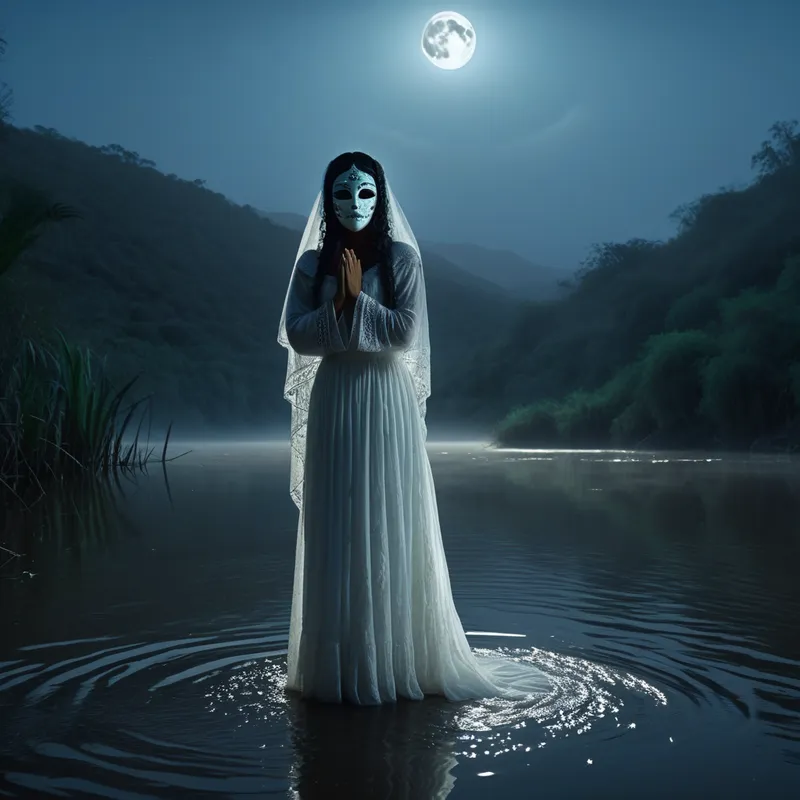
Now, when the night is deep and the wind carries the scent of the river, you can hear her. A low, aching sob that seems to come from the water itself. She is La Llorona, forever clad in a spectral white gown, forever walking the banks of every river, creek, and canal. She weeps for her lost children, and in her desperate search, she is said to mistake other children for her own, drawing them toward the water’s edge with her sorrowful cries. Parents warn their little ones: stay away from the water at night, or La Llorona may take you, trying to fill the bottomless void in her arms.
Cultural Origins & Context
The wail of La Llorona is not a single story but a chorus of echoes from a deep cultural past. Her roots are tangled in the very soil of Mexico, a fusion of pre-Hispanic mourning goddesses and colonial-era trauma. Scholars hear in her cries the voice of Cihuacóatl, a Mesoamerican deity who was heard wailing at night, foretelling war and the loss of children. They see the tragic figure of La Malinche, the indigenous interpreter and consort to Cortés, whose historical role made her a symbol of both betrayal and the painful birth of a new, mixed-race people.
The myth as commonly told today solidified during the colonial period. It was passed down not in books, but in the oral tradition—by grandmothers at the hearth, mothers tucking children into bed, and workers sharing stories in the fields. Its primary societal function was, and remains, multifaceted: a cautionary tale to keep children safe from dangerous waters, a narrative container for the profound grief of maternal loss, and a folk explanation for the unsettling, lonely sounds of the night. It is a story told in whispers, a shared cultural shiver that binds communities together in a collective, respectful fear. It gives a name and a face to the formless anxieties of parenthood and the haunting presence of historical sorrow.
Symbolic Architecture
Beneath the ghost story lies a profound symbolic architecture. La Llorona is not merely a spooky specter; she is the embodied shadow of the divine mother. She represents the archetype of motherhood inverted by unbearable pain—the life-giver become the life-taker, not out of malice, but from a psyche shattered by betrayal and despair.
The river is not just a place of death, but the relentless flow of time, memory, and consequence into which we cast our most irreversible acts.
Her white gown symbolizes both her lost innocence and her eternal state of mourning, a wedding shroud for a life that never was. The children represent not only her literal offspring but also her future, her hopes, her own inner innocence, which she destroys in a fit of passionate reaction to abandonment. Her eternal weeping is the psyche’s refusal to let trauma be buried; it insists on being heard, generation after generation, as a warning and a testament.
She symbolizes the ultimate psychological exile: to be forever separated from what you love most by your own hand. She is the part of the soul that makes a catastrophic, irreversible decision in a moment of blinding emotional pain and is then condemned to wander the liminal shores of consciousness, reliving that moment for eternity.
The Dreamer's Resonance
When La Llorona enters modern dreams, she is rarely a literal ghost. She appears as the dreamer’s own unprocessed, wailing grief. To dream of hearing her cry is to sense a deep, somatic sorrow within oneself that has not found a voice—perhaps grief for a lost relationship, a abandoned creative project (a "brainchild"), or a version of oneself that was "drowned" by life’s circumstances or one’s own choices.
To dream of being La Llorona, searching desperately by a river, indicates a profound psychological process of confronting one’s own feelings of betrayal and catastrophic failure. The dreamer may be grappling with a decision they regret, one that seemingly destroyed something precious. The river in the dream is the flow of the unconscious, and the search is the soul’s attempt to retrieve what was lost to its own depths—not to undo the act, but to reclaim responsibility and integrate the memory. The dream is a somber, necessary navigation of guilt and the longing for redemption.

Alchemical Translation
The myth of La Llorona models a harrowing, incomplete alchemy. It shows the nigredo—the blackening, the descent into madness and utter despair—without the promise of a clear redemption. For the modern individual, her story is not a map to follow, but a warning signpost on the path of individuation.
The true alchemical work begins not when we stop weeping, but when we dare to ask what our eternal weeping is trying to water.
The first step of transmutation is to stop running from the wail. To individuate is to turn toward our personal "La Llorona"—that part of us haunted by a past mistake, frozen in grief, or defined by a moment of weakness. We must listen to her cry without identifying with it completely; we must acknowledge the sorrow without becoming the eternal mourner.
The second step is to re-contextualize the river. In the myth, the river is only a place of loss. In the alchemical process, we must learn to see it also as a place of reflection and fluidity. We cannot pull our lost "children" from the same waters of reaction and pain into which they were cast. We must find a new relationship to the flow of our life—one of conscious choice rather than desperate action.
Finally, the work is to give the ghost a different task. La Llorona’s curse is her endless, fruitless search. The psychic transmutation occurs when we redirect that relentless energy. The search for what was lost externally becomes an inward journey of re-parenting the wounded self that felt so abandoned and capable of such destruction. We cannot bring the past back to life, but we can, through conscious integration, stop the eternal weeping and allow the specter to finally lay her burden down, not by finding her children, but by realizing she must mother the forsaken soul within. Her white gown can then transform from a shroud into a garment of clarified, hard-won wisdom. The myth ends in a loop of sorrow, but the individual soul, heeding its warning, can write a different ending.
Associated Symbols
Explore related symbols from the CaleaDream lexicon: