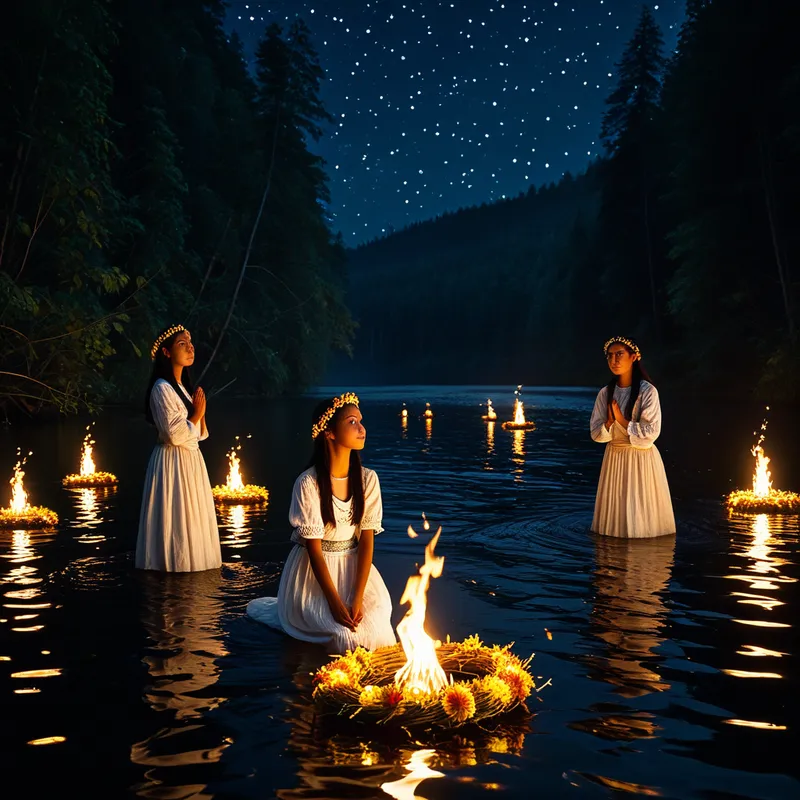
Kupalo Night Festival Myth Meaning & Symbolism
A midsummer myth of twin deities, forbidden love, and a fiery sacrifice that transforms grief into the flowering herbs of healing and remembrance.
The Tale of Kupalo Night Festival
Listen, and let the veil between the worlds grow thin. It is the night when the sun, Dazhbog, pauses at the peak of his strength, and the world holds its breath in the luminous dusk. This is Kupalo Night, the shortest night, yet the one brimming with the deepest magic.
In the time when gods walked closer to the earth, there lived a sister and brother, born of the same breath of creation. She was Kupalnitsa, whose spirit was the clear spring, the morning dew, the gentle rain that coaxed life from the soil. Her hair was the color of ripe wheat, and her laughter made flowers bloom. He was Kupalo, whose essence was the summer sun, the warmth on the skin, the wild joy of the dance. His smile could light the darkest forest path.
They were inseparable, twin flames of life’s vigor. Yet, a terrible law, older than the gods themselves, hung over them: a law of Prav. Brother must not look upon sister with a lover’s eyes. Their love, pure in its sibling form, was a force of creation, but if it twisted into earthly passion, it would become a force of terrible, unraveling chaos.
But on this night, when the boundaries of Yav and Nav blurred, fate played its trick. As the people lit the great bonfires and began their joyous leaps, singing to ward off the spirits of gloom, Kupalo and Kupalnitsa joined the circle. The drumming entered their blood. The smoke and the scent of blooming fern filled their heads. In the dizzying whirl, their hands touched, and in that touch, the innocent bond shimmered and transformed. He looked at her, not as a sister, but as a man beholding the essence of life itself. She met his gaze, and in it, saw not a brother, but the very fire of existence.
The law was broken. The world shuddered. The joyous festival air cracked with a silent thunder of transgression. To restore balance, a price had to be paid—a sacrifice to cleanse the profaned sacred bond.
Guided by the mournful whispers of the forest spirits, the Rusalkas, Kupalo was led to a lonely riverbank. There, a grim effigy, woven from last year’s straw and wildflowers, awaited him. It wore his face. Understanding dawned upon him, not with fear, but with a sorrowful acceptance. He was the sun at its zenith; what follows the peak but the descent? For life to continue, the old form must yield.
The people, their joy now tempered with solemnity, lifted the effigy. They carried it not to the water, but to the purifying heart of the festival bonfire. With a chorus of ancient songs, they committed the figure of Kupalo to the flames. The straw man was consumed in a roaring blaze, his light returning to the sun, his form to ash.
Kupalnitsa watched, her tears becoming the river’s flow. Her grief was so profound it could have drowned the world. But as the last ember of the effigy died, she did not throw herself into the waves. Instead, she walked into the dark forest, her tears watering the roots of the oaks and the ferns. Where her tears fell, new, unknown herbs sprang forth—bitter herbs of remembrance, sweet herbs of healing, herbs that could reveal truth or bring forgetfulness. She did not die; she transmuted. Her love, her loss, her very being, became the green, growing pharmacy of the earth, a different kind of fertility born from sacrifice.
And so, every year on this night, the sun-Kupalo is ritually burned, and the water-Kupalnitsa weeps her healing gifts into the world. Their forbidden union is forever postponed, yet eternally commemorated in the leap over fire and the flow of water, in the search for a flower that does not exist, and in the bittersweet herbs that do.
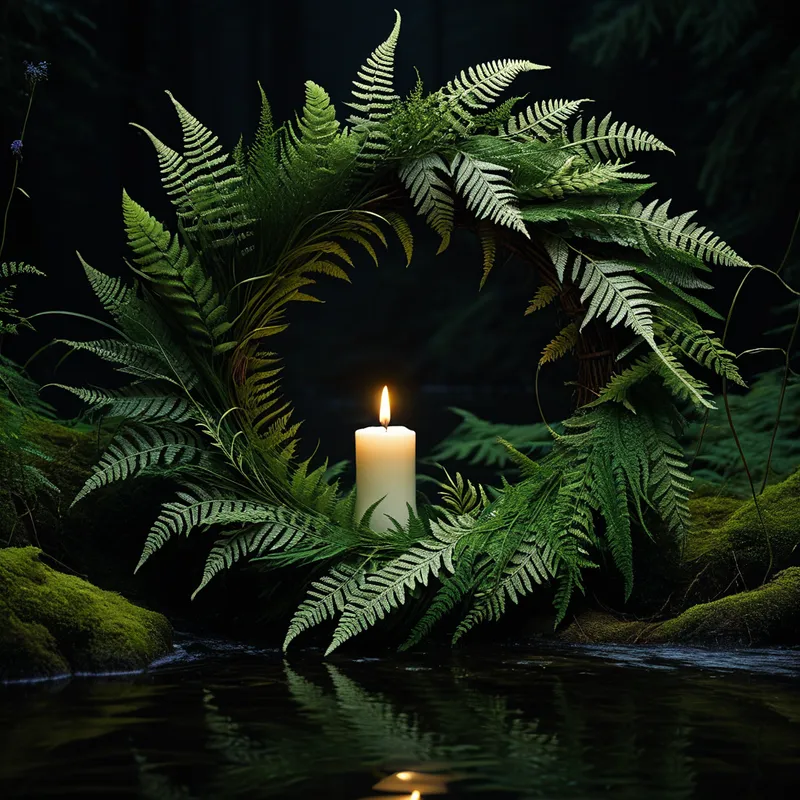
Cultural Origins & Context
The myth of Kupalo Night is not a single, canonical scripture, but a living tapestry woven from pre-Christian Slavic agrarian and animistic traditions. It was a folk cosmology enacted, not read. The festival, coinciding with the summer solstice, was a critical hinge in the yearly cycle, a moment of maximum solar power and potent earthly fertility. The telling was in the doing: the communities who gathered to build the bonfires, weave the wreaths, and sing the cyclical songs were the bards.
The narrative was passed down through ritual practice and oral folklore, often fragmented into songs, charms, and prohibitions associated with the night’s magic. It served multiple societal functions: it explained the necessary decline of the sun after the solstice, it provided a sacred framework for courtship rituals (where real-world brothers and sisters were symbolically separated), and it channeled the powerful, sometimes chaotic, energies of young love and fertility into a structured, community-sanctioned event. The myth justified the rituals, and the rituals embodied the myth, creating a feedback loop that reinforced social order, agricultural hopes, and a profound connection to the natural world’s turning.
Symbolic Architecture
At its core, the myth is a profound allegory of necessary separation and sacred transformation. The twin deities represent complementary cosmic principles: the active, fiery, masculine principle of Kupalo and the receptive, fluid, feminine principle of Kupalnitsa. Their initial unity is the undifferentiated potential of life.
The first law of consciousness is distinction. To know the self, one must first perceive what the self is not.
The "forbidden love" is not merely a taboo but symbolizes the danger of a consciousness collapsing back into its own source, a psychic incest where differentiation fails. The fiery sacrifice of the straw effigy is not a punishment, but an alchemical solve—the dissolution of the identified form (the solar ego at its peak) so that its essence may be freed. Kupalnitsa’s transformation into healing herbs is the coagula—the re-formation of that essence into a new, nourishing, and accessible form. The Fern Flower, forever sought but never found, represents the unattainable ideal of perfect, unchanging union—a divine state that humans can only ritualistically approach but never permanently grasp.

The Dreamer's Resonance
When this myth stirs in the modern dreamer, it often signals a profound crossroads of identity and relationship. To dream of a joyous festival that suddenly turns solemn, of a twin or double being consumed by flames, or of weeping tears that become growing plants, is to touch this archetypal pattern.
Somatically, one might feel the heat of the bonfire (a rush of energy or anxiety) juxtaposed with the cool flow of a river (a deep sadness or release). Psychologically, the dreamer is navigating the necessary "death" of an old identity or a fused relationship—perhaps a career peak that must end, a dependent bond with a family member that must be healthily severed, or an idealized self-image that must be sacrificed. The grief felt is Kupalnitsa’s grief, the raw material of future healing. The dream is the psyche’s ritual space, staging this sacred drama to initiate the transformation from a fused state to a differentiated, generative one.

Alchemical Translation
For the individual on the path of individuation, the Kupalo myth models the painful but essential process of sacrificing the innocent union. We all harbor inner "twins"—perhaps the fused identity of child-and-parent, or the unconscious identification with a social role or a perfect ideal.
The peak of the sun is also the beginning of its journey into the underworld. To cling to the zenith is to deny the soul its full orbit.
The "Kupalo" within must be willingly offered to the fire of conscious awareness. This is the sacrifice of the brilliant, but limited, conscious attitude that has served its time. The "Kupalnitsa" within—the feeling, nurturing, connective function—must then endure the grief of this separation. She does not follow him into death (neurotic collapse) but allows her sorrow to fertilize the unconscious. The outcome is not a reunion with the lost twin, but the birth of something new: the "healing herbs." These are the integrated insights, the creative gifts, the compassionate wisdom that can only grow from the compost of our surrendered attachments. The modern festival is the conscious engagement with our own cycles—honoring our peaks, ritually releasing what must end, and tending the new growth that emerges from the fertile dark.
Associated Symbols
Explore related symbols from the CaleaDream lexicon:
- Fire — The purifying, sacrificial blaze of the Kupalo bonfire, representing the conscious will to transform and release an old identity or attachment.
- Water — The flowing rivers and tears of Kupalnitsa, symbolizing the deep emotional current, the unconscious, and the medium of healing and transformation.
- Flower — The elusive Fern Flower, representing the quest for perfect union, enlightenment, or an idealized love that drives the ritual search on the sacred night.
- Forest — The liminal, magical space where the festival occurs and Kupalnitsa transforms, representing the untamed psyche, the unconscious, and the realm of potential.
- Sacrifice — The core act of the myth: the willing offering of the straw effigy (the old form) to restore balance and enable new growth.
- Ritual — The entire structure of the festival—leaping fires, floating wreaths, singing—as a container for channeling powerful archetypal energies safely.
- Rebirth — The ultimate promise of the myth: not a literal resurrection, but the transformation of grief into healing herbs, of sacrifice into new forms of life.
- Love — The forbidden, transformative force that begins as innocent unity, becomes a catalyst for chaos, and is ultimately transmuted into generative, healing power.
- Night — The specific, potent Kupalo Night, the shortest night, representing a threshold time when boundaries dissolve and profound inner work becomes possible.
- Festival — The communal celebration and enactment of the myth, showing how individual psychic processes are mirrored and supported by collective cultural containers.
- Circle — The dancing circle around the fire, the floating wreaths, and the cyclical nature of the solstice, representing wholeness, eternity, and the completion of a cycle.