Kundalini Myth Meaning & Symbolism
The story of a divine serpent coiled at the base of the spine, whose awakening initiates a fiery ascent through the body, culminating in cosmic union and enlightenment.
The Tale of Kundalini
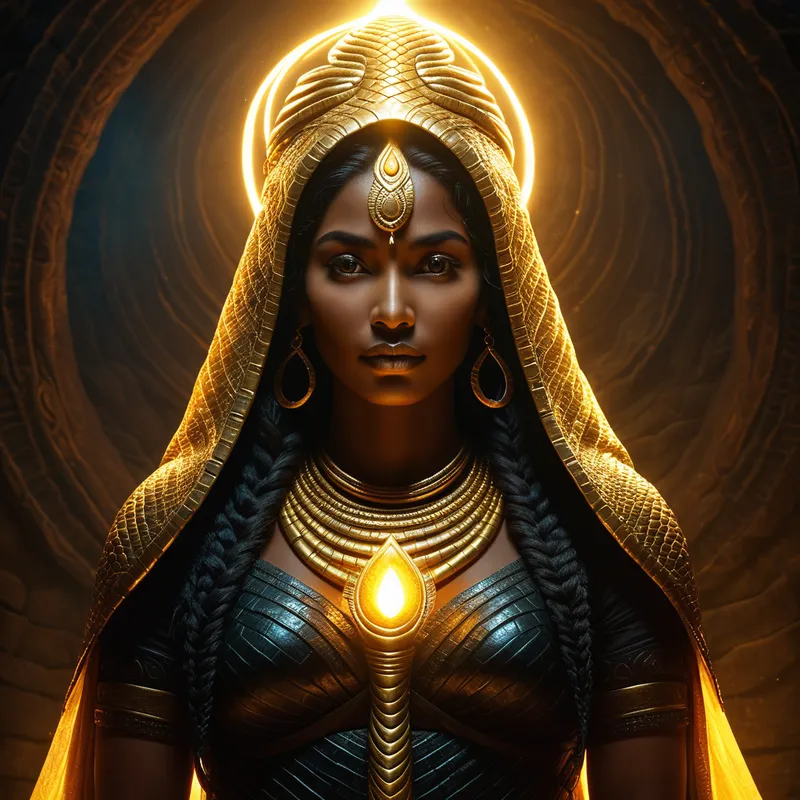
Listen. In the deepest, most silent cavern of the human form, where the root of being touches the dark earth of matter, she sleeps. She is Kundalini, the coiled one. Wrapped three and a half times around the lingam at the Muladhara Chakra, she is a sleeping goddess, a serpent of infinite potential dreaming of ascent.
Her slumber is not empty. It is a gathering, a condensation of all the universe’s unmanifest power into a single, spiraling point. The air in that cavern is thick with the perfume of latent creation and the deep, resonant hum of Aum. She is Shakti herself, the dynamic feminine force of the cosmos, waiting for the call of her eternal consort, Shiva, who resides far above in the crown of the head, in the thousand-petaled lotus of Sahasrara. Between them stretches the sacred axis, the Sushumna Nadi, a pathway of purest moonlight, flanked by the solar and lunar rivers of Pingala and Ida.
The call comes not from sound, but from silence. It is the fierce, unwavering tapas of the yogi, the heat of discipline born from longing. It is the sacred syllable, the mantra that vibrates in the very marrow of the bone. The call pierces the deep dream of the serpent. She stirs. A tremor runs through her luminous coils. She lifts her hooded head, and her eyes open—twin suns in the subterranean dark.
With a hiss that is the sound of all beginnings, she uncoils. She enters the Sushumna, the royal road. Her ascent is fire and nectar. It is a river of lightning climbing a ladder of lotus blossoms. As she rises, she encounters the gateways, the chakras, each a world unto itself, each guarded by deities and elemental powers. At the sacrum, the water element churns. At the navel, a blazing sun of personal power. At the heart, an emerald expanse of unconditional love. At the throat, the space of pure truth. At the brow, the command of inner vision. At each station, if the passage is clear, she purifies and energizes, burning the dross of ignorance, awakening dormant faculties.
The journey is tumultuous, a divine storm within the microcosm. The body may tremble with unknown currents. The mind may be flooded with visions of light and shadow. This is the sacred crisis, the inner sacrifice. Finally, she reaches the crown. Here, in the palace of pure consciousness, the sleeping Shiva awakens. The serpent goddess, the dynamic Shakti, meets her silent lord. In that moment of ultimate union, a flash of lightning becomes a steady dawn. The individual drop of consciousness merges with the ocean. The coiled potential becomes uncoiled reality. The seeker and the sought vanish. What remains is Moksha—a silence that sings, a void that is utterly full. The serpent has returned home, and in doing so, has revealed that home was everywhere, and always.

Cultural Origins & Context
The myth of Kundalini is not a single, codified story from a particular epic, but a living, experiential map woven into the fabric of Sanatana Dharma. Its earliest seeds are found in the esoteric dialogues of the Upanishads, which speak of nadis (energy channels) and the inner fire. It was systematically elaborated in the medieval texts of Tantra and Yoga, particularly within the Kashmir Shaivism tradition, which poetically frames the entire cosmos as the play of Shiva and Shakti.
This knowledge was traditionally passed down through a guru-disciple (guru-shishya) lineage, often in secret or through highly symbolic language to protect the unready from its potent force. Its societal function was transcendent: it provided a sophisticated psycho-spiritual technology for achieving liberation within one lifetime. It democratized the divine, asserting that the macrocosm of the gods and the microcosm of the human body were identical. The myth was not just to be heard, but to be enacted within the temple of one’s own nervous system, making every sincere practitioner a potential hero of this most intimate journey.
Symbolic Architecture
The myth is a profound symbolic blueprint for the evolution of consciousness. Every element is a mirror to an inner reality.
The sleeping serpent is the dormant totality of our psychic and spiritual potential—the unconscious in its most creative, divine aspect, not as a repository of trauma, but as a reservoir of Shakti, the world-creating energy.
The Sushumna represents the integrated spine of consciousness itself, the midline where opposites unite. The coiling three and a half times signifies the cycles of time, the three states of consciousness (waking, dreaming, deep sleep), and the half representing the transcendent fourth state, Turiya. The ascent through the chakras is the sequential maturation of the human being: from survival instincts (Muladhara) to emotional and creative power (Svadhishthana), to will and identity (Manipura), to love and compassion (Anahata), to authentic expression (Vishuddha), to intuition and insight (Ajna), and finally to unitive consciousness (Sahasrara).
The union of Kundalini-Shakti and Shiva is the ultimate alchemical marriage within the psyche. It is the reconciliation of the dynamic, ever-changing world of form (Shakti) with the timeless, witnessing awareness (Shiva). This resolves the fundamental human split between being and doing, spirit and matter, the individual and the cosmos.
The Dreamer's Resonance
When this myth stirs in the modern dreamer, it often signals a profound somatic and psychological initiation. One may dream of serpents not as threats, but as luminous, intelligent guides. Dreams of climbing immense interior staircases, ladders of light, or spiraling towers directly mirror the ascent through the Sushumna. Explosions of light in the head, sensations of energy moving up the spine, or dreams of blooming lotuses are classic somatic translations of the chakras activating.
Psychologically, this dream pattern emerges during periods of intense transformation, often precipitated by crisis, deep therapy, or spiritual practice. The "rising" energy is the psyche’s own transformative power mobilizing to break through calcified patterns, repressed trauma (the "blockages" in the chakras), and limited self-concepts. The tumultuous phase of the ascent can manifest in dreams as purgatorial landscapes, chaotic storms, or encounters with shadowy figures—the psychic "dross" being burned away. The culmination in a dream of radiant, peaceful union, vast silence, or infinite space marks a moment of profound psychic integration and expanded awareness.
Alchemical Translation
For the modern individual navigating the path of individuation, the Kundalini myth is a master guide for psychic transmutation. It reframes psychological growth not as merely adjusting to the outer world, but as a heroic, inward journey of awakening a divine force.
The process begins with the courageous turn inward—the "tapas" or heat of self-confrontation and disciplined attention that stirs the sleeping depths of the unconscious.
The "ascent" is the slow, often non-linear process of bringing unconscious contents—complexes, talents, archaic patterns—into the light of consciousness. Each chakra represents a layer of the personality to be integrated: our relationship with the body and security, with desire and creativity, with power and will, with love and connection, with truth and authenticity, with vision and meaning. A "block" is a psychological complex; its "piercing" is the hard-won insight that releases bound energy.
The final union is the achievement of the Self, Jung’s term for the central, unifying archetype of the psyche. It is the experience where the ego, having navigated the full spectrum of its own being, no longer feels separate from the source. The energy that was coiled in identification with limited patterns (the serpent) is now fully available for conscious, creative life (the awakened Shakti in union with Shiva). The myth teaches that enlightenment is not an escape from humanity, but its ultimate fulfillment—a state where one’s individual life becomes a clear channel for the transformative, world-manifesting power of the divine.
Associated Symbols
Explore related symbols from the CaleaDream lexicon: