
Kuchisake-onna Myth Meaning & Symbolism
A vengeful spirit, her beauty mutilated, haunts the night asking if she is pretty, forcing a confrontation with societal masks and the wounded self.
The Tale of Kuchisake-onna
The city breathes in the twilight, a creature of concrete and electric light. But as the last train sighs into the distance and the shop shutters rattle down, an older breath stirs in the narrow spaces between buildings. This is the hour when the pavement still holds the day’s warmth but the air carries the chill of coming night. This is her hour.
She walks the backstreets and school routes, a woman in a long coat, her face hidden behind a white surgical mask. Only her eyes are visible, dark and depthless pools above the sterile cloth. And she is always walking, a slow, deliberate pace that seems to measure the distance between one lonely soul and the next. She seeks the solitary walker, the student running late, the salaryman taking a shortcut home.
When she finds you, she will fall into step beside you, her presence an sudden, icy weight in the air. Her voice, when it comes, is soft, almost polite, muffled by the mask.
“Am I pretty?”
The question hangs in the damp air. To say no is to invite immediate, violent wrath. The safe answer, the only answer, seems to be “yes.” But this is her trap. With a sound like tearing silk, she will peel the mask away.
Her mouth is a horror. From ear to ear it gapes, a ragged, crimson canyon splitting her face, the teeth within like broken tombstones in a wet wound. It is the gash of a monstrous smile. And she will ask again, the question now dripping with a terrible irony.
“Am I pretty… now?”
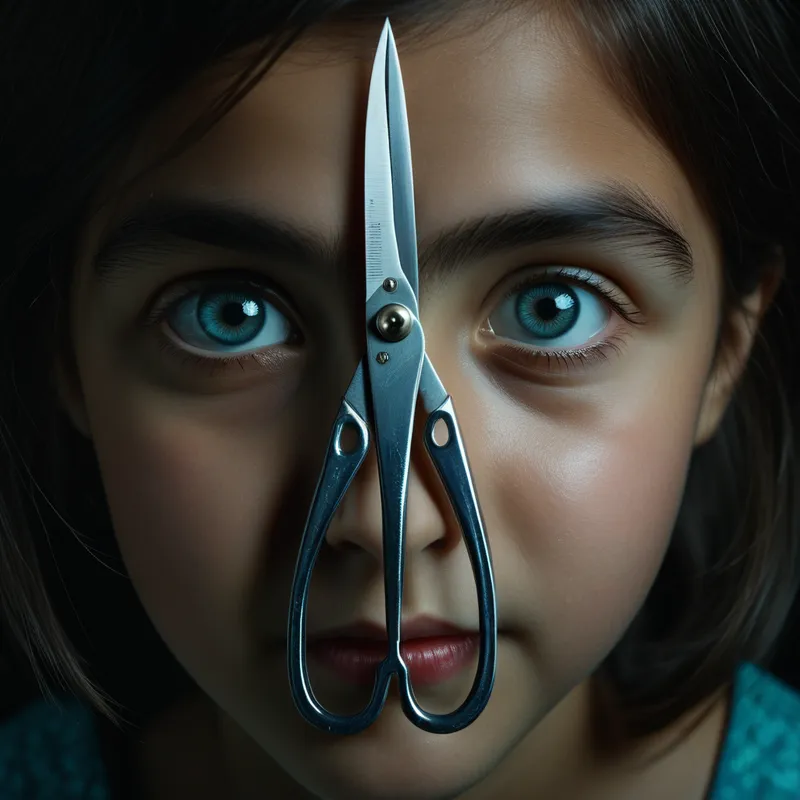
Panic is a live wire in the blood. There is no right answer. To call this beauty is a lie that mocks her suffering. To call it ugly is to condemn yourself. In that frozen moment, as her hand moves toward the scissors she carries, some ancient instinct for survival whispers a third path. Distract. Defer.
“You are… average,” you might stammer. Or, “I must ask my friend.” Or you might throw hard candy or coins at her feet, saying “Pomade! Pomade!”—a nonsensical charm from a half-remembered rumor.
If your answer confuses her, if your offering or your stalling plea creates a crack in her single-minded purpose, you may have a heartbeat to run. You must not look back. You must find a place of safety—a home, a police box—and bar the door. For she will follow, her scissors clicking like insect mandibles on the pavement behind you, until you cross a threshold she cannot, or will not, cross.
And there, in the safety of light and locked doors, you are left with the echo of the question, now etched into your own soul. Am I pretty? The myth does not end with her defeat, but with your escape, forever carrying the memory of the wound you witnessed, and the mask you yourself wear to face the world.
Cultural Origins & Context
Kuchisake-onna, the Slit-Mouthed Woman, is a potent example of a modern urban legend that achieved the pervasive power of myth. Her story erupted in mainstream Japanese consciousness in the late 1970s, spreading with viral ferocity through schoolyards, tabloids, and television. This was not an ancient tale passed down by village elders, but a folklore born of the modern urban experience, reflecting the anxieties of its time.
The post-war economic boom had transformed Japan, creating immense pressure to conform, succeed, and present a flawless, harmonious face to society—the tatemae. Simultaneously, the 1970s saw a rise in cosmetic surgery, placing beauty and its artificial attainment under a new spotlight. Kuchisake-onna is a direct spawn of this environment. She is often given a backstory as a vain wife mutilated by a jealous or betrayed husband, a cautionary tale about the perils of infidelity or excessive pride in appearance. Her weapon of choice, the sewing scissors or hasami, ties her to the domestic sphere, the very place where her betrayal supposedly occurred.
The legend functioned as a potent social regulator, particularly for children. Parents and teachers used her story to enforce curfews (“Come home before dark, or Kuchisake-onna will get you”) and discourage vanity. But its true power lay in its collective, participatory nature. The “rules” for survival—the answers that could confuse her, the items that could distract her—were constantly evolving through playground gossip, creating a shared cultural code. She became a modern yūrei, a spirit whose specific horror was tailored to cut directly to the heart of contemporary social fears about judgment, shame, and the violent cost of failing to maintain the perfect mask.
Symbolic Architecture
At its core, the myth of Kuchisake-onna is a terrifyingly literal encounter with the Shadow. She is not merely a monster, but the embodied truth of a wound that has been violently silenced and forced behind a mask.
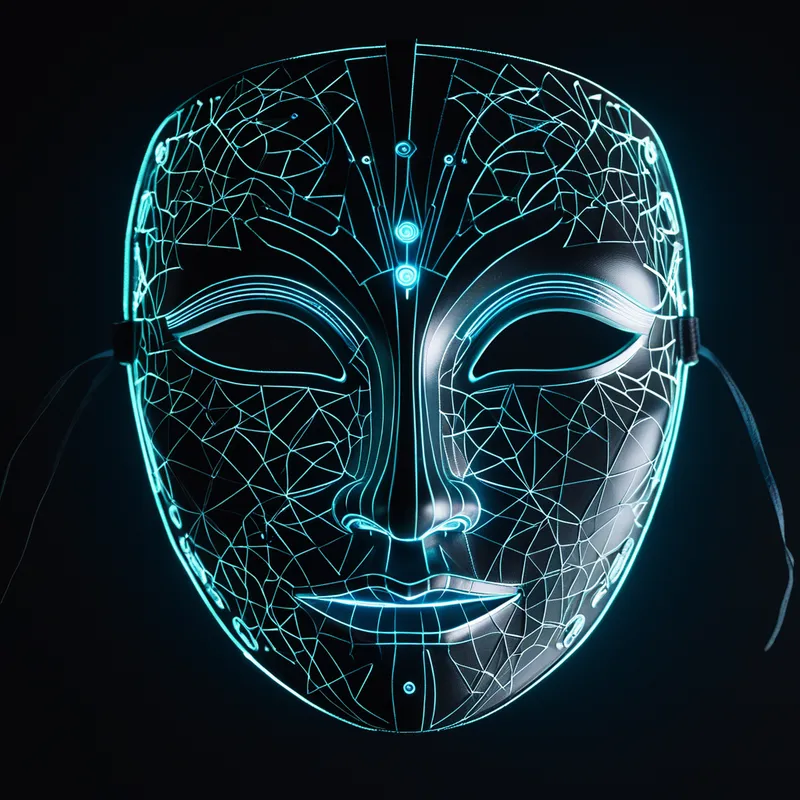
The surgical mask is the perfect symbol of the modern persona—sterile, anonymous, protective, and concealing. It is the face we present in polite society, in crowded trains, in professional settings. It says, “I am no threat; I contain myself.” To remove it is to reveal what lies beneath the social contract: the raw, unhealed injury of rejection, betrayal, and profound shame. Her mutilation is a permanent scream made flesh.
The question, “Am I pretty?” is never about aesthetics. It is the fundamental human cry for validation, for worth, for love. When that cry is met with violence or betrayal, the wound does not heal—it becomes the identity.
Her scissors represent the dual-edged nature of judgment. They are a domestic tool perverted into an instrument of punishment, cutting both ways. They created her wound (in the backstory), and they now threaten to inflict it upon others. This reflects the psychological truth that those who are deeply wounded often become wounders, trapped in a cycle of passing on their pain. The myth presents a brutal choice: validate the lie of the mask and be complicit in the denial, or reject the horrifying truth and be destroyed by it. The “escape” answers represent the psyche’s desperate, third-way ingenuity—the ability to sidestep a binary trap through ambiguity, distraction, or a symbolic offering, buying time for the conscious ego to flee and integrate the shock.
The Dreamer's Resonance
When the archetype of Kuchisake-onna surfaces in modern dreams, the dreamer is likely confronting a profound crisis of self-presentation and internalized judgment. The dream may not feature the literal figure, but its symbolic architecture: being pursued by a silent, masked figure; being asked an unanswerable, high-stakes question by an authority; or discovering that one’s own reflection in a mirror is horrifically altered.
Somatically, this can feel like a constriction in the throat and jaw—the physical seat of speech and expression. The dreamer may awake with a sense of suffocation, as if the surgical mask has become real. Psychologically, this dream pattern signals that a long-held persona—the “pretty” or acceptable face shown to the world—has been ruptured by an emerging truth. This truth feels ugly, shameful, and dangerous. It could be a repressed anger, a forbidden desire, a traumatic memory, or simply a part of the personality deemed “unattractive” by internal or external critics.
The pursuit in the dream mirrors the psyche’s insistence that this material can no longer be outrun. The dream is the alleyway where the ego, the “I” that walks home alone, is finally cornered by the aspect of self it has tried to mask. The terrifying question is the Shadow demanding acknowledgment: “Do you see me now? Will you accept what I have become?”

Alchemical Translation
The individuation process modeled by this myth is not one of heroic slaying, but of terrifying dialogue and cunning survival. Kuchisake-onna represents a traumatic complex—a bundle of thoughts, feelings, and memories around beauty, worth, and betrayal—that possesses autonomous, destructive power within the psyche. The goal is not to destroy her, for she is a part of the self, but to break the spell of her binary trap.
The first alchemical stage is Confrontatio. This is the moment the mask comes off. In psychological terms, it is the unavoidable, often crisis-driven, awareness of a deep wound or flaw one has spent a lifetime concealing. The pain of this revelation feels annihilating.
The second stage is the Circumventio, the “confusing answer.” This is the creative, non-literal response of the conscious mind. It represents refusing to engage the complex on its own devastating terms. Instead of answering “yes” (identification with the persona) or “no” (identification with the wound), one must say, “You are average,” or “Let me think.” This is the act of creating psychological space. It is the therapeutic question, the journal entry, the artistic expression that contains the conflict without being consumed by it.
The hard candy or coins thrown at her feet are symbolic payments—an acknowledgment of the debt owed to this neglected part of the soul. It is a gesture of respect, however small, that temporarily appeases the hunger of the complex.
The final stage is the Receptio, the barred sanctuary. After the confrontation and the creative sidestep, the ego must retreat to a place of conscious integration. It must “get home” and “lock the door.” This is the act of bringing the shock of the encounter into the light of analysis, compassion, and understanding. The complex, once a pursuing phantom, is now known. Its question—“Am I pretty?”—ceases to be a threat and becomes, however painfully, our question to answer for ourselves. We realize the mask and the wound are two sides of the same face. The alchemical work is to hold that contradiction, to transmute the pursuit into an inner dialogue, and to discover that true wholeness includes the scar.
Associated Symbols
Explore related symbols from the CaleaDream lexicon: