Krishna-Arjuna Dialogue Myth Meaning & Symbolism
A warrior prince, paralyzed by moral crisis, receives divine counsel on the battlefield, revealing the nature of reality, duty, and the eternal self.
The Tale of Krishna-Arjuna Dialogue
The dawn did not break that day; it congealed. A cold, metallic light seeped over the plain of Kurukshetra, illuminating not hope, but the grim architecture of destiny. The air, once filled with the scent of earth and grass, was now a broth of dust, sweat, and the oiled iron of a hundred thousand warriors. Conches blared, a sound not of music but of [the world](/myths/the-world “Myth from Tarot culture.”/)’s lungs emptying in one final, defiant shout. Elephants stamped, their bells a death knell. This was the day the epic of an age would be written in blood and revelation.
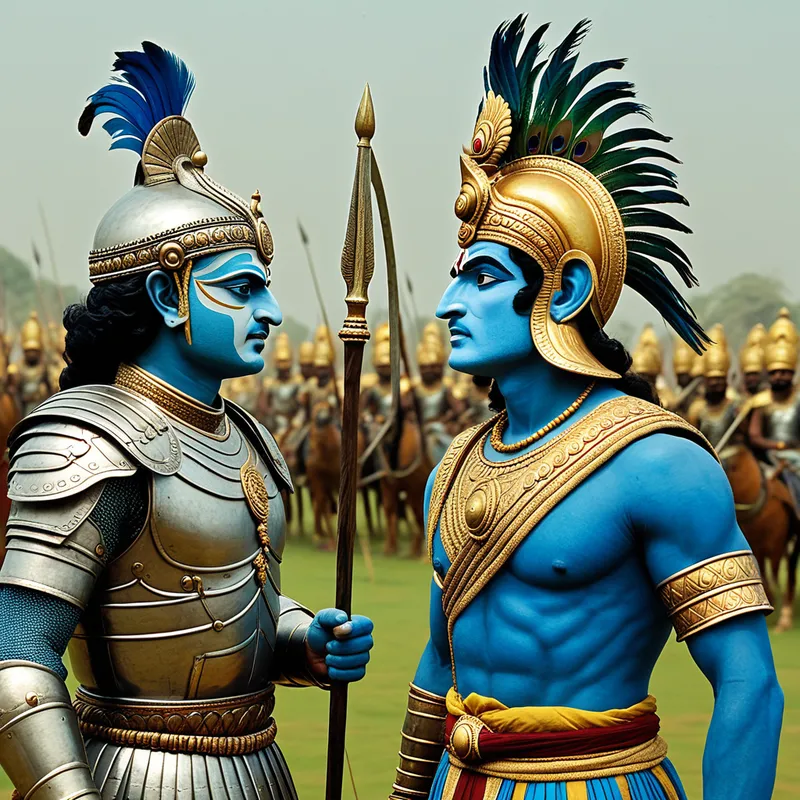
Between the two vast, seething armies, a single chariot stood still. Its banner bore the emblem of [Hanuman](/myths/hanuman “Myth from Hindu culture.”/), a signal of divine sanction. Yet, within this fortress on wheels, the greatest archer of his time, Arjuna, was crumbling. His mighty bow, [Gandiva](/myths/gandiva “Myth from Hindu culture.”/), famed for its twang that could shatter mountains, felt like a serpent of lead in his hands. His gaze swept across the no-man’s-land, and he did not see enemies. He saw grandfathers. He saw beloved teachers who had taught him the very art of war he must now turn against them. He saw cousins, uncles, brothers—the tangled, gnarled roots of his own family tree, now arrayed for mutual slaughter.
A great shudder passed through him. His limbs failed. The world narrowed to the pounding of his own heart, a drumbeat of despair. “How can I fight?” he whispered, his voice lost in the war-cries. “What victory is worth this sin? The kingdom drenched in the blood of kin is a kingdom of ghosts.” He sank to the floor of [the chariot](/myths/the-chariot “Myth from Tarot culture.”/), his splendor undone. “I will not fight.”
Then, the charioteer spoke. He was no ordinary driver, but [Krishna](/myths/krishna “Myth from Hindu culture.”/), friend, cousin, and the unmanifest divinity clothed in mortal form. His hands, which held the reins of four white horses, held the reins of time itself. His eyes were not of this battlefield. “You grieve for those who do not grieve, O Arjuna,” he said, his voice a deep river flowing beneath the cacophony. “The wise do not mourn for the living or the dead.”
From this moment of absolute human collapse, the chariot became the axis of the universe. Krishna did not command Arjuna to fight. He invited him to see. And as he spoke, the world began to peel away. He spoke of the eternal atman, which is never born and never dies, as a man casts off worn-out garments for new ones. He spoke of dharma, the sacred order that upholds creation, and of the poison of inaction. He mapped the paths of knowledge, devotion, and selfless action. The lesson unfolded like a cosmic [lotus](/myths/lotus “Myth from Hindu culture.”/), petal by petal, until the teachings reached their zenith.
“Behold now, Arjuna, my supreme form.” And in that space between two breaths, Krishna granted him the divine eye. The friendly cousin vanished. In his place was the [Vishvarupa](/myths/vishvarupa “Myth from Hindu culture.”/)—the Form of All. Arjuna saw universes being born and dying in the blink of that form’s eyes. He saw all warriors, all beings, streaming into countless mouths filled with flaming teeth. He saw time, not as a line, but as a devouring presence. He saw the entire cosmic play, terrible and beautiful, and he trembled, overcome, his hands pressed together in awe and terror. “I am time, the great destroyer of worlds,” the form thundered. “I have come to consume these men. Even without you, they will cease to be.”
The vision withdrew, leaving the familiar Krishna once more in the charioteer’s seat. The plain of Kurukshetra returned, but it was not the same plain. Arjuna was not the same man. The paralysis of grief had been incinerated in the fire of understanding. His doubt was silenced. He picked up Gandiva, his hands now steady. “My delusion is destroyed. I stand firm, my confusion dispelled. I will act according to your word.”
Cultural Origins & Context
This dialogue forms the heart of the Bhagavad Gita, a text embedded within the colossal epic, the Mahabharata. Composed in classical Sanskrit, its origins are traditionally placed in the late centuries BCE, though its philosophical core is considered timeless (sanatana). It was not a text for the secluded ascetic alone, but a revolutionary discourse delivered in the most public, chaotic, and ethically fraught arena imaginable: the battlefield.
The Gita was passed down through an unbroken oral tradition, recited by sages and learned by heart by generations. Its narrator is Sanjaya, who, granted divine sight by the sage [Vyasa](/myths/vyasa “Myth from Hindu culture.”/), reports the dialogue to the blind king Dhritarashtra. This framing is profound—the wisdom of the ages is conveyed to a power-hungry, willfully blind ruler through an intermediary, highlighting that true sight is spiritual, not physical. Societally, the Gita functioned as the ultimate guide for navigating the central tension of ashrama and varna: how to live a life of righteous action in the world without being corrupted by it. It provided a philosophical foundation for duty, ethics, and the pursuit of liberation ([moksha](/myths/moksha “Myth from Hindu culture.”/)) within the very confines of social and familial obligation.
Symbolic Architecture
The myth is a perfect [mandala](/symbols/mandala “Symbol: A sacred geometric circle representing wholeness, the cosmos, and the journey toward spiritual integration.”/) of psychological and cosmic [symbolism](/symbols/symbolism “Symbol: The use of symbols to represent ideas or qualities, often conveying deeper meanings beyond literal interpretation. In dreams, it’s the language of the unconscious.”/). The battlefield of Kurukshetra is not merely a geographical [location](/symbols/location “Symbol: The symbol of ‘Location’ signifies a sense of place, context, and the environment in which experiences unfold.”/); it is Dharmakshetra—the field of righteousness. It represents the [human](/symbols/human “Symbol: The symbol of a human represents individuality, complexity of emotions, and social relationships.”/) [condition](/symbols/condition “Symbol: Condition reflects the state of being, often focusing on physical, emotional, or situational aspects of life.”/) itself, the inner and outer [landscape](/symbols/landscape “Symbol: Landscapes in dreams are powerful symbols representing the dreamer’s emotional state, personal journey, and the broader context of life situations.”/) where the eternal war between higher and lower [nature](/symbols/nature “Symbol: Nature symbolizes growth, connectivity, and the primal forces of existence.”/), order and [chaos](/symbols/chaos “Symbol: In Arts & Music, chaos represents raw creative potential, uncontrolled expression, and the breakdown of order to forge new artistic forms.”/), [truth](/symbols/truth “Symbol: Truth represents authenticity, honesty, and the quest for knowledge beyond mere appearances.”/) and delusion, is perpetually waged.
The chariot is the human body. The five horses are the five senses. The reins are the mind. The charioteer is the discriminating intellect (buddhi). The passenger is the individual soul (jiva). The journey is life.
Arjuna represents the human ego-[consciousness](/symbols/consciousness “Symbol: Consciousness represents the state of awareness and perception, encompassing thoughts, feelings, and experiences.”/) in its [moment](/symbols/moment “Symbol: The symbol of a ‘moment’ embodies the significance of transient experiences that encapsulate emotional depth or pivotal transformations in life.”/) of supreme [crisis](/symbols/crisis “Symbol: A crisis symbolizes turmoil, urgent challenges, and the need for immediate resolution or change.”/). He is skilled, noble, and capable, yet when faced with the paradoxical, [shadow](/symbols/shadow “Symbol: The ‘shadow’ embodies the unconscious, repressed aspects of the self and often represents fears or hidden emotions.”/)-laden complexity of real [life](/symbols/life “Symbol: The symbol of ‘Life’ represents a journey of growth, interconnectedness, and existential meaning, encompassing both the joys and challenges that define human experience.”/)—where duty conflicts with love, where [action](/symbols/action “Symbol: Action in dreams represents the drive for agency, motivation, and the ability to take control of situations in waking life.”/) is fraught with sin—he collapses into neurosis, a “crisis of meaning.” His refusal to fight is not cowardice, but [the ego](/myths/the-ego “Myth from Jungian culture.”/)‘s understandable recoil from the terrifying ambiguities of embodied existence.
Krishna symbolizes the Self, the guiding inner divinity, the [archetype](/symbols/archetype “Symbol: A universal, primordial pattern or prototype in the collective unconscious that shapes human experience, behavior, and creative expression.”/) of wholeness. He does not exist outside Arjuna, but as the deepest [layer](/symbols/layer “Symbol: Layers often symbolize complexity, depth, and protection in dreams, representing the various aspects of the self or situations.”/) of his own being. He is the [friend](/symbols/friend “Symbol: A friend in dreams often represents companionship, connection, and the desire for social support, reflecting aspects of our interactions and relationships in waking life.”/) (sakha), the inner companion who knows the [soul](/symbols/soul “Symbol: The soul represents the essence of a person, encompassing their spirit, identity, and connection to the universe.”/)‘s true [purpose](/symbols/purpose “Symbol: Purpose signifies direction, meaning, and intention in life, often reflecting personal ambitions and core values.”/). His [role](/symbols/role “Symbol: The concept of ‘role’ in dreams often reflects one’s identity or how individuals perceive their place within various social structures.”/) as charioteer is key: the higher Self does not destroy the ego, but seeks to guide it, to steer the entire psychophysical apparatus toward its dharma.
The Vishvarupa is the ultimate unveiling of [reality](/symbols/reality “Symbol: Reality signifies the state of existence and perception, often reflecting one’s understanding of truth and life experiences.”/) as it is, stripped of the ego’s comforting projections. It is the [psyche](/myths/psyche “Myth from Greek culture.”/) confronting the raw, amoral, awe-ful dynamism of the unconscious and the [cosmos](/symbols/cosmos “Symbol: The entire universe as an ordered, harmonious system, often representing the totality of existence, spiritual connection, and the unknown.”/)—the terrifying yet necessary [vision](/symbols/vision “Symbol: Vision reflects perception, insight, and clarity — often signifying the ability to foresee or understand deeper truths.”/) that shatters the ego’s limited [perspective](/symbols/perspective “Symbol: Perspective in dreams reflects one’s viewpoints, attitudes, and how one interprets experiences.”/) and forces a [death](/symbols/death “Symbol: Symbolizes transformation, endings, and new beginnings; often associated with fear of the unknown.”/)-and-[rebirth](/symbols/rebirth “Symbol: A profound transformation where old aspects of self or life die, making way for new beginnings, growth, and renewal.”/) of consciousness.

The Dreamer’s Resonance
When this mythic pattern stirs in the modern dreamer, it signals a profound crossroads in the psyche. One does not dream of Krishna and Arjuna literally, but of the situation.
You may dream of being paralyzed before a crucial presentation, your notes turning to ash. You may dream of standing at an altar, unable to say “I do,” while a familiar, calm presence watches from the pews. You may dream of your car, symbol of your directed life, stalled at a chaotic intersection as a storm rages, with a voice from the back seat offering cryptic advice.
The somatic experience is key: a heavy lethargy in the limbs, a tightening in the chest, a feeling of being “frozen.” This is the Arjuna-state—the ego’s investment in a personal, historical identity (my family, my reputation, my past) locking it in conflict with the demands of [the Self](/myths/the-self “Myth from Jungian culture.”/), which calls for a forward movement into the unknown. The dream is the psyche’s attempt to stage the confrontation the waking ego has been avoiding. The calm, authoritative figure (a mentor, a stranger, a glowing animal) that appears is the emergent symbol of the inner guide, the nascent connection to the Self, offering not a solution, but a shift in perception. The dreamer is undergoing the necessary, painful dissolution of an old, too-small identity to make room for a broader consciousness.

Alchemical Translation
The alchemy modeled here is the transmutation of the leaden, conflicted ego into an instrument of golden, conscious action. It is the core of individuation. The process begins in the [nigredo](/myths/nigredo “Myth from Alchemical culture.”/), the blackening: Arjuna’s despair on the chariot floor. This is [the dark night of the soul](/myths/the-dark-night-of-the-soul “Myth from Christian Mysticism culture.”/), where all previous values and identities are rendered meaningless.
The first alchemical operation is not doing, but seeing. The heat of crisis cooks the psyche until the essence separates from the dross.
Krishna’s discourse represents the albedo, the whitening—the illuminating insights that wash over the darkened mind. The teachings on the eternal atman separate the sense of identity from the personal drama (the opus separationis). The vision of the Vishvarupa is the citrinitas, the yellowing—a direct, awe-striking encounter with the magnificence and terror of the unconscious, the mysterium tremendum et fascinans.
The final stage, the [rubedo](/myths/rubedo “Myth from Alchemical culture.”/) or reddening, is not detailed in the myth’s immediate aftermath but is implied in Arjuna’s resolute action. It is the integration. He picks up his bow, but he is no longer the same Arjuna who dropped it. He acts, but his action is now nishkama [karma](/myths/karma “Myth from Hindu culture.”/)—action performed without attachment to the personal fruits of success or failure. The ego has not been erased; it has been redeemed by becoming a willing participant in a drama larger than itself. The alchemical gold is this state of engaged detachment, where one fulfills their unique duty in the world (svadharma) with skill and passion, yet remains inwardly anchored to the timeless Self. The battle must be fought, but the true victory is the transformation of the warrior’s consciousness.
Associated Symbols
Explore related symbols from the CaleaDream lexicon: