Kostroma Myth Meaning & Symbolism
A myth of sacred twins, a tragic mistake, and the eternal cycle of separation and reunion that governs the fertility of the land and soul.
The Tale of Kostroma
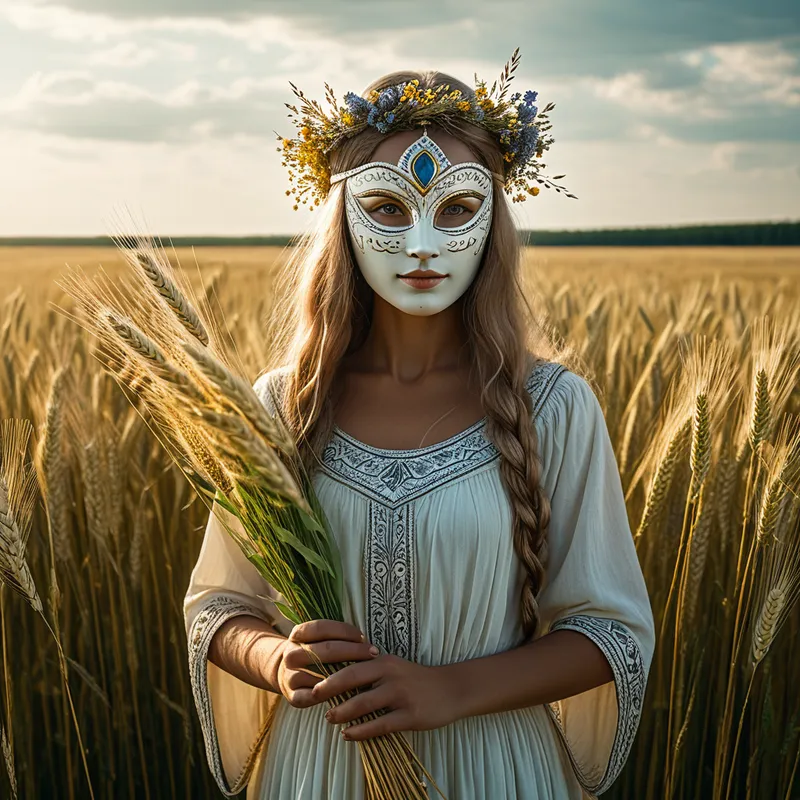
Listen, and hear the rustle in the tall summer rye. It is not just the wind. It is the sigh of Kostroma, whose story is woven into the very stalks.
In the time when the world was young and the gods walked closer to the earth, there were two born under a single, blessed star: Kupalo and Kostroma. Brother and sister, sun and spring, two halves of a single, radiant soul. Their laughter made the rivers run clear and the fruit swell sweet on the branch. They were inseparable, a perfect circle of joy.
But the circle was broken. Fate, or a mischievous bird—some say it was the trickster spirit Nav—whispered a curse upon them. It decreed that a great calamity would befall them if they ever learned they were siblings. So they grew, knowing each other only as beloved companions, their bond deepening with each passing season, innocent of the truth that pulsed in their shared blood.
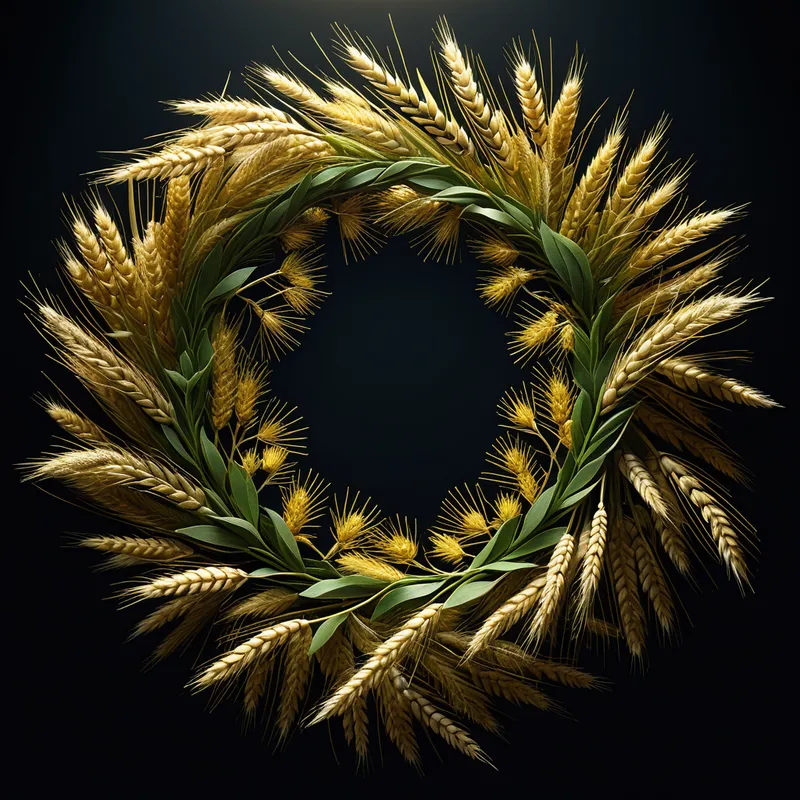
One day, by the banks of the River Smorodina, a place of thresholds, Kostroma wove a garland of flowers. She sang a song of love, and Kupalo, drawn by her voice, came to her. They exchanged the garlands, a ritual of betrothal. The earth itself seemed to hold its breath. But as they joined hands, the ancient curse awoke. The wind snatched Kostroma’s wreath and cast it upon the dark waters. In Slavic custom, a floating wreath foretells marriage, but a sinking one prophesies death. Hers sank like a stone.
And in that moment, the truth was shouted from the whispering reeds: “You are brother and sister!” The revelation was a lightning strike. Horror flooded them. Their perfect world shattered into a thousand sharp fragments. For Kupalo, the shame and despair were a fire he could not bear. He threw himself into the deep forest, and there, by a lonely lake, he took his own life.
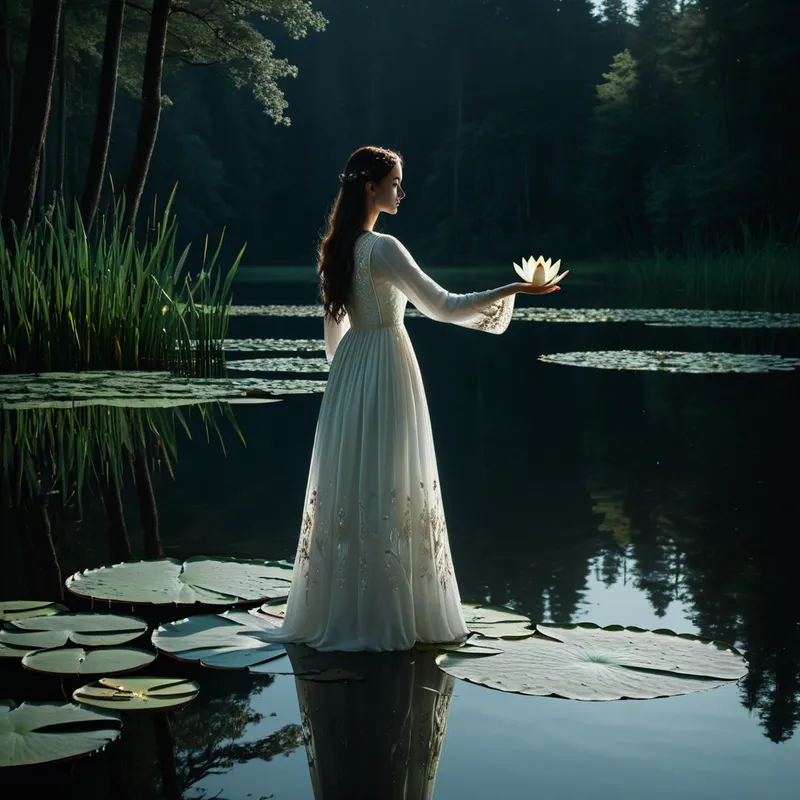
Kostroma, finding her other half gone, her love turned to ashes in her mouth, was consumed by a grief so vast it became the only thing she was. She walked to the edge of that same dark water, saw the ghost of her wreath in the lilies, and followed her brother into the depths.
But the gods of life do not let such pure essences be lost. The waters did not claim them forever. Kupalo was transformed, his spirit rising not as a man, but as a fiery, masculine force of fertility and summer solstice. Kostroma, from her watery grave, became an eternal, mournful spirit of spring, a goddess whose return each year is bittersweet, born from loss. They were reunited not in life, but in function—two forces forever bound, forever apart, whose tragic story must be remembered for the grain to grow and the rivers to flow.
Cultural Origins & Context
The myth of Kostroma and Kupalo is not a single, canonical text, but a living pattern woven into the seasonal fabric of pre-Christian Slavic spirituality. It was breathed into life through ritual, not scripture. The primary vessel for this story was the great summer festival of Ivan Kupala or Kupala Night, held on the solstice.
On this night, the myth was not merely told; it was performed. Villagers would create an effigy of Kostroma—a straw doll adorned with flowers and ribbons. This effigy was paraded, lamented, and finally, with great ceremony, ritually destroyed: drowned in a river, burned, or torn apart and scattered in the fields. This act was the dramatic re-enactment of her death. The songs sung were not joyful, but poignant plach (laments), dirges for the lost maiden. Through this collective, somatic ritual, the community participated in the necessary cycle: the sacrifice of the spring maiden (Kostroma) to ensure the arrival of the potent summer sun (Kupalo) and, ultimately, a bountiful harvest. The myth served as the sacred charter for this essential, ecological and psychological process.
Symbolic Architecture
At its heart, this is a myth of the primordial unity shattered, and the agonizing journey toward a new, conscious wholeness.
The sacred twins represent the original, undifferentiated state of the psyche—a paradise of unconscious completeness. There is no separation between self and other, masculine and feminine, inner and outer. This is the garden before the fall, the infant’s blissful union with the world.
The wreath is the circle of the self. To give it away is to offer one’s wholeness to another. To have it sink is for the ego to be drowned by the unconscious.
The fatal revelation—"You are brother and sister"—is the dawn of consciousness itself. It is the moment of differentiation, the painful knowledge that what we desire (the Other) is, in a profound sense, already a part of us (the Self). This recognition breaks the paradise of projection. Kupalo’s flight and suicide symbolize the violent rejection of this truth, the attempt by the conscious ego (often symbolized by solar, masculine energy) to annihilate itself rather than integrate the shadow of incestuous, unconscious content.
Kostroma’s subsequent drowning is the necessary counterpart: the dissolution of the old identity (the maiden, the spring) back into the watery womb of the unconscious. Their transformation into deities is the alchemical outcome. They are no longer human children in an earthly paradise, but eternal, archetypal principles. They achieve reunion not on a personal, egoic level, but on a transpersonal, cosmic scale—as the inseparable, cyclical forces of fertility that govern the world.
The Dreamer's Resonance
When this myth stirs in the modern soul, it often surfaces in dreams of profound, inexplicable connection followed by devastating separation. You may dream of a twin, a soulmate, or a perfect companion from whom you are suddenly and irrevocably torn by a shocking revelation or a simple, cruel twist of fate. The setting is frequently liminal: riverbanks, shorelines, forest edges—places where one world meets another.
Somatically, this can feel like a physical rending in the chest, a literal heartache upon waking. Psychologically, it signals a crucial point in the process of individuation: the painful but necessary end of a symbiotic relationship, whether with a person, a project, or an idealized version of yourself. The dream is the psyche’s ritual of “Kostroma,” drowning the old form of a relationship to your own inner other (your anima or animus) so that it may be reborn as a functional, archetypal force within you, rather than a projected fantasy outside of you. The grief is real, because a part of you is truly dying.

Alchemical Translation
The alchemy of Kostroma is the opus contra naturam—the work against nature—of transforming an unconscious, instinctual bond into a conscious, spiritual unity. The first, fatal union (the betrothal) is coniunctio on the wrong level, a naive merging that leads to catastrophe. The revelation is the separatio, the brutal but essential separation of components without which no transformation is possible.
One must lose the brother to find the god within; one must drown the sister to resurrect the goddess.
Kupalo’s fire and Kostroma’s water are the opposing elements that must be reconciled. The ego (Kupalo) must undergo its mortificatio (suicide)—not a literal death, but the death of its arrogance, its belief that it can exist in a pure, solar state without its dark, watery counterpart. The soul (Kostroma) must undergo its solutio (drowning)—a dissolution of rigid identity and emotional complexes.
Their final state as deities represents the unio mentalis, the psychic union achieved on the level of mind and spirit. For the modern individual, this translates to the hard-won realization that the wholeness we seek in another, in success, or in a perfect past, is actually an inner configuration. We must ritually “drown” our projections (the Kostroma effigy) and “ignite” our inner responsibility (the Kupalo fire). The myth teaches that paradise is not a place to return to, but a state to be forged in the crucible of conscious suffering. The joyous festival of Ivan Kupala that follows the lament is the promise: after the sacrifice of what was, comes the fertile power of what can be.
Associated Symbols
Explore related symbols from the CaleaDream lexicon: