Koan Myth Meaning & Symbolism
A paradoxical riddle from Zen, the Koan is not a puzzle to solve but a mirror to shatter, revealing the mind's luminous, unconstructed nature.
The Tale of Koan
Listen. There is a story that is not a story. It begins not with a hero, but with a question that hangs in the air like a bell that has been struck but makes no sound.
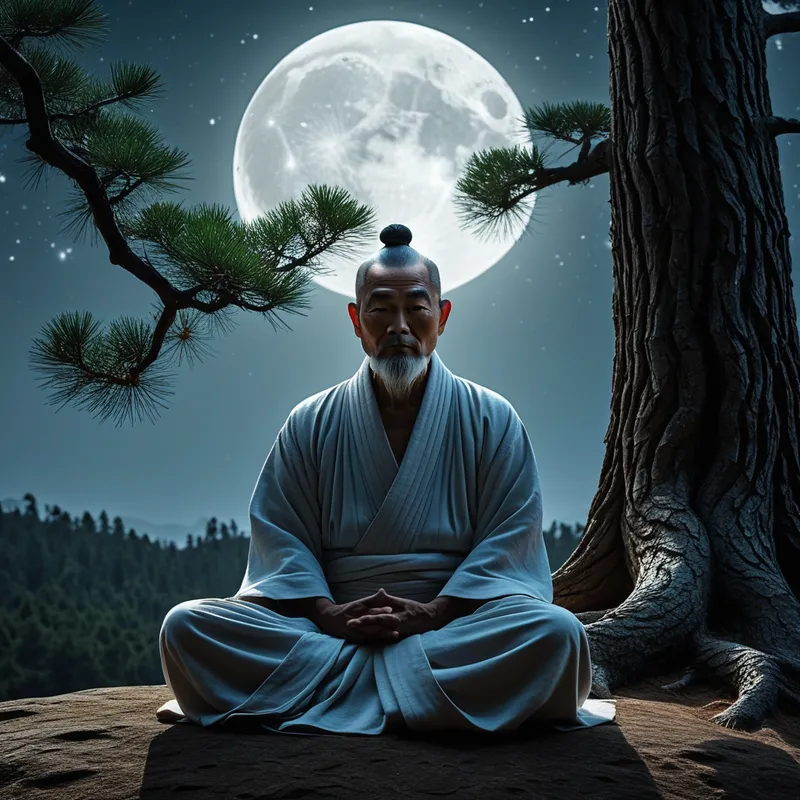
In the mist-wrapped mountains of ancient China, in a monastery where the only music was the wind in the bamboo and the steady drip of condensation from the eaves, there lived a master. His face was a map of silent years, his eyes pools of still water reflecting everything and holding nothing. Before him knelt a seeker, a monk whose mind was a frantic scribe, writing and rewriting the scriptures, seeking the truth in the spaces between words.
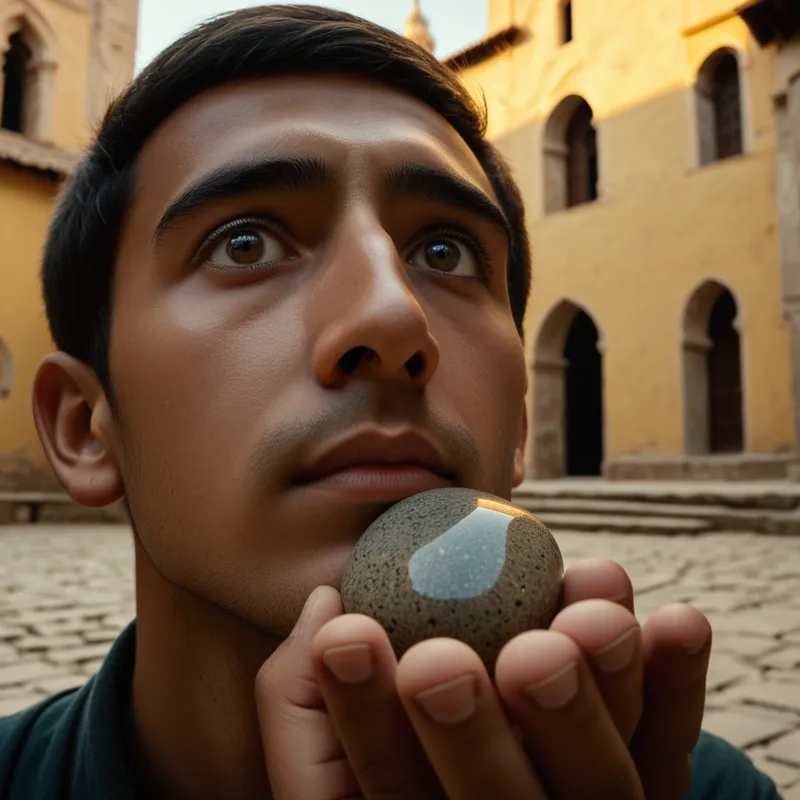
The master did not speak of sutras. He did not speak of virtue. Instead, he lifted a single, ordinary stone from the earth of the courtyard. He held it in his palm as if it were the universe’s first and only artifact. “What is this?” he asked, his voice the texture of worn silk.
The monk, eager, recited: “It is a manifestation of the Buddha-nature. It is emptiness in form. It is a teaching of impermanence.”
The master said nothing. The stone remained.
Days turned. The question remained, a pebble in the monk’s shoe, a stone in his gut. “What is this?” It haunted his walking, his eating, his sleep. He dreamed of the stone growing, shrinking, speaking in a language of pure geometry. He consulted texts; he meditated until his legs screamed. He returned. “It is not a stone! It is my own mind projecting form!”
The master looked at him, then at the stone. He said nothing.
The monk’s world became a cage of “What is this?”. Logic became a shattered vase. Reason, a path that led in circles. Despair washed over him like a cold mountain stream. He had nothing left to offer, no more answers to give. Exhausted, hollowed out, he stood one evening as the last light bled from the sky. The master was raking the gravel into perfect, meaningless lines.
“What is this?” the master asked again, not looking up.
And in that moment, the monk did not think. The frantic scribe within him lay down his brush and died. The barrier between the stone, the rake, the master, the sound of the gravel, the chill of the air, and the one who perceived it all—it dissolved like mist in sudden sun. There was no question. There was no answer. There was only this. A sound escaped him, not a word, but a breath that was also a laugh and a sob. He saw the stone, truly, for the first time. It was just a stone. And it was everything.
The master stopped raking. A faint, knowing smile touched his lips, as fleeting as a dragonfly on water. He said nothing. The teaching was complete.
Cultural Origins & Context
The Koan is not a myth in the traditional sense of a narrative about gods and heroes. It is a functional myth, an enacted ritual of the mind, born in the crucible of Chan Buddhism in Tang and Song Dynasty China. It migrated to Japan as Zen, carried by monks across the sea like a precious, living seed.
These were not stories to be believed, but encounters to be embodied. They emerged from the recorded sayings and doings of great masters like Linji Yixuan and Dongshan Liangjie. Passed down orally and later compiled in collections like The Gateless Gate and The Blue Cliff Record, they served as a direct transmission outside the scriptures. Their societal function was subversive: to short-circuit the intellectualizing, conceptual mind that the monastic education itself could sometimes reinforce. The Koan was the master’s sword, used to cut through the disciple’s attachment to words, logic, and even to the serene states of meditation, pointing directly at the nature of reality and mind.
Symbolic Architecture
The Koan is an alchemical vessel for the psyche. Its primary symbols are paradox, silence, and the ordinary object.
The paradoxical question—“What is the sound of one hand clapping?” “What was your original face before your parents were born?”—represents the ultimate limitation of the binary, discriminating mind. It is a logical impasse, a cognitive cliff. The mind, the hero of our personal saga, arrives at this cliff and finds its maps useless. Its tools of analysis break. This shattering is not failure, but the necessary initiation.
The Koan is not a lock to be picked, but a mirror to be stepped through. The answer is not found in the reflection, but in the shattering.
The master symbolizes the Self, the integrated wholeness of the psyche that already knows what the striving ego cannot grasp. The master’s silence is not withholding; it is the space in which the ego’s chatter dies down, allowing a deeper intelligence to surface. The ordinary object—the stone, the staff, the cup of tea—is the ultimate symbol. It represents the sacred hidden in the mundane, the infinite depth of reality present in the simplest, most overlooked phenomenon. To see the stone as it is, free of projection and concept, is to achieve the mythic goal: enlightenment, or Satori.
The Dreamer's Resonance
When the pattern of the Koan appears in modern dreams, it signals a profound psychological process: the ego’s confrontation with the impossible. The dreamer may find themselves in an exam where the questions are written in a fluid, disappearing script. They may be given a task—like counting grains of sand or holding two opposing truths at once—that is fundamentally uncompletable by the conscious mind.
Somatically, this can feel like frustration, vertigo, or a tightening in the chest and head—the body registering the mind’s gridlock. Psychologically, it marks a critical juncture in what Jung called the transcendent function. The conscious attitude has been pushed to its limit by a content from the unconscious (the paradoxical task). The old way of “solving” life’s problems no longer works. The dream is orchestrating a crisis meant to break the identification with the rational problem-solver, to create a fertile void. The resolution, if it comes in the dream, is never a neat answer. It is a shift in perception—a sudden laugh, a mundane object glowing with significance, or a deep, wordless peace amidst the confusion. This is the dream-ego touching, for a moment, the state of the monk who finally saw.
Alchemical Translation
The Koan models the individuation process with stark, elegant brutality. The seeker (the conscious ego) brings its refined ore—its education, ethics, and spiritual aspirations—to the alchemist (the guiding principle of the Self, often projected onto a therapist, mentor, or inner guide). The alchemist does not praise the ore. Instead, they place it in the vas of the paradoxical question, the nigredo.
Here, in the blackening, all the ego’s certainties dissolve. The “lead” of logical identity is rendered useless. This is a necessary despair, the dark night of the soul. The ego must be humbled, reduced to its essence. The rising action of frantic seeking is the separatio, trying to divide the insoluble problem into parts. It fails.
The resolution is the coniunctio, the mystical marriage. It is not an answer that the ego finds, but a death of the ego as the sole perceiver. The boundary between subject (the seeker) and object (the Koan, the world) collapses. In that fusion, a transmutation occurs. The lead of the conceptual mind becomes the gold of direct, unmediated experience. The stone is just a stone, and in that “just,” the whole universe is revealed. The individual is no longer merely solving life’s puzzles from a distance; they are realizing they are the very ground upon which the puzzle is laid. The Koan’s alchemy turns seeking into being, and questions into a silent, encompassing presence.
The ultimate Koan is the self. The ultimate answer is the breath you just took, and the world it sustains.
Associated Symbols
Explore related symbols from the CaleaDream lexicon: