Knights of the Round Table Myth Meaning & Symbolism
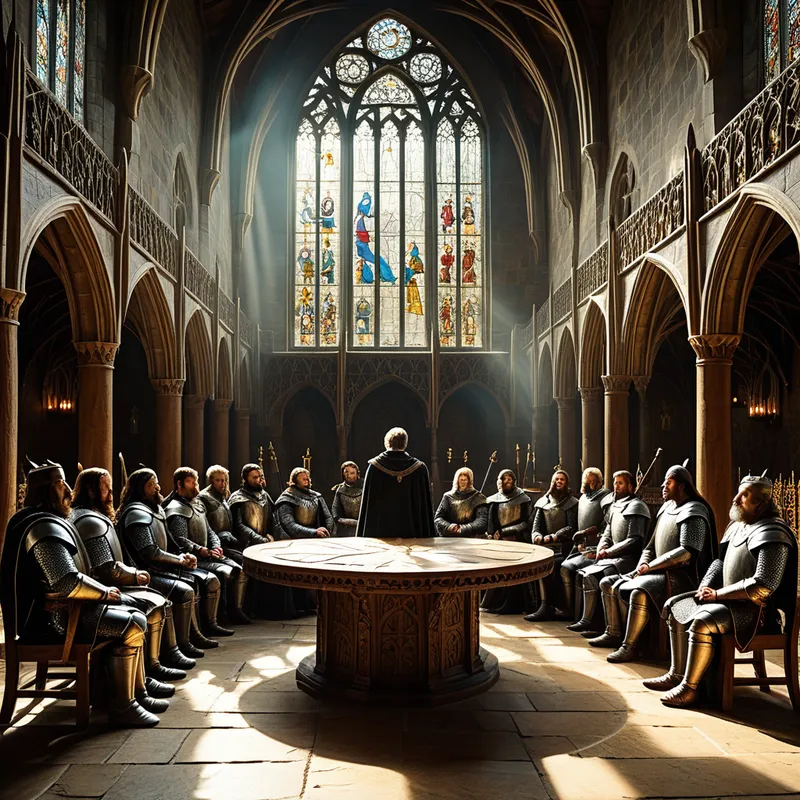
A fellowship of knights bound by a sacred code, seated at a round table, embodying the quest for a holy grail and the fragile dream of perfect unity.
The Tale of Knights of the Round Table
Hear now the tale of the table that was not a table, but a world. In the days when the mist clung to the valleys of Camelot, a king dreamed of a kingdom without end, a fellowship without flaw. His name was Arthur, born of dragon-fire and secret stone, and he drew from the stone a sword named Excalibur, a blade that was less a weapon than a covenant with the land itself.
But a sword can cleave, and a throne divides. Arthur saw in his hall the high-backed chairs of power, where men sat in ranks of greater and lesser, and envy festered in the shadows. From this vision of discord, a new vision was forged. He called upon the enchantment of Merlin, whose eyes saw the wheel of the stars, and together they birthed a wonder: the Round Table. Hewn from a single, ancient oak, it was a circle of perfect equality. No head, no foot. Here, the king was but a first among equals, and the only rank was the nobility of one’s vow.
To this circle came the flower of Logres. Sir Lancelot du Lac, whose strength was a tempest and whose heart was a fault line. Sir Galahad, whose soul was a mirror without stain. Sir Gawain, bound by a code of courtesy as unyielding as his blade. Sir Percival, whose innocence was his only shield. One hundred and fifty knights, each sworn to a code that wove together courage, mercy, and truth. They swore to protect the weak, to right wrongs, to live for honor, not for glory. And at the table, one seat remained empty, carved with letters of gold and dread: the Siege Perilous. It was a silent promise and a silent threat, for it would hold only the one who was perfect, and it would destroy any other who dared to sit.
Their quests were the heartbeat of the realm. They rode out into a world thick with enchantment and danger—to slay dragons that were also metaphors, to rescue maidens who were also sovereigns of forgotten lands, to battle giants that were also the petrified forms of ancient pride. But above all quests shone one, a beacon that called them not to battle, but to vision: the Quest for the Holy Grail. It was a cup, a stone, a dish of plenty—a vessel of such divine grace that it could only be seen by the pure in heart. The knights scattered to the four winds, each following a path that mirrored the landscape of his own soul. Through the Wasteland, where the rivers ran dry and the king languished, they rode. Many fell, distracted by lesser battles or their own hidden shadows. In the end, it was the flawless Galahad, the steadfast Percival, and the gentle Bors who found the Grail in the mystical castle of Corbenic, healing the land with its presence before it vanished from the world, too holy to remain.
Yet the circle, for all its perfection, was drawn in sand before a rising tide. The flaw within the finest knight, Lancelot’s forbidden love for Queen Guinevere, became a crack that split the world. Betrayal, jealousy, and war shattered the fellowship. The Table stood empty, its knights fallen by each other’s hands. Arthur, mortally wounded, was borne away to the isle of Avalon, and a great silence fell over Camelot. The dream was broken, but the whisper of it remained, carried on the wind: that once, there was a circle, and within it, a fleeting glimpse of heaven.
Cultural Origins & Context
The myth of the Round Table is not a single story but a vast tapestry woven over centuries. Its threads begin in the fragmentary histories of post-Roman Britain, where a war-leader named Arthur may have briefly stemmed the tide of Saxon invasion. This historical ghost was clothed in legend by Welsh bards, who sang of a heroic chieftain in their tales of the Mabinogion. The myth truly crystallized in the 12th century, an era of crusades and courtly love. Geoffrey of Monmouth’s pseudo-history provided a royal lineage, but it was the French poet Chrétien de Troyes who, serving the courts of Champagne, introduced the chivalric ideal, the romance of Lancelot, and the first literary mention of the Grail.
The Table itself, as a symbol of equality, may reflect a nostalgic idealization of feudal fellowship, a counterpoint to the rigid hierarchies of medieval society. The stories were societal mirrors and moral compasses. Told in great halls by minstrels and later penned by clerks like Sir Thomas Malory in his Le Morte d’Arthur, they served to define and propagate the code of chivalry—a complex system of martial, religious, and courtly ethics for the knightly class. They were entertainment, yes, but also instruction manuals for the soul of a warrior, teaching that true strength must be tempered by piety, loyalty, and restraint.
Symbolic Architecture
At its heart, the Round Table is a mandala—a symbol of psychic wholeness and cosmic order. It represents the Self attempting to organize the disparate, often warring, elements of the personality (the knights) into a harmonious council.
The circle admits no hierarchy; it is the shape of the completed soul, where the king within must sit in council with all his inner knights, from the passionate Lancelot to the ascetic Galahad.
The knights themselves are not individuals but archetypal fragments of a single seeking consciousness. Lancelot is the shadow of the perfect knight—the immense capability tragically bound to human passion and failure. Gawain is the persona, the strict code of social honor. Galahad is the spiritual ideal, the inhuman perfection that the ego aspires to but cannot integrate without ceasing to be human. The Siege Perilous is the terrifying vacancy at the center of any quest for meaning—it can only be filled by a transcendent, transformative experience (the Grail), and to approach it unprepared is annihilation.
The Holy Grail quest is the ultimate symbol of the individuation journey. It is not a physical search but an inward ordeal of purification. The Wasteland is the psychic state of aridity and depression when one is cut off from the nourishing waters of the unconscious (the Grail). The healing of the Fisher King and his land symbolizes the restoration of psychic vitality that occurs when the conscious mind successfully integrates a profound content from the deep unconscious.
The Dreamer’s Resonance
To dream of the Round Table is to dream of one’s own inner council in a state of formation or crisis. Dreaming of sitting at the table suggests a somatic and psychological process of claiming one’s authority, of recognizing the various “knights” or sub-personalities within (the inner critic, the nurturer, the warrior, the seeker) and attempting to bring them to order. There is often a feeling of solemn responsibility and nascent unity.
Dreaming of the table broken, or of knights fighting, mirrors an internal civil war—a conflict between duty and desire (Arthur vs. Lancelot), between spiritual aspiration and earthly attachment. The dreamer may be experiencing a profound betrayal of their own values or feeling the fragmentation of a once-cohesive life purpose. Dreaming of the Siege Perilous, that haunting empty chair, points directly to the dreamer’s confrontation with their own potential for transformation. It evokes both awe and dread, a somatic pull towards a destiny or a wholeness that feels terrifyingly beyond one’s current self. It is the seat of the unlived life, demanding to be filled.
Alchemical Translation
The Arthurian cycle is a grand alchemical opus for the psyche. Camelot represents the prima materia—the raw, idealistic potential of the conscious ego (Arthur) attempting to build a lasting kingdom of the Self. The forging of the Table is the creation of the vas, the sacred vessel, wherein the great work of integration will occur.
The quest is the nigredo, the dark night of the soul, where the knight must wander lost in the forest of the unconscious, confronting his shadows (the dragons, the treacherous bridges). The discovery of the Grail by the chosen few is the albedo, the whitening—a moment of sublime, transcendent illumination that heals the internal Wasteland.
Yet the myth is profoundly realistic in its alchemy. It does not end with the whitening, but proceeds to the rubedo, the reddening, which is not gold but blood. The fatal triangle of Arthur, Guinevere, and Lancelot is the inevitable corrosion of the ideal by the complexities of human relationship, the intrusion of the personal shadow into the collective dream. The fall of Camelot is the necessary mortificatio, the death of the naive ego-structure. This is not failure, but a deeper stage of the work.
The final translation is in Arthur’s journey to Avalon. He is not dead, but “sleeping,” awaiting the hour of his kingdom’s greatest need. This is the ultimate alchemical truth: the work of individuation is never finally complete. The integrated Self is not a permanent state achieved, but a pattern of wholeness that forms, dissolves, and reforms at deeper levels. The modern individual does not build a Camelot to live in forever. They undertake the quest, experience the fleeting Grail-moment of integration, endure the shattering of their initial ideals, and learn to carry the wounded king within to the isle of healing, where the work continues, out of sight, in the depths of the soul. The Round Table is not a memory of a lost paradise, but a blueprint for an eternal, internal process.
Associated Symbols
Explore related symbols from the CaleaDream lexicon: