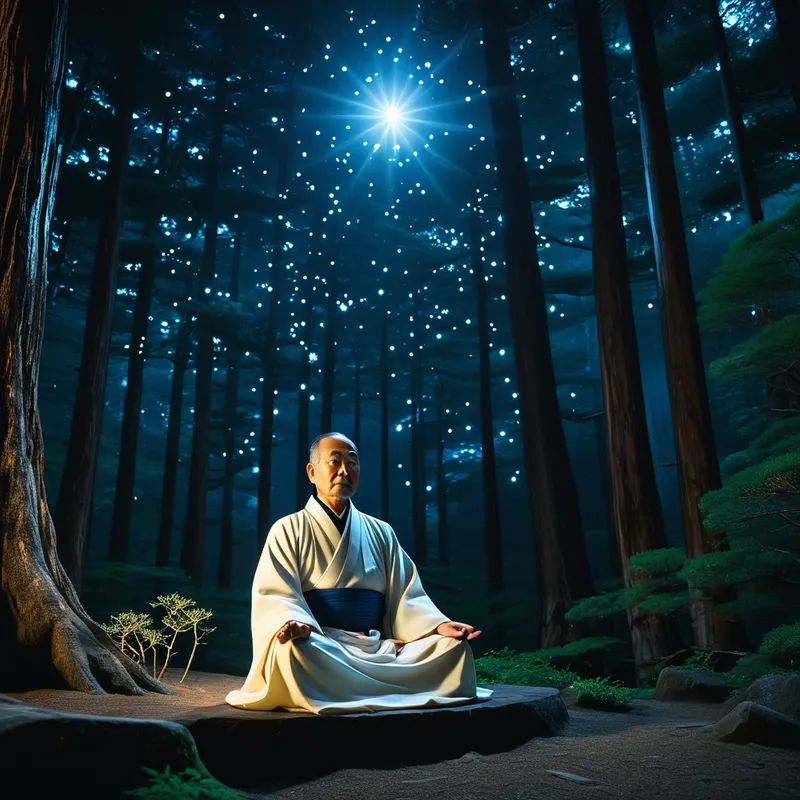
Kūkai Myth Meaning & Symbolism
The story of Kōbō Daishi, who mastered esoteric truth to become one with the cosmos, embodying the ultimate quest for enlightenment.
The Tale of Kūkai
Listen. In the time when the Nara capitals were young and the spirits of the land still whispered through the cryptomeria, there was a seeker. His name was Kūkai. He was not born of thunder or sun, but of noble flesh and a mind that burned with a single question: Where is the true teaching? The sutras of his time spoke in riddles; the path was obscured.
He turned his back on the world of men and entered the mountains. On the slopes of Mount Kōya, later to be his sanctuary, he was but a solitary figure against the vast green. He walked until his sandals wore thin, chanted until his voice was the wind’s, and sat in meditation until moss crept over his still legs. He sought the Dainichi Nyorai, the Great Sun Buddha, not as a distant deity, but as the very substance of reality. Yet the door remained shut.
A vision came. It was said the true, esoteric teachings—the secret keys to the universe—lay not in Japan, but across the treacherous sea, in the Tang capital of Chang’an. With the blessing of the emperor, Kūkai joined an envoy ship. The voyage was a trial of the soul; the sea was a gray, heaving monster for four moons, testing his resolve with storm and despair.
He arrived in the colossal, humming heart of Tang China, a stranger in a world of profound learning. His quest led him to the monastery of Qinglongsi, to the feet of the master Hui Guo. The master, old and illumined, looked upon the young Japanese monk and wept. “I have waited for you,” he said. “The sun of the Dharma has set in the east, but now it shall rise again in the west.” In a consecrated mandala hall, amidst the silent gaze of painted deities, Hui Guo transmitted to Kūkai the full, riverine flow of the Shingon lineage—the mudras, the mantras, the mandalas. The door swung open.
Upon his return, Kūkai was a vessel of the secret. He did not hoard it. He planted it. On wild Mount Kōya, he established a city of meditation, a mandala made of temple halls and towering trees. He taught that enlightenment is in this very body, in this very life. He brought water to villages, founded schools for commoners, and with his single-pointed vajra, he consecrated the land.
And when his work in this form was complete, he did not die. He entered a state of deep, eternal samadhi within his mausoleum on Kōya. The people say he waits there still, in meditation so profound it sustains the world, having become not a memory, but a living principle—the man who became the teaching, who became the mountain, who became one with Dainichi.
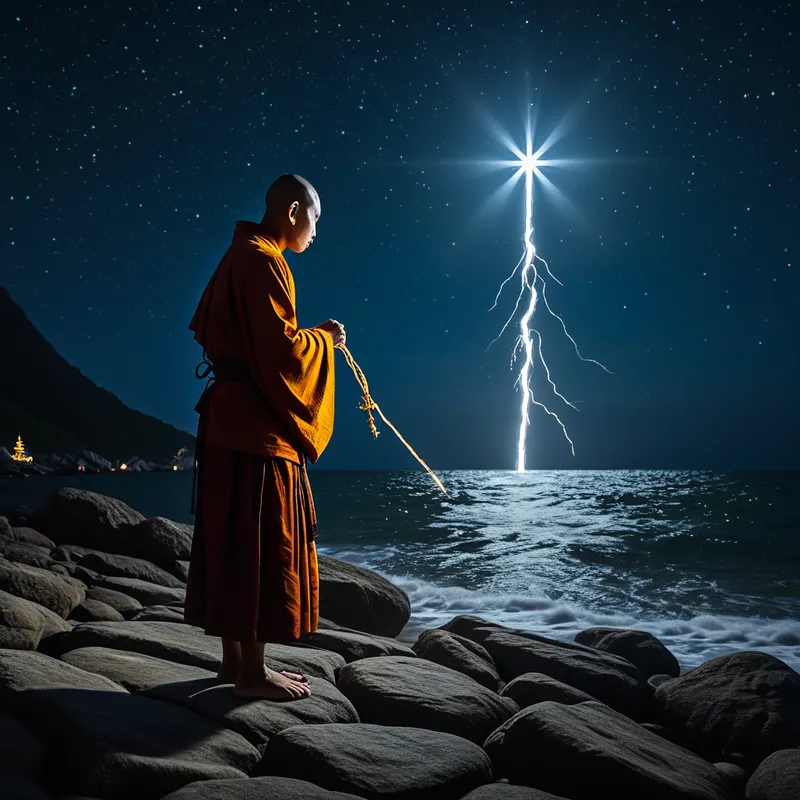
Cultural Origins & Context
Kūkai (774–835 CE) is a unique figure straddling history and myth. Unlike purely legendary kami, he is a documented historical person—a scholar, engineer, poet, and the founder of the Shingon school of Buddhism. The mythologization of Kūkai began almost immediately after his entry into eternal meditation. He was posthumously given the honorific title Kōbō Daishi, “The Great Master Who Propagated the Dharma.”
His stories were passed down not just by monastic lineages but through popular folklore along the Shikoku Pilgrimage, a route intimately tied to his legendary travels. These tales, told by pilgrims and villagers, transformed the erudite monk into a folk hero and a bodhisattva of compassion. He became the archetypal wise man who could strike the ground to create a spring, who could converse with dragons, and whose spiritual power was as tangible as the bridges he built or the calligraphy he brushed. This myth served a crucial societal function: it made the lofty, complex ideals of esoteric Buddhism accessible and immediate. Kōbō Daishi was not a remote Buddha; he was a friend of the people, a protector of the nation, and proof that ultimate realization was possible within the human journey.
Symbolic Architecture
At its core, Kūkai’s myth is a master symbol of the quest for authentic knowledge and the subsequent embodiment of that knowledge. His journey maps the archetypal passage from seeking to finding to becoming.
The true mandala is not drawn on silk; it is inscribed in the body, spoken by the tongue, and realized in the heart-mind. The microcosm and macrocosm are not separate realms to be bridged, but a single truth to be recognized.
His initial asceticism represents the necessary but incomplete stage of purification and longing. The perilous sea voyage to China is the classic night sea journey, a venture into the chaotic unknown of the foreign and the unconscious to retrieve a vital treasure. The master Hui Guo recognizing him symbolizes the moment of psychic recognition, where the seeker’s inner readiness meets the external transmission of gnosis. This is the gift of the Senex.
Most profoundly, Kūkai’s life after his return symbolizes the alchemy of service. The secret teachings (mikkyō) are not for private ecstasy but for public good—digging wells, educating, healing. His final, eternal samadhi on Mount Kōya completes the symbol: the individual consciousness (Kūkai) fully dissolves into and sustains the universal consciousness (Dainichi). The sage becomes the landscape; the knower becomes the known.
The Dreamer's Resonance
When the pattern of Kūkai’s myth stirs in the modern dreamer, it signals a profound psychic transition from seeking external authority to cultivating inner authenticity. To dream of a long, arduous journey toward a distant teacher or city may reflect a deep, often frustrating thirst for real knowledge—not facts, but transformative wisdom that makes sense of one’s life.
Dreams of trying to recite a forgotten mantra, or of a teacher who speaks in a language you almost understand, point to the psyche’s readiness to receive a new “transmission.” It is the intuition that a key piece of understanding is within reach, if only one can find the right “master” or inner state to unlock it. Somatically, this can feel like a pressure in the chest or throat—the wisdom seeking to be voiced, the mantra seeking to be born.
Conversely, dreams of becoming like a mountain, or of one’s body merging with a tree or landscape, resonate with the myth’s final stage. This suggests a psychological process of grounding and integration, where newly realized insights are becoming the bedrock of the personality itself. The seeker is beginning to become the sage.
Alchemical Translation
For the modern individual, Kūkai’s myth models the complete arc of individuation. It begins with the Orphan stage: feeling that the prevailing “sutras” of one’s culture—its values, career paths, identities—are inadequate, leaving one spiritually homeless.
The first transmutation is the courage to become a pilgrim in your own life, to declare the common world insufficient and set out for your personal ‘Tang.’
The voyage and study represent the Hermit and Scholar phases—a disciplined withdrawal and dedicated study of the inner and outer worlds (psychology, art, science, meditation) to acquire your unique “esoteric teaching.” The encounter with the inner Master (Hui Guo) is the critical juncture of Aha! or gnosis, where intellectual knowledge drops into the heart and becomes lived truth.
The final, and most challenging alchemy, is the return. This is the translation of personal insight into world-building. It is the artist creating their work, the therapist founding a practice, the engineer applying their skill for communal good—the building of your own “Mount Kōya.” The eternal samadhi is not literal death, but the achievement of a state where one’s core purpose and consciousness are so aligned that action arises from being. The struggle for a separate self dissolves into the effortless activity of one’s true nature. The individual ego, having sought the cosmic Buddha, discovers it was never anything else.
Associated Symbols
Explore related symbols from the CaleaDream lexicon: