Kirin Myth Meaning & Symbolism
A celestial beast of pure omen appears only in eras of perfect virtue, embodying divine justice, profound peace, and the arrival of a sage ruler.
The Tale of Kirin
Listen, and let the veil between worlds grow thin. In an age lost to the scrolls, when the land was ruled by the clamor of ambition and the whisper of deceit, the heavens grew heavy with silence. The people toiled under skies that promised nothing, their prayers rising like smoke and dissipating into the indifferent air. The emperor, a man of weary wisdom, sat upon a throne that felt more like a cage of jade and expectation. He sought not conquest, but a sign—a single thread of celestial intent woven into the tapestry of his reign.
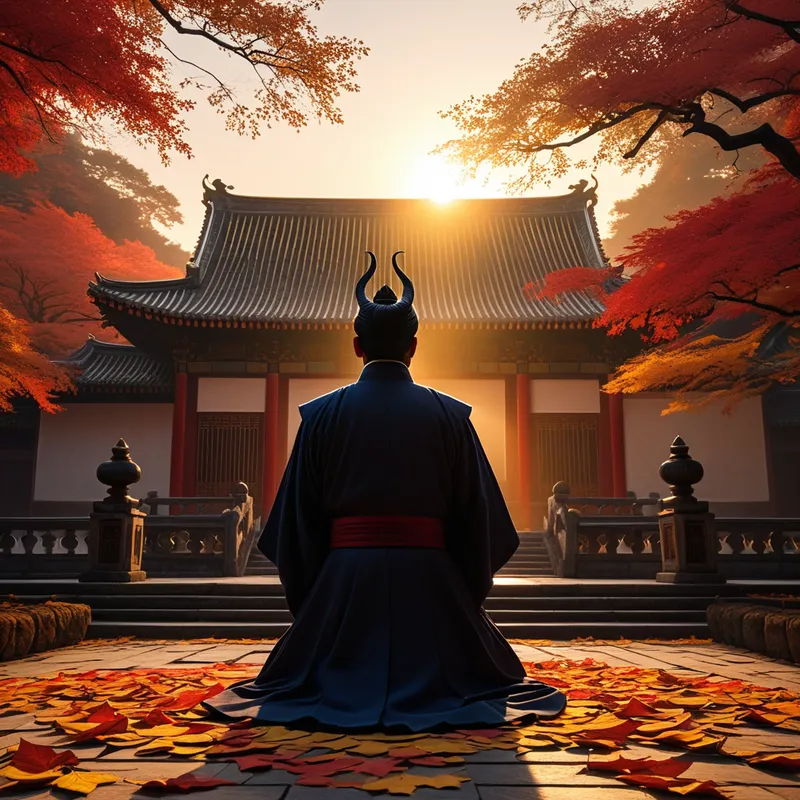
Then, in the season when the maple leaves blush crimson with the blood of the dying year, the air itself changed. It was in the sacred hour between dog and wolf, twilight’s deep breath. A hush fell over the imperial gardens, so profound the crickets ceased their song. The very bamboo stalks stilled, holding their breath. From the western quarter, where the last embers of the sun bled into violet, a soft luminescence began to grow.
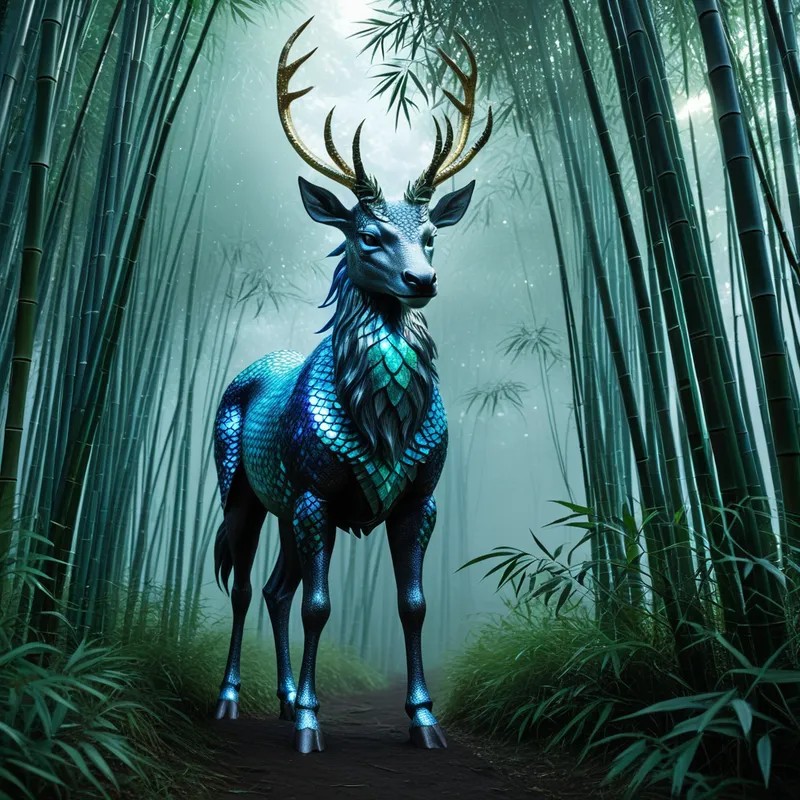
It moved with a sound like silk brushing against silk, a whisper of scales and grace. Through the mist it came—a creature of impossible synthesis. Its body was that of a mighty stag, yet clad not in fur, but in the armor of a dragon, each scale a mirror to the fading sky. Its head was noble and draconic, but its eyes held the deep, knowing peace of ancient forests, not fire. From its brow spiraled a single horn, a shaft of polished pearl that gathered the twilight and made it its own. Its tail was a plume of sacred flame, burning without heat, and its hooves were said to touch the earth so lightly they left no mark, sparing even the blade of grass.
The Kirin did not charge; it appeared. It stood at the edge of the emperor’s viewing pavilion, a living sculpture of omen. It made no sound, yet its presence was a thunderous quiet that shook the soul. The emperor, forsaking all ceremony, knelt. He saw in its gaze not judgment, but a reflection—a reflection of a potential world, a kingdom aligned with the virtuous pulse of the cosmos. The beast lowered its head, not in submission, but in acknowledgment. For three days and three nights, it was said to walk the borders of the capital, a silent, radiant sentinel. Then, as dawn broke on the fourth day, it simply faded, dissolving into the rising sun like a dream upon waking. But the land was changed. A profound peace, a tangible sense of right order, settled upon the realm. The emperor ruled with a renewed, quiet certainty, for he had been witnessed by heaven’s own messenger. The Kirin had come, and its coming was the answer.
Cultural Origins & Context
The Kirin (or Qilin in Chinese) is a myth that traveled the Silk Road of the spirit, entering Japan with other elements of continental culture, Buddhism, and Confucian thought. It is not a native kami of the Shinto tradition, but a celestial being belonging to a higher, universal order. Its primary function was not as a object of worship, but as a supreme omen and a symbolic benchmark for earthly rule.
In Japan, the Kirin found its home in courtly literature, historical chronicles, and art. It was the property of scholars and the ruling class, a symbol used to legitimize and philosophically ground imperial authority. Its appearance in texts like the Nihon Shoki was not a call to adventure, but a stamp of cosmological approval. The myth served a profound societal function: it posited that true sovereignty was not derived from military might or lineage alone, but from toku—virtue, moral power. The Kirin was the external, miraculous validation of an internal, invisible quality. It was a narrative tool that held the ruler accountable to a heavenly standard, suggesting that the harmony of the nation was directly tied to the moral character of its leader.
Symbolic Architecture
The Kirin is a masterpiece of symbolic architecture, a composite creature where every element is a deliberate cipher. It is a walking paradox, embodying the reconciliation of opposites—the ultimate symbol of auspicious paradox.
Its deer-like body symbolizes gentleness, peace, and a connection to the natural world. The dragon scales represent power, protection, and celestial authority. The single horn, often likened to that of a unicorn, is not a weapon but a symbol of focused purity, a laser of benevolent intent that pierces confusion. Its hooves that do not crush grass speak of a consciousness so elevated it exists in harmony with all life, causing no unnecessary harm. It is a carnivore that refuses to eat living flesh, subsisting on air and virtue—a being of immense power that utterly refuses to wield that power destructively.
The Kirin does not conquer; it consecrates. It is the embodiment of the principle that the highest strength is expressed as perfect restraint.
Psychologically, the Kirin represents the Self in its most integrated, individuated form—what Carl Jung might call the Self. It is the psychic entity that emerges when our inner conflicts (animal/dragon, gentle/powerful) are not fought, but synthesized into a new, transcendent form. It is the "peace that passeth understanding" made manifest, the internal ruler whose authority is based not on the tyranny of the ego, but on the authentic virtue of the whole personality.
The Dreamer's Resonance
When the image of the Kirin surfaces in the modern dreamscape, it is rarely as a simple, majestic animal. It appears as a feeling of profound, unsettling peace, or as a luminous, silent figure at the periphery of a chaotic dream narrative. To dream of the Kirin is to encounter the psyche’s own announcement of a profound internal shift.
Somatically, the dreamer may report a sensation of awe, a chilling stillness, or a warm, expansive light in the chest—the body recognizing a truth the mind has yet to articulate. Psychologically, this dream marks a crossroads where a long-held inner conflict is resolving not through battle, but through a mysterious, graceful synthesis. It often appears after a period of intense moral struggle or ethical refinement, when the ego has exhausted its efforts and surrendered to a deeper process. The Kirin-dream is the unconscious confirming that one’s actions or life direction are now in alignment with a more authentic, soul-level purpose. Its silence in the dream is critical; it does not give instructions, it is the instruction. It signifies the arrival of a new, internal authority based on integrity, not force.
Alchemical Translation
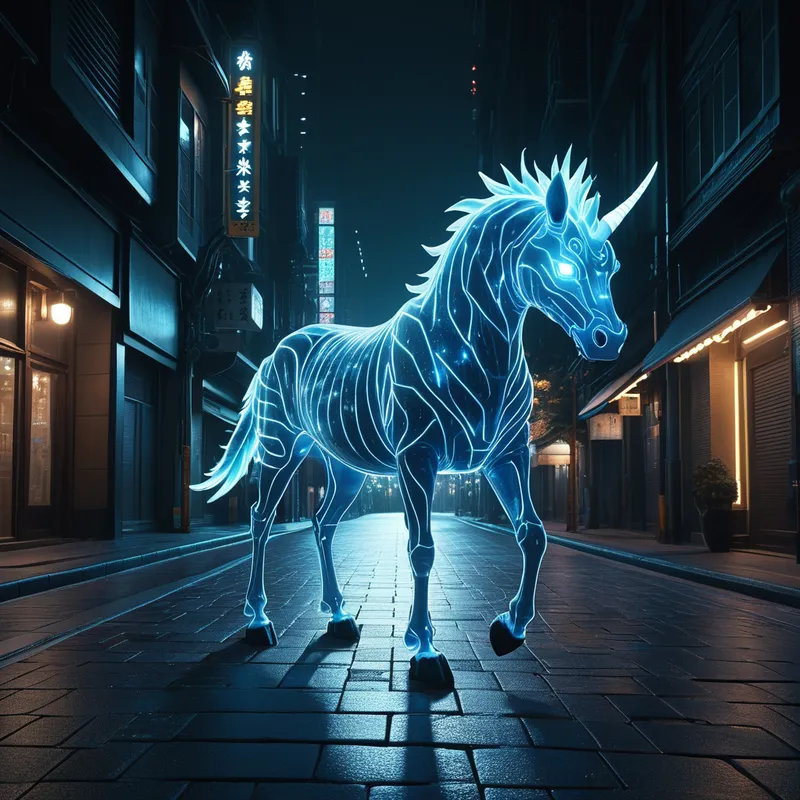
The myth of the Kirin models a specific and rare form of psychic alchemy: the transmutation through presence, not process. Unlike the hero’s arduous journey or the phoenix’s fiery death and rebirth, the Kirin’s "work" is its mere being. Its appearance is the transformation.
For the modern individual engaged in the work of individuation, the Kirin myth teaches that the ultimate goal is not to become a warrior who defeats their shadow, but to become a vessel so refined that the shadow and the light can coexist in a harmonious, chimeric form. The alchemical operation here is coagulatio—the bringing together of disparate elements into a sacred, solid body of the Self.
The struggle is not to find the sage, but to create the inner conditions—the virtuous reign—to which the sage within will deign to appear.
The modern seeker’s "imperial garden" is their own lifestyle, ethics, and relationship to power. The "conflict" is the daily choice between egoic force and authentic virtue. The "rising action" is the gradual, often unnoticed, commitment to causing less harm, speaking with more truth, acting with more integrity. There is no dramatic climax, only a dawning realization. The "resolution" is the sudden, graceful arrival of an inner state where one’s power is naturally aligned with peace, where authority feels like responsibility, not privilege. One does not chase the Kirin. One cultivates the realm to which it belongs, and one day, in the twilight of an old way of being, it simply steps forward from the mist of the unconscious, a living testament that the alchemy is complete. The reign of the integrated Self has begun.
Associated Symbols
Explore related symbols from the CaleaDream lexicon: