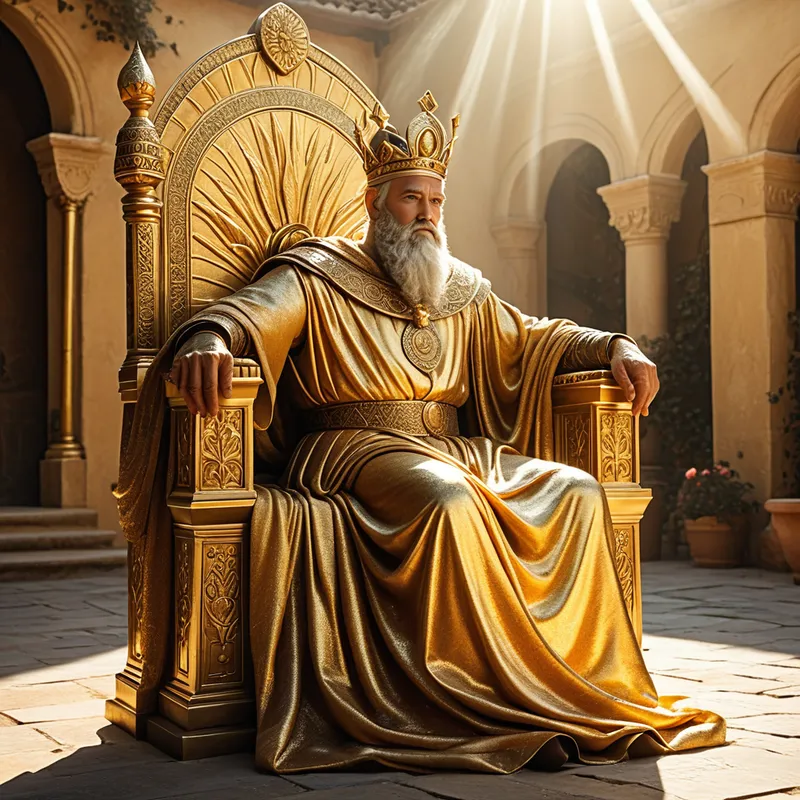
King Midas and the golden touc Myth Meaning & Symbolism
A king's wish for a golden touch becomes a curse, teaching that true wealth lies not in gold, but in the warmth of human connection.
The Tale of King Midas and the golden touc
In the sun-baked hills of ancient Phrygia, where [the river](/myths/the-river “Myth from Buddhist culture.”/) Pactolus whispered secrets to the reeds, there ruled a king named [Midas](/myths/midas “Myth from Global/Universal culture.”/). His wealth was legendary, his vaults groaned with treasure, yet a hollow echo resided in his heart—a whisper that no amount of coin could ever truly fill. He wandered his lush gardens, a king amidst abundance, yet his eyes were forever fixed on the gleam of metal, not the bloom of the flower.
One day, his servants found an old, drunken satyr, [Silenus](/myths/silenus “Myth from Greek culture.”/), sleeping in the king’s prized rose garden. Instead of driving him out, Midas recognized the companion of the god Dionysus. For ten days and nights, Midas hosted the reveler with feasts and music, treating him as an honored guest. When Dionysus, grateful for the kindness shown to his beloved teacher, appeared in a wreath of ivy and vine, he offered Midas any boon his heart desired.
The king did not hesitate. His mind, polished smooth by avarice, reflected only one image. “Grant me,” he said, his voice trembling with desire, “that everything I touch be turned to gold.”
A shadow passed over the god’s face, a flicker of divine pity. “So be it,” Dionysus intoned, and a strange, cold warmth seeped into Midas’s bones.
At first, it was a miracle. He brushed an oak branch in his courtyard—it shimmered, hardened, became a statue of purest gold. He lifted a stone—it grew heavy and brilliant in his palm. He ran to his palace, giddy, touching a column, a door, a table. Each object sang a silent, metallic chime as it transformed. He was a creator, a god of instant wealth! He called for a feast to celebrate his boundless fortune.
A servant placed a loaf of bread before him. He reached for it, his fingers closing around the crust. It solidified into a dense, inedible lump. He raised a cup of wine to his lips. The liquid thickened, congealed into a golden syrup that coated his throat. Panic, cold and sharp, pierced his euphoria. He touched a fig, an apple—all became beautiful, worthless metal.
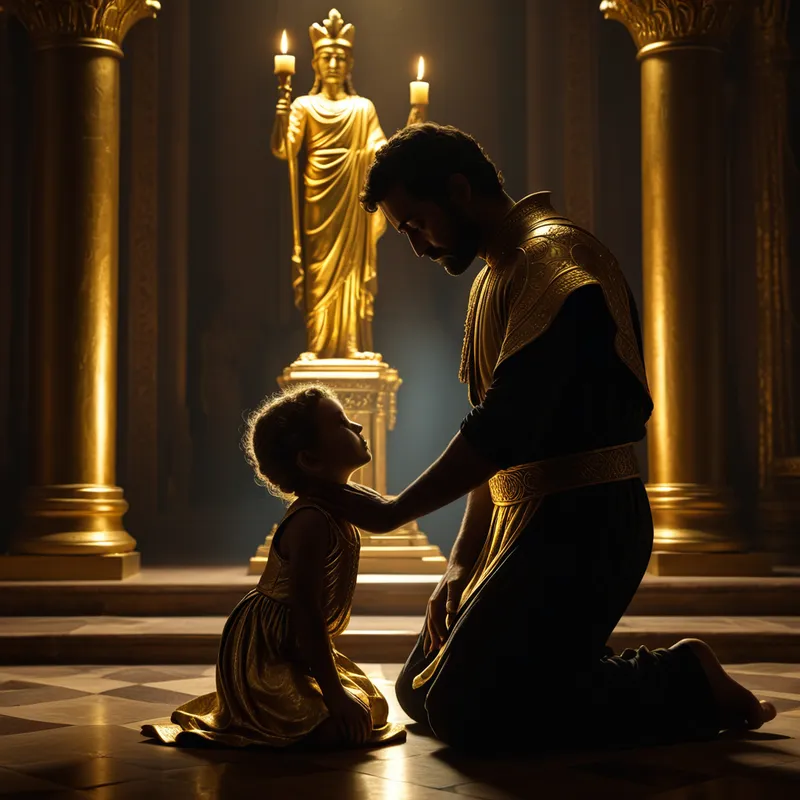
Then, his young daughter, hearing his cries of distress, ran to him and threw her arms around his neck. He felt her warm breath on his cheek, then a sudden stiffness. Her loving embrace became a rigid, unmoving pressure. He pulled back in horror to see her face, a moment of concern forever captured in a mask of flawless, chilling gold. His greatest treasure had become a tomb.
The king’s wail echoed through the golden halls. He had built a mausoleum of his own making. Clawing at his own golden robes, he stumbled back to the riverbank where Dionysus had granted his wish. He fell to his knees in the mud, his tears cutting tracks through the dust on his face. “God of the vine, forgive a foolish man! Take back this terrible gift! I would give all my gold for a crust of bread, for the warmth of my child’s hand!”
The river seemed to hold its breath. Then, the voice of Dionysus flowed from the [water](/myths/water “Myth from Chinese culture.”/) and [the wind](/myths/the-wind “Myth from Various culture.”/). “Go to the source of the Pactolus. Bathe in its waters. What you have so foolishly asked for, the river will wash away.”
Midas plunged into the headwaters. A strange, glittering silt—the very essence of his curse—was carried from his skin, settling in the riverbed, legend says, as the first gold dust of the Pactolus. He emerged, shivering, human. He ran back to his palace, his heart pounding not with greed, but with terror and hope. He touched the golden statue of his daughter. Under his trembling fingers, the gold softened, warmed, flushed with color. Life returned to her eyes, and she drew breath, confused but alive. The king wept, holding her, feeling the simple, profound wealth of a beating heart against his own.
Cultural Origins & Context
The myth of Midas is primarily preserved through the lens of Greek literature, most notably in Ovid’s [Metamorphoses](/myths/metamorphoses “Myth from Greek culture.”/), yet it speaks with the accent of an older, Anatolian world. Historically, a [King Midas](/myths/king-midas “Myth from Greek culture.”/) ruled the Phrygian kingdom in the 8th century BCE, a figure of immense wealth and power. The Greeks, encountering the splendor of Phrygia, wove historical memory into archetypal narrative.
This was a story told not just in royal courts but in symposia and public gatherings, a cautionary tale that functioned as social and psychological ballast. In a culture navigating the rise of coinage and monetary economy, the myth served as a profound check on the human spirit. It asked a critical question of an increasingly mercantile age: when everything has a price, what becomes of that which is priceless? The storyteller, whether a bard or a philosopher, used Midas to delineate the sacred boundary between [the market](/myths/the-market “Myth from Various culture.”/) and [the hearth](/myths/the-hearth “Myth from Norse culture.”/), between chremata and philia. It was a myth that warned a civilization, in its ascent, not to confuse means with ends.
Symbolic Architecture
At its core, the myth is an anatomy of a psychic [inflation](/symbols/inflation “Symbol: A dream symbol representing feelings of diminishing value, loss of control, or expansion beyond sustainable limits in one’s life or psyche.”/)—the identification of [the ego](/myths/the-ego “Myth from Jungian culture.”/) with a divine or magical power. The golden touch is not merely a power of creation, but of [fixation](/symbols/fixation “Symbol: An obsessive focus on a single idea, object, or person, often representing a spiritual blockage or an unresolved archetypal pattern.”/). It is the literalization of a single value, the monomaniacal [application](/symbols/application “Symbol: An application symbolizes engagement, integration of knowledge, or the pursuit of goals, often representing self-improvement and personal development.”/) of one principle to the multifaceted complexity of [life](/symbols/life “Symbol: The symbol of ‘Life’ represents a journey of growth, interconnectedness, and existential meaning, encompassing both the joys and challenges that define human experience.”/).
The golden touch is the psyche’s capacity to turn living process into dead artifact, to mistake the symbol for the thing itself.
Gold here symbolizes absolute, [static](/symbols/static “Symbol: Static represents interference, disruption, and the breakdown of clear communication or signal, often evoking feelings of frustration and disconnection.”/) value. It is the end of exchange, the cessation of flow. To turn [food](/symbols/food “Symbol: Food in dreams often symbolizes nourishment, both physical and emotional, representing the fulfillment of basic needs as well as deeper desires for connection or growth.”/) to gold is to sever the [connection](/symbols/connection “Symbol: Connection symbolizes relationships, communication, and bonds among individuals.”/) between need and nourishment. To turn a loved one to gold is to enact the ultimate objectification, valuing the [idea](/symbols/idea “Symbol: An ‘Idea’ represents a spark of creativity, innovation, or realization, often emerging as a solution to a problem or a new outlook on life.”/) of possession over the dynamic [reality](/symbols/reality “Symbol: Reality signifies the state of existence and perception, often reflecting one’s understanding of truth and life experiences.”/) of [relationship](/symbols/relationship “Symbol: A representation of connections we have with others in our lives, often reflecting our emotional state.”/). Midas becomes a [prisoner](/symbols/prisoner “Symbol: Being a prisoner in a dream often symbolizes feelings of restriction, lack of freedom, or entrapment in waking life.”/) in a [universe](/symbols/universe “Symbol: The universe symbolizes vastness, interconnectedness, and the mysteries of existence beyond the individual self.”/) of his own making, a solipsistic [realm](/symbols/realm “Symbol: The symbol of ‘Realm’ often signifies the boundaries of one’s consciousness, experiences, or emotional states, suggesting aspects of reality that are either explored or ignored.”/) where all mirrors reflect back only his own desire. The [river](/symbols/river “Symbol: A river often symbolizes the flow of emotions, the passage of time, and life’s journey, reflecting transitions and movement in one’s life.”/) Pactolus, then, represents the necessary [dissolution](/symbols/dissolution “Symbol: The process of breaking down, dispersing, or losing form, often representing transformation, release, or the end of a state of being.”/). It is the fluid, cleansing principle of [psyche](/myths/psyche “Myth from Greek culture.”/) that must wash away the rigid, conscious ego’s catastrophic wish. The [redemption](/symbols/redemption “Symbol: A theme in arts and music representing transformation from failure or sin to salvation, often through creative expression or cathartic performance.”/) is not in renouncing value, but in re-discovering its [source](/symbols/source “Symbol: The origin point of something, often representing beginnings, nourishment, or the fundamental cause behind phenomena.”/) in the flowing, living world, not in the frozen hoard.

The Dreamer’s Resonance
When this myth stirs in the modern dreamscape, it rarely appears as a king with a crown. It manifests as a profound somatic anxiety. You may dream that your handshake turns a colleague to stone, or that your kiss leaves a loved one cold and distant. You may find yourself in a house where every object is perfectly beautiful, immaculate, and utterly sterile, and you are dying of hunger and thirst.
These are dreams of the Shadow of ambition, of a success that has cost you your humanity. The “[Midas touch](/myths/midas-touch “Myth from Greek culture.”/)” in dreams is the fear that your drive, your professional skill, or your desire for control is poisoning your connections, turning living relationships into transactional ones, or artistic expression into a commodity. The body feels heavy, metallic, cold—a somatic signal of emotional isolation. The dream is a crisis of contact, warning that the dreamer’s mode of engaging with [the world](/myths/the-world “Myth from Tarot culture.”/) is becoming a force of petrification rather than nurturance. The turning point in such a dream is often an encounter with water—tears, a river, a rainstorm—signaling the unconscious’s move toward liquefaction and emotional release.

Alchemical Translation
The path of Midas is a stark roadmap for a critical phase of individuation: the confrontation with the negredo, the blackening, that follows an ego inflation. [The alchemist](/myths/the-alchemist “Myth from Various culture.”/) seeks to turn lead into gold, but Midas commits the fatal error of seeking to turn everything into gold, skipping the necessary stages of dissolution and putrefaction.
His journey models the psychic transmutation from the Ruler archetype in its shadow aspect—the tyrant who demands the world conform to his will—to the Ruler in its mature form: the steward who nurtures his kingdom. The initial “gold” he creates is aurum vulgi, [the fool](/myths/the-fool “Myth from Tarot culture.”/)’s gold of literal wealth and status. The curse forces him into the [solutio](/myths/solutio “Myth from Alchemical culture.”/), the dissolution in the river of his own tears and regret. He is stripped bare, humbled, reduced to his essential human need.
The final gold, the aurum philosophicum, is not a substance he owns, but a realization he embodies: that true sovereignty is the capacity to hold the living, the mutable, and the vulnerable as sacred.
His redemption is the alchemical coniunctio—the sacred reunion—with his daughter, symbolizing the redeemed relationship to his own soul, his capacity for feeling and relatedness, which he had nearly sacrificed on the altar of his wish. For the modern individual, the myth instructs that any gift, any talent, any drive, if not integrated with humility and compassion, becomes a curse. Our task is not to acquire a golden touch, but to learn the touch that turns gold back into life.
Associated Symbols
Explore related symbols from the CaleaDream lexicon: