Kensho Myth Meaning & Symbolism
A sudden, shattering glimpse of true nature, where the constructed self dissolves into luminous, boundless reality, leaving only the suchness of things.
The Tale of Kensho
Listen. There is a story not of gods or demons, but of a crack in the world.
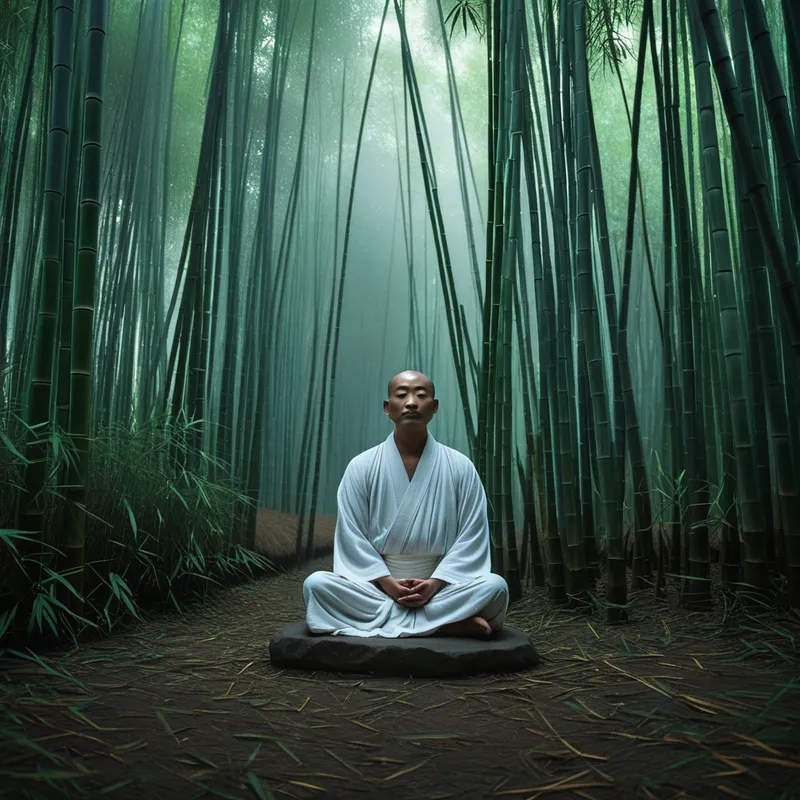
It begins in the ordinary realm of dust and toil. A seeker, weary from a lifetime of polishing stones, hoping to find a jewel within. They sit in the prescribed posture, in the prescribed hall, following the breath as a prisoner follows the walls of their cell. The mind is a marketplace of clamoring thoughts: Am I doing it right? When will I see it? What is the point of this endless sitting? The world is solid, heavy, defined. The mountain is a mountain. The river is a river. The self is a knot of history and hunger, sitting on this cushion.
Then, a moment. Not born of effort, but arriving like a thief in the temple of certainty.
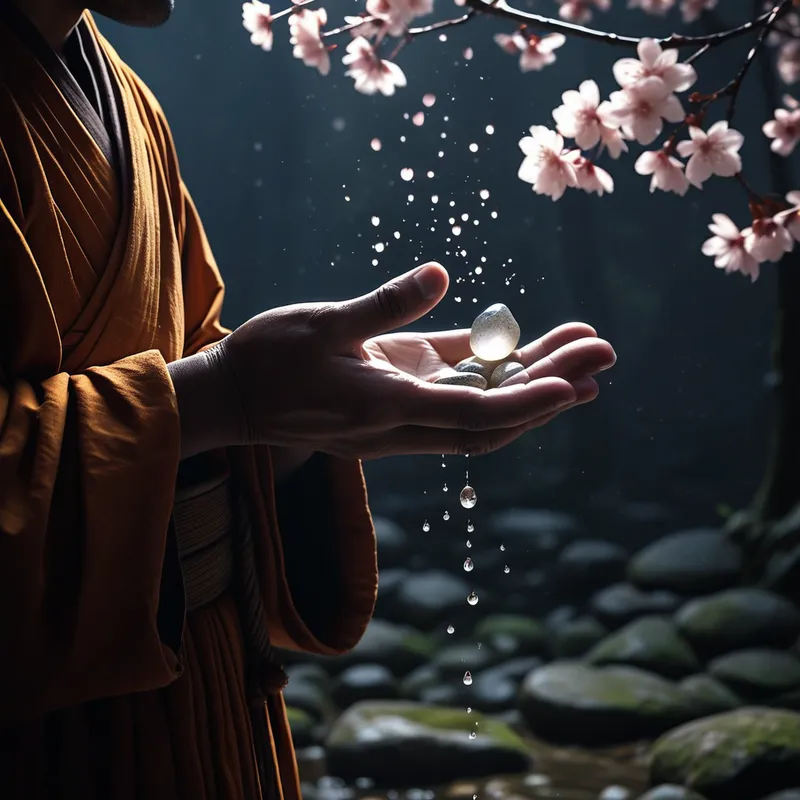
Perhaps it is the sound of a single pebble striking bamboo. Not the sound itself, but the silence that swallows it. Perhaps it is the sight of a plum blossom falling, and in its arc, the entire history of spring and decay is written and erased. In that instant, the scaffolding of the world gives way.
The mountain is no longer a mountain. It is a roaring, singing congregation of particles, of light and stone, of time itself wearing a green cloak. The river is no longer a river, but the very bloodstream of the earth, and the seeker is not separate from its flow. The knot of self—the name, the story, the ache—unties itself. It does not vanish, but expands, dissolves, becomes transparent. There is no “I” seeing the mountain. There is only seeing. The boundary between seer and seen, knower and known, breather and breath, evaporates like morning mist under a sudden sun.
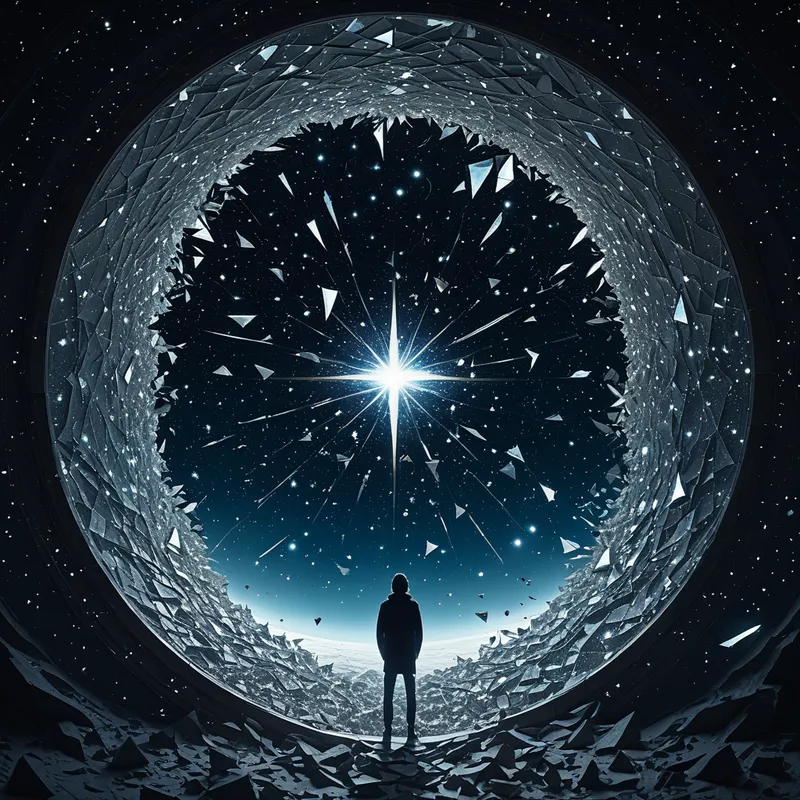
It is a shattering of glass, but the glass was the lens through which everything was viewed. What remains is not nothingness, but a breathtaking, luminous suchness. Everything is exactly as it is, and in that, it is miraculously, unbearably perfect. The ordinary is revealed as the sacred. The stone floor is the Buddha’s palm. The chatter of birds is the sutra.
This is not an end. The light fades, as all dawns must. The mountain settles back into being a mountain. The river resumes its course. But the crack remains. The world has been seen through, and it can never be entirely solid again. The seeker rises, their body the same, yet everything is different. They have glimpsed the source, and though they must walk again in the world of dust, they carry a secret dawn within their chest.
Cultural Origins & Context
The term Kensho finds its roots in the Zen traditions of China and Japan. It is not a myth in the classical sense of a narrative about external deities, but rather a mythologized experience—a map of the territory of awakening that has been passed down through countless personal testimonies and teaching stories (koans).
Its primary transmission was not through texts alone, but in the intimate, fierce crucible of the teacher-student relationship within monastic communities. The master, having traversed the territory, would use direct pointing, paradoxical statements, or even a sudden shout or blow to shatter the student’s conceptual mind, creating the conditions where Kensho might flash forth. Its societal function was radical: to verify authentic awakening, to separate genuine insight from tranquilized states or intellectual understanding, and to ignite the continuous process of integration known as satori.
Symbolic Architecture
Psychologically, Kensho represents the catastrophic and ecstatic dissolution of the ego-complex. The constructed self, with its defenses, narratives, and perpetual sense of lack, is seen through as a contingent, transparent phenomenon, not a solid entity.
The prison was not made of walls, but of the belief that one was inside something. Kensho is the moment the prisoner realizes they are the space in which the prison appears.
The “mountain” and “river” symbolize the phenomenal world of objects and distinctions (<abbr title="Sanskrit: 'phenomenal, conditioned reality as perceived through the senses and mind'>samsara). Their transformation represents the shift from perceiving reality through the filter of subject-object duality to experiencing it directly, in its interdependent, non-dual suchness (tathata). The suddenness of the event underscores that this is not an intellectual achievement but a perceptual revolution—a falling away of the veil, not a gradual painting of a new picture.
The Dreamer's Resonance
In modern dreams, the pattern of Kensho does not appear as a Buddhist monk on a cushion. It manifests as dreams of profound, wordless realization. A dream where one looks in a mirror and sees a beloved ancestor, a starfield, or a smiling stranger—and knows this, too, is “me.” A dream where the walls of a familiar room become insubstantial, revealing a vast landscape beyond. A dream of hearing a secret that explains everything, yet upon waking, the words are gone, leaving only a residue of oceanic peace.
Somatically, the dreamer may awaken with a sense of expansion, lightness, or a curious disorientation where the solidity of their personal identity feels temporarily softened. Psychologically, these dreams often occur during periods of intense inner work, burnout of old ego strategies, or deep grief—when the psyche is ripe for a restructuring. They signal the unconscious initiating a spontaneous process of de-integration, making space for a broader, more authentic consciousness to emerge.
Alchemical Translation
The alchemical journey of individuation finds a powerful model in the Kensho myth. The first stage, nigredo (the blackening), is the seeker’s sincere confrontation with suffering, doubt, and the “great matter of life and death.” The relentless meditation, the koan that will not be solved, represents this dissolution of certainty.
The alchemical fire is not willpower, but the heat generated when the mind turns back upon itself and consumes its own assumptions.
Kensho itself is the dazzling albedo (the whitening)—the sudden, silver flash of the luna illuminating the darkness. It is the direct experience of the Self (Self), as distinct from the ego. This is not the end of the work, but its true beginning. The final, arduous stages of citrinitas (yellowing) and rubedo (reddening) mirror the Zen path of satori—the gradual, lifelong integration of that flash into every cell, relationship, and moment of daily life. The stone must be turned to gold not once in the furnace, but continuously in the marketplace. The modern individual’s triumph is not in achieving a permanent peak experience, but in allowing that glimpse of boundless reality to continually inform and transform their finite, human journey. The mountain becomes a mountain again, but now, it is a mountain seen with the eyes of the source from which both mountains and seers arise.
Associated Symbols
Explore related symbols from the CaleaDream lexicon: