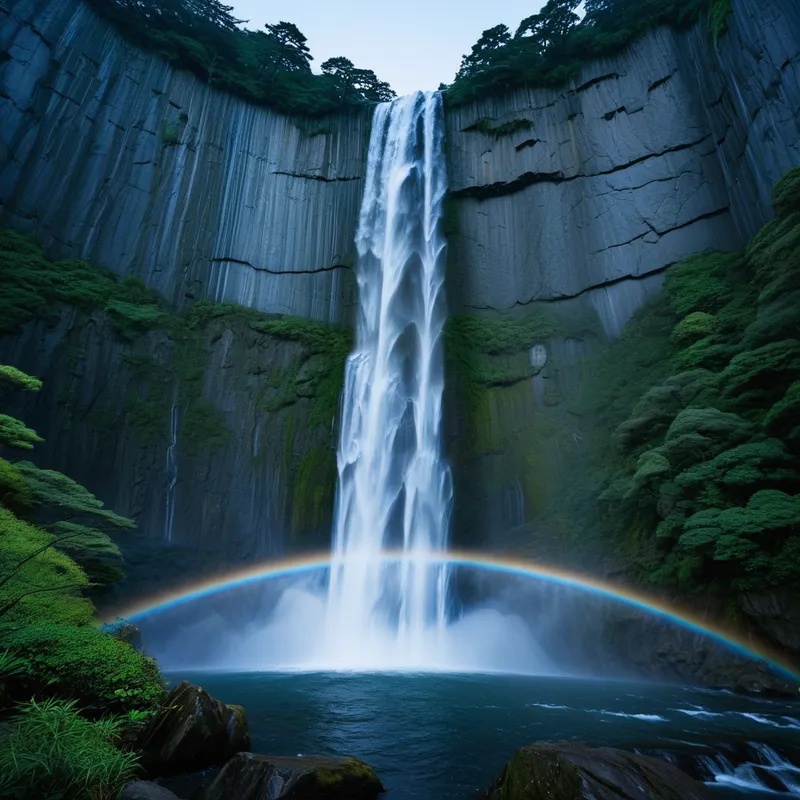
Kegon Falls Myth Meaning & Symbolism
A tale of a young god's love for a mortal, his tragic fall, and the eternal waterfall born from divine tears and a mother's boundless compassion.
The Tale of Kegon Falls
Listen, and hear the water’s ancient song. It does not begin with a crash, but with a whisper in the high, sacred peaks of Nantai-san. Here, among the cedars that touch the clouds, dwelled the mountain’s spirit, a young and vibrant kami named for the mountain itself. His domain was the wind in the passes, the snow on the summit, the silent strength of stone. Yet, from his lofty throne, his gaze was drawn earthward, to a flicker of warmth in the valley below—a humble village where mortals lived their brief, burning lives.
There, he saw her. A maiden of such grace and gentle spirit that the very sunlight seemed to linger on her path. Her laughter was the sound of a clear stream, and in her eyes, he saw a world more vivid than any vista from his peak. The god’s heart, a timeless force of nature, was pierced by a human ache. Love, a tempest unknown to the eternal mountains, swept through him. Casting aside his divine form, he descended. He took the shape of a handsome youth and walked into her world.
Their meeting was not of storm and earthquake, but of shared glances and quiet words by the village well. He was a stranger from the high trails, he said. She, with a heart open as a meadow, welcomed him. Their love bloomed like the sudden, brilliant flowers of the alpine summer. For a season, the god knew mortal joy—the warmth of a hand, the shared silence of evening, the fragile, precious beauty of a life measured in heartbeats. He built a life with her in the shadow of his own mountain.
But the cosmos has its balance. A kami cannot live a mortal life without consequence. The very fabric of his being began to fray. Some say the other gods of the land grew wary; others whisper that mortal existence is a poison to the divine. A sickness took him—a wasting shadow that no herb or prayer could cure. It was the world itself rejecting his chosen form. As he lay dying in the arms of his weeping wife, he finally revealed his truth. “I am the spirit of the mountain,” he breathed. “My love for you was my undoing, and I do not regret it.”
With his last breath, his mortal shell dissolved. His essence, his tama, fled back to the peaks from whence it came. His mortal wife was left with empty arms and a heart shattered like river ice. Her grief was a torrent that could not be contained. She ran from the village, up the treacherous paths, following the pull of her lost love’s spirit. For days she climbed, fueled by despair, until she stood at the very brink of a great cliff on Nantai-san, where the lake Chūzenji spills over the earth’s lip.
Looking down into the dizzying abyss, she saw not an end, but a reunion. In her profound sorrow, she did not leap to her death. Instead, she wept. And as she wept, a miracle of compassion unfolded. The Yaoyorozu no Kami, the Eight Million Gods, witnessed her boundless love and bottomless pain. Moved by a fidelity that bridged the human and the divine, they acted. Her tears multiplied, merging with the waters of the lake. The cliff face opened, and the lake poured forth—not as a mere river, but as a thunderous, eternal cascade.
And within the roaring heart of the newborn waterfall, the gods woven a final mercy. The spirit of the mountain god was not restored to his lonely peak. Instead, he was placed within the everlasting fall, his essence forever mingling with the plunging waters born from his beloved’s tears. She was transformed, her human sorrow alchemized into the waterfall’s enduring presence—a guardian spirit, a chinju no kami, of the sacred site. Thus, Kegon Falls was born: not from geological accident, but from love, loss, and divine grace, a perpetual monument where a god’s love and a mortal’s devotion became one with the land itself.
Cultural Origins & Context
The myth of Kegon Falls is intrinsically tied to the real, awe-inspiring waterfall that descends from Lake Chūzenji at Nikkō, one of Japan’s most sacred landscapes. This story belongs to the rich tapestry of Shinto, a tradition where the natural world is inherently alive with spiritual presence (kami). Unlike centralized mythologies, Shinto stories are often local, explaining the spiritual origin of specific features—a mountain, a rock, a spring, or in this case, a waterfall.
This tale was passed down orally, likely by the kannushi and villagers of the Nikkō region, as a foundation myth for a profoundly numinous site. Its societal function was multifaceted. First, it sacralized the landscape, providing a divine reason for the waterfall’s existence and power, instructing people to approach it with reverence, not just awe. Second, it explored the permeable boundary between the human and divine realms, a core Shinto concept where interaction is possible but fraught with cosmic law. Finally, it served as a narrative vessel for profound human emotions—love, grief, sacrifice—elevating them to a cosmic scale and offering a framework for understanding profound loss as something that can, through the compassion of the Yaoyorozu no Kami, be transformed into something eternally beautiful and powerful.
Symbolic Architecture
At its core, this myth is an alchemical diagram of relationship and its ultimate cost. The mountain god, Nantai, represents the archetypal Spirit of Stasis—eternal, unchanging, and anchored. His love for the mortal maiden is the irresistible call of the Other, the world of process, emotion, and decay. His descent is the ultimate act of incarnation, a divine being willingly entering the realm of time, vulnerability, and death.
The waterfall is the manifest symbol of the soul’s journey: a descent that is not a fall into oblivion, but a necessary plunge into the depths of experience to find a new, dynamic form of being.
The maiden represents humanity’s capacity for a love so deep it pursues the divine into the very heart of mystery. Her climb is the ascent of grief, a journey from passive sorrow to active, desperate seeking. Her tears are not just saltwater; they are the liquefied essence of her soul, the currency of her devotion. The miraculous intervention of the gods signifies that in the economy of the cosmos, such profound emotional truth has weight and can alter reality. The waterfall becomes the permanent, dynamic union of the two lovers—the god’s spirit (the force of the water) and the woman’s emotion (the water itself). It is a marriage of spirit and matter, eternity and moment, power and vulnerability.
The Dreamer's Resonance
When this myth stirs in the modern psyche, it often surfaces in dreams of profound relational transformation or loss. To dream of being the god, descending from a high, cold place into a warm but fragile connection, speaks to the soul’s risk of incarnation—of committing to a love, a project, or a life path that demands one’s very essence, knowing it may lead to a kind of death of the old self.
To dream of being the weeping climber, chasing a lost love up a mountain toward a precipice, signals a somatic process of grief-work that is both exhausting and imperative. The body in the dream feels the burn of the climb, the choke of tears, the vertigo at the cliff’s edge. This is the psyche forcing a confrontation with a core loss, not to end in suicide, but to reach the point of absolute emotional truth—the “lake of tears”—from which a new outpouring of the self can begin. The dream may culminate not in a jump, but in the transformative roar of the waterfall, indicating that the dreamer is in the process of alchemizing personal sorrow into a new, powerful expression of their life force.

Alchemical Translation
For the individual on the path of individuation, the Kegon Falls myth models the critical phase of sacrificial incarnation and transmutation through grief. The first step is the god’s choice: the conscious ego (the mountain spirit, secure in its identity) must willingly “fall” into the depths of the unconscious (the human world of relationship, emotion, and the unknown) to retrieve its missing wholeness. This is always a perilous gambit; the old, rigid identity will sicken and die.
The prolonged, agonizing climb of the grieving wife represents the often-tortuous work of integrating this experience. It is the conscious mind struggling to comprehend and process the death of a former state of being—a relationship, a career, a self-image. The tears are the necessary dissolution; the old structures must be liquefied by feeling.
The miracle is not avoiding the plunge, but discovering that the plunge itself is the creation of a new, sacred axis of the personality—a permanent connection between the heights of the spirit and the depths of the heart.
The final, alchemical act is performed by the Yaoyorozu no Kami, which in psychological terms is the transcendent function of the Self—the guiding, unifying center of the total psyche. It takes the raw materials of the experience (the dead god-spirit, the liquid grief) and forges them into a new, eternal dynamic: the waterfall. The individual no longer is the isolated mountain or the dissolved mortal. They become the process itself—the continuous, powerful, beautiful flow between spirit and soul, conscious and unconscious, which is the hallmark of the individuated life. The personal tragedy becomes the source of one’s unique voice, creativity, and enduring power.
Associated Symbols
Explore related symbols from the CaleaDream lexicon: