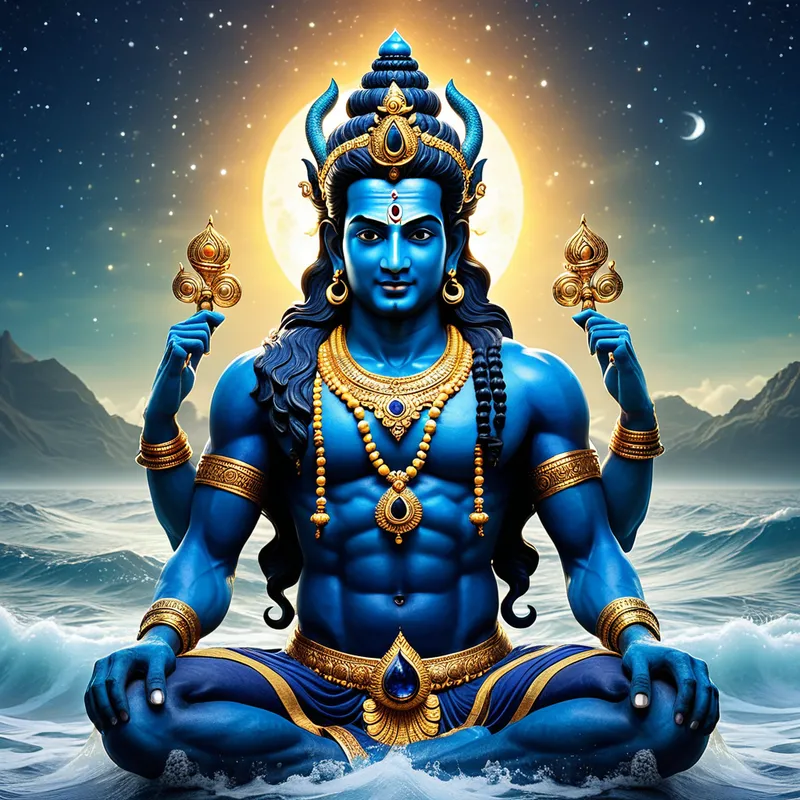
Kaustubha Myth Meaning & Symbolism
The celestial jewel born from the primordial ocean's churning, claimed by Vishnu, symbolizing the luminous, indivisible consciousness won through profound inner struggle.
The Tale of Kaustubha
Listen. Before the worlds were as they are, in the fathomless silence between cycles, the gods grew weary. A subtle poison of entropy, of doubt, had seeped into the marrow of creation. Immortality was theirs, yet they felt a lack—a thirst for the nectar of unassailable being, the amrita. But such a prize cannot be plucked from a tree; it must be wrung from the very fabric of existence.
So they descended to the shore of the Kshira Sagara, the ocean of milk, a placid expanse holding all possibilities in its white depths. Yet they could not stir it alone. They sought an uneasy alliance with their eternal opposites, the asuras. The pact was simple: together, they would churn the ocean of creation itself, and share the spoils. The great serpent-king, Vasuki, was coiled around the cosmic mountain Mandara, which rested on the back of the great turtle, Kurma. Gods at the tail, demons at the head, they began to pull.
The labor was cosmic. The mountain spun, grinding against the turtle’s shell. The ocean, once still, convulsed. From its tortured depths, it first gave forth not treasures, but horrors: a deadly poison, Halahala, that threatened to end all worlds. Then, wonders began to surface: the wish-fulfilling cow, the goddess of wine, the moon. The ocean heaved, a universe in birth pangs.
And then, from the very epicenter of this tumult, where the forces of order and chaos met in a violent, creative vortex, a light emerged. It was not a flash, but a slow, inevitable rising—a concentration of luminosity so pure it seemed to draw all surrounding light into itself. It was the Kaustubha. It did not sparkle with mere reflection; it glowed with its own inner dawn, a perfect, self-contained sun cooled into a jewel. Its facets held the blueprint of clarity, the essence of discernment.
A hush fell, even amidst the churning. All eyes, divine and demonic, beheld it. Desire, sharp and immediate, flared in every heart. But as hands reached and arguments began, a profound presence manifested. It was Vishnu, the all-pervading one, who had been the silent axis of the entire endeavor. Without a word, he approached the radiant gem. There was no struggle, no claim staked. The Kaustubha, as if recognizing its true locus, floated gently to rest upon his chest, over his heart. It settled there, not as an ornament, but as an integral part of his divine form—the luminous seal of his sovereignty, the visible emblem of the consciousness that holds the churning universe in balance. The churning continued, but the first and greatest prize had found its home.

Cultural Origins & Context
The myth of the Kaustubha is embedded within the grander narrative of the Samudra Manthan, one of the most iconic and frequently depicted episodes in Puranic literature. Found in texts like the Vishnu Purana and the Shiva Purana, this story functioned as a cosmic etiology, explaining the origin of numerous divine beings and objects. It was transmitted for millennia through oral recitation by storytellers and priests, and later immortalized in the breathtaking stone carvings of temples like Angkor Wat and the wall reliefs of countless Indian shrines.
Societally, it served multiple functions. On one level, it was a theodicy, explaining the presence of both nourishing and destructive forces in the world (the goddess Lakshmi and the poison Halahala). On another, it reinforced a core theological principle: that the highest reality (Brahman), represented by Vishnu, is the ultimate sovereign and beneficiary of all cosmic action, even that undertaken by lesser forces for their own ends. The Kaustubha, as his exclusive adornment, marked him as the supreme consciousness for whom the entire universe is a mere expression.
Symbolic Architecture
The Kaustubha is far more than a divine accessory. It is a supreme symbol of crystallized consciousness, won through the most profound alchemical process imaginable.
The gem is not found in placid waters, but forged in the violent interface between opposing cosmic forces.
The Kshira Sagara represents the unmanifest, potential state of the psyche—the oceanic unconscious, teeming with latent possibilities and primordial fears. The churning is the immense, often painful, effort of psychological and spiritual work. The gods and demons symbolize the inherent duality within the individual: the aspirational, ordering tendencies (the devas) and the instinctual, possessive, shadowy drives (the asuras). Lasting transformation requires engaging both, putting them to work on a common, monumental task.
The Kaustubha emerges after the poison. This sequence is non-negotiable. The first yield of deep introspection is often the toxic material of the shadow—repressed traumas, shame, and destructive patterns. This must be acknowledged and integrated (symbolized by Shiva drinking the poison) before the true treasures can surface. The gem, therefore, is the prize of successful navigation through one's own darkness.
Its placement on Vishnu's chest is profoundly significant. It rests over the Anahata, the heart center. It symbolizes the individuated point of luminous awareness that arises when the chaotic contents of the personal and collective unconscious have been processed and ordered. It is the "pearl of great price," the integrated Self that is both unique and a perfect reflection of the divine.
The Dreamer's Resonance
When this myth stirs in the modern psyche, it often manifests in dreams of profound inner conflict yielding a sudden, shocking clarity. A dreamer may find themselves in a vast, turbulent body of water—an ocean, a whirlpool, a stormy lake. They are often both the churner and the churned, feeling torn between powerful, opposing forces within themselves: duty versus desire, ambition versus contentment, logic versus intuition.
The pivotal moment is the emergence of the "gem." In dreams, this may not be a literal jewel. It could be a brilliantly clear idea, a perfectly formed crystal discovered in the mud, a child of light, or simply an overwhelming feeling of lucid peace at the center of a nightmare. Somaticly, the dreamer might report a sensation of a weight or a knot in the chest dissolving, replaced by a warm, radiating lightness. Psychologically, this signals a moment of synthesis. After a prolonged period of inner struggle, often felt as anxiety, depression, or confusion, a core insight has been forged. A fundamental truth about the self has crystallized from the chaos, offering a new, stable center of identity.

Alchemical Translation
The journey of the Kaustubha models the complete arc of individuation. We begin in the undifferentiated ocean of the unconscious, identified with its swirling currents. The call to consciousness is the call to churn—to engage in the difficult, often messy work of self-examination, therapy, creative expression, or spiritual practice.
The alchemical vessel is not a glass flask, but the totality of one's lived experience, heated by friction and pressure.
The "demons" we pull with—our greed, anger, envy, fear—are not enemies to be destroyed, but necessary forces that provide the tensile strength for the work. The poison that surfaces first is the shadow, the unacceptable parts of ourselves we have submerged. Integrating this poison is the crucial, dangerous first step; avoiding it ensures the process yields only more toxicity.
The subsequent "treasures"—the cow of nourishment, the moon of reflection—represent the various psychic faculties and gifts that become available as we integrate more of ourselves. But the Kaustubha is the ultimate goal: the realization of the Self. It is the point where the personal psyche aligns with the transpersonal ground of being. It is not an achievement to be boasted of, but a state of being that naturally adorns the core of one's existence. Once "won," it is simply who you are—the calm, luminous center that wears the churning world as a garment, not as a threat. The gem on Vishnu's chest reminds us that sovereignty over one's inner universe is the true prize of the soul's long labor, and that this sovereignty is characterized not by brute force, but by radiant, compassionate awareness.
Associated Symbols
Explore related symbols from the CaleaDream lexicon: