Karma Yoga Myth Meaning & Symbolism
The timeless teaching of performing one's sacred duty without attachment to results, as revealed on the battlefield of the soul.
The Tale of Karma Yoga
Listen, then, to the tale that unfolds not in a distant, forgotten age, but in the eternal now of the human heart. The air on the plain of Kurukshetra is heavy, thick with the scent of damp earth and the metallic promise of blood. Two vast armies, the Pandavas and the Kauravas, stand arrayed like two oceans of men, steel, and fury, their silence more terrible than any war cry.
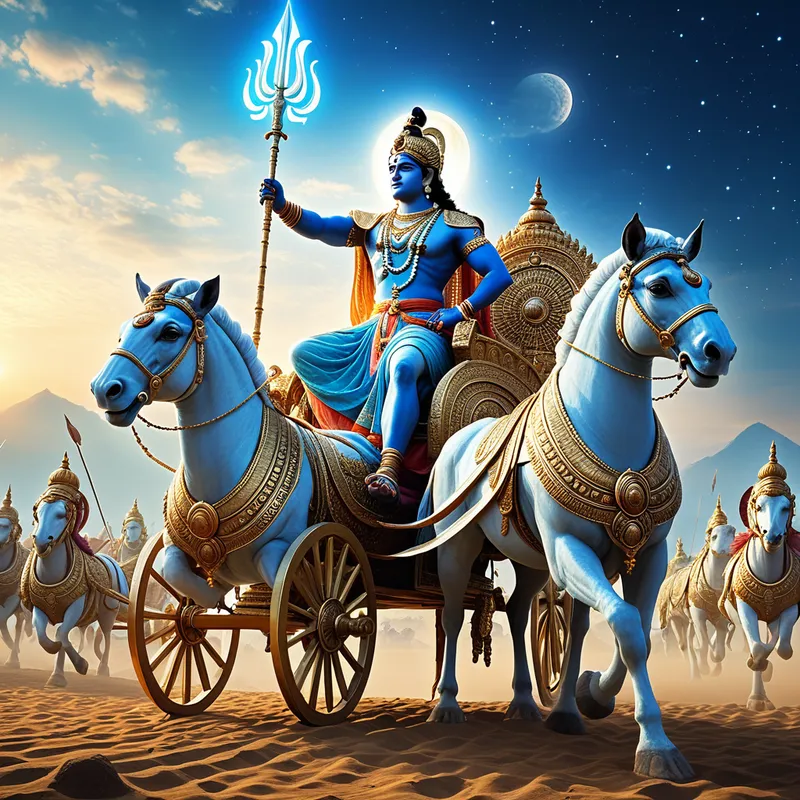
Between them, in a splendid chariot yoked to white stallions, stands Arjuna. His limbs, trained for a lifetime in the art of war, feel like stone. His eyes, keen as a hawk’s, scan the opposing lines and see not enemies, but his own blood. His beloved grandfather, Bhishma, stands with the foe. His revered teachers, Drona and Shalya, are arrayed against him. Friends, cousins, kin—all gathered for mutual slaughter.
A great shudder passes through him. His mighty bow, Gandiva, slips from his grasp and clatters against the chariot floor. His heart contracts, a vortex of grief and confusion. “What victory can be worth this?” he cries out, his voice lost in the vast silence. “To rule a kingdom soaked in the blood of my family? This is sin, not duty!” He sinks down, declaring he will not fight. The cosmos holds its breath.
Then, the charioteer speaks. He is Krishna, who has taken the humble role of driver. A smile touches his lips, not of mockery, but of infinite compassion. He does not command. He begins to speak. His voice is not loud, yet it cuts through the fog of Arjuna’s despair like a clear bell.
He speaks of what never dies and what is merely shed, like old garments. He speaks of the eternal Atman within all beings. He paints a vision of the cosmos as a divine, interconnected play, a Lila, where all actions already unfold within the will of the supreme. Arjuna listens, his despair slowly turning to awe, then to a dawning, terrifying clarity.
Krishna reveals his true, universal form—the Vishvarupa—a vision of all time, all creation, and all dissolution contained within a single, awe-inspiring body. Arjuna sees the warriors on the field already rushing into the flaming mouths of this divine being. He sees that the outcome is not in his hands. His duty, his Dharma, is in his hands. The action is his; the fruit of the action belongs to the cosmos.
Tears of devotion and understanding wash his face clean. He rises. He picks up Gandiva. The conflict within has been resolved not by choosing inaction, but by transforming action itself. He will fight, not for victory, not for a kingdom, but because it is the sacred duty before him, to be performed with skill, with dedication, and with a heart utterly free from attachment to what comes after. The chariot moves forward. The first arrow is loosed. The path of Karma Yoga is born.
Cultural Origins & Context
This is the heart of the Bhagavad Gita, a text that is not a standalone book but a pivotal episode within the immense epic, the Mahabharata. Composed in classical Sanskrit, its origins are traditionally placed between the 5th and 2nd centuries BCE, though its oral roots delve deeper into antiquity. It was not the product of a secluded monastery but emerged from a warrior culture, spoken on a battlefield. It was a discourse for the kshatriya (the warrior-ruler class), making its message of detached action profoundly practical and immediate.
The Gita was passed down through an unbroken chain of guru-disciple transmission, recited, memorized, and commented upon by sages like Adi Shankara. Its societal function was multifaceted: a guide for ethical conduct in times of impossible moral conflict, a philosophical treatise reconciling the paths of action, devotion, and knowledge, and a spiritual manual for living fully in the world without being consumed by it. It provided a dharmic compass for a society where duty, caste (Varna), and stage of life (Ashrama) defined one’s righteous path.
Symbolic Architecture
The myth is a perfect map of the human psyche in crisis. Kurukshetra is not merely a historical field; it is the Dharma-kshetra, the battlefield of one’s own life, where the eternal war between our higher nature and lower impulses, between duty and desire, is waged daily.
Arjuna represents the individual human ego, the conscious self, brilliant and capable, yet paralyzed when faced with the complexity of life’s moral and emotional dilemmas. His despair is the crisis of meaning that precedes any genuine transformation.
Krishna is the symbol of the Antaryamin, the inner charioteer, the voice of intuitive wisdom and transpersonal consciousness that resides within but is often drowned out by the ego’s turmoil. He is not an external god but the archetype of the integrated Self.
The chariot is the human body. The five horses are the five senses, powerful and needing to be reined in by the mind (the reins), which is guided by the intelligence (the charioteer). Arjuna’s act of laying down his bow is the ego’s surrender, the necessary precondition for the Self to take the reins. The entire dialogue is an internal process—the conscious mind in conference with the deeper Self, seeking orientation.
The core teaching—to act without attachment to the fruits of action—is the alchemical key. It transforms mundane, karma-generating deed into sacred, liberating Karma Yoga. The “fruit” symbolizes our psychological attachments: our craving for success, our fear of failure, our need for validation, our sense of personal ownership over outcomes. Relinquishing these is not passivity, but the ultimate empowerment to act with purity and freedom.

The Dreamer’s Resonance
When this myth stirs in the modern unconscious, it rarely appears as a man in a chariot. Instead, the dreamer finds themselves in a recurring, frustrating loop: preparing endlessly for a presentation that never happens, running on a treadmill towards a receding goal, or being handed a tool for a vital task only to find it has no edge. These are dreams of Arjuna’s paralysis.
The somatic feeling is one of heavy stagnation—a weight in the chest, leaden limbs. Psychologically, the dreamer is caught in a conflict between a deeply felt inner duty (perhaps to a creative calling, a relationship, or a personal standard) and an overwhelming aversion to the messy, painful, or uncertain action it requires. The “enemy” army in the dream may be composed of colleagues, family members, or shadowy figures representing aspects of the self the dreamer is reluctant to “slay”—outdated identities, dependencies, or fears.
The moment of resonance, the dream’s potential turning point, might be a sudden, inexplicable sense of calm in the chaos, the appearance of a quiet, knowing figure (a guide, an animal, even a voice), or the simple, clear realization of the next right step, devoid of its emotional baggage. This is Krishna’s counsel breaking through.

Alchemical Translation
The individuation process modeled here is the transmutation of the ego from a brittle, outcome-identified entity into a fluid instrument of the Self. The first alchemical stage is the nigredo: Arjuna’s dark night of the soul, the confrontation with the shadow in the form of familial and social obligations that feel murderous. This despair is necessary; it burns away naive certainties.
The central operation is separatio: the fierce, conscious separation of action from identity. One learns to pour oneself fully into the work—the art, the conversation, the labor—while holding the result lightly, as an offering. This is the sacred sacrifice.
Krishna’s revelation of the Vishvarupa represents the albedo, the illuminating vision of the unified Self, where all opposites—creation and destruction, friend and foe, success and failure—are contained and harmonized within a greater whole. The ego, seeing this, is humbled and liberated simultaneously.
Finally, the rubedo, the reddening, is Arjuna picking up his bow. It is the return to the world, but now the action is imbued with a new quality. It is performed with excellence (yoga is skill in action), but without the fever of personal ambition. The modern individual undergoing this alchemy moves from being a prisoner of their own agenda—anxious, controlling, burned out—to becoming a clear channel for life to move through. They become a Karma Yogi: engaged, effective, and profoundly at peace, not because the world is peaceful, but because their center is established in the action itself, not in its fleeting reward. The battlefield remains, but the war within is over.
Associated Symbols
Explore related symbols from the CaleaDream lexicon: