Karma Myth Meaning & Symbolism
The cosmic principle where every action, thought, and intention weaves the tapestry of destiny, binding the soul to cycles of cause and effect until liberation.
The Tale of Karma
Listen. In the beginning, before the worlds were named, there was a hum. Not a sound, but a vibration—the primal syllable of Om. From that hum, the great Brahma exhaled, and the universe blossomed like a lotus on the dark waters of potential. But with creation came a question, echoing in the hollows of the newly formed heavens: How shall order be kept? How shall the dance of life not descend into chaos?
The answer did not come as a thunderbolt, but as a law, woven into the very fabric of space and time. It was the silent, inevitable principle of Karma. It declared that every motion, from the flutter of a sparrow's wing to the most secret yearning of a human heart, would cast a ripple across the cosmos. Every action would bear a fruit, sweet or bitter, in its own season.
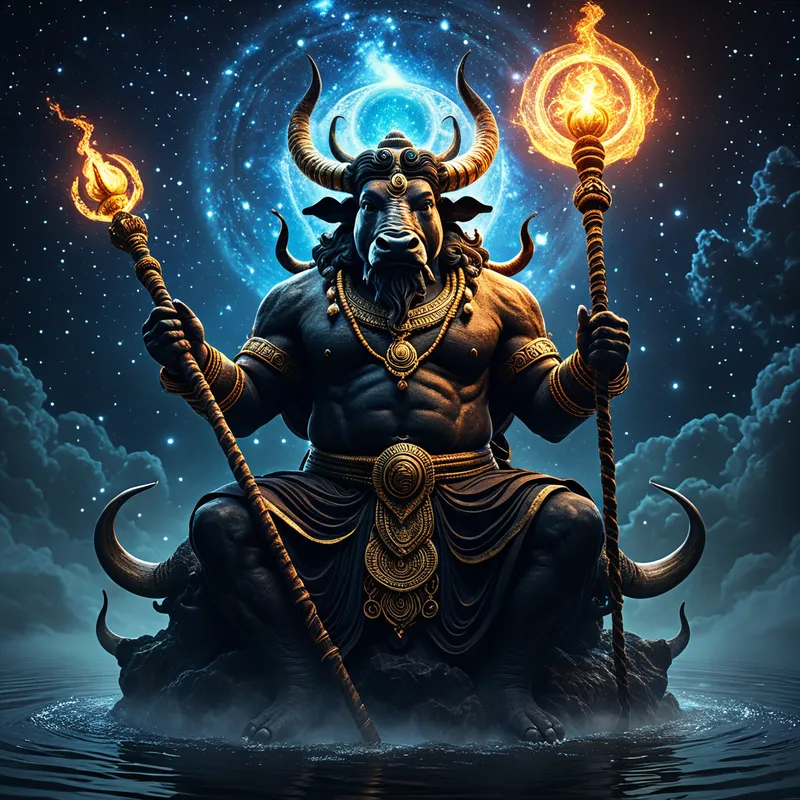
To uphold this law, a king was appointed. Not in the shining courts of Svarga, but in a realm of sober truth, a place of shadows and stark light. This was Yama. His palace was not of gold, but of solemnity. His mount was the powerful, dark water buffalo, symbol of untamed duty. In his hands, he held the pasha, to gently but firmly guide souls, and the danda, the rod of justice.
And for Yama, a scribe was created. From Brahma's own body, born not of woman but of divine intent, came Chitragupta. His name means "hidden picture." In the great, silent hall of records, where the air smells of ancient parchment and ozone, Chitragupta tends to the Agrasandhani. This is no ordinary book. It is a living tapestry. With every thought you think, a word you speak, a deed you do, a new line etches itself onto its endless pages. The ink is the light of your own intention.
When a soul's time in one body ends, it journeys, weary and confused, to Yama's realm. It stands before the king, who is neither cruel nor kind, but impeccably just. Chitragupta unrolls the scroll of that soul's life. He reads aloud not just the deeds, but the whispers behind them—the generosity tinged with pride, the anger born of fear, the small kindness done when no one was looking. The soul hears its own life echoed back, a perfect, unflinching record. Based on this account, Yama pronounces the destination: a season in celestial gardens to enjoy the fruits of good punya, or a turn in the refining fires to exhaust the weight of papa. And then, inevitably, the return. The soul is sent back, into the womb of time and matter, to live another life, to weave another thread into the endless web of cause and effect—Samsara.
This is the tale. Not of a battle, but of a balance. Not of a monster to be slain, but of a mirror, held up to every living being, across all the ages of the world.
Cultural Origins & Context
The concept of Karma is not the invention of a single sage or the plot of a solitary epic. It is a foundational pillar that emerged from the deep, collective contemplation of ancient Rishis as they observed the unerring patterns of nature and human life. Its earliest seeds are found in the Vedas, but it is in the Upanishads that it blossoms into a sophisticated metaphysical principle, intricately linked with the doctrines of Atman and Brahman.
This was not merely priestly philosophy; it was a social and ethical compass. In a culture structured by Dharma, Karma provided the "why." It explained social station, personal fortune, and sudden tragedy not as random acts of capricious gods, but as the mature fruit of past actions, both in this life and previous ones. It was transmitted through the great epics—the Mahabharata and Ramayana—where the complex workings of Karma drive the fates of heroes and villains alike. Storytellers, priests, and grandparents alike passed down this understanding, making it the bedrock of personal responsibility and the engine of the spiritual quest for Moksha.
Symbolic Architecture
At its core, the myth of Karma is a grand symbolic architecture for the psyche's own bookkeeping. It personifies the unconscious self-regulating principle of the human mind.
Karma is the universe's most meticulous accountant, and the soul is both the client and the ledger.
Yama represents the objective, non-negotiable aspect of psychological consequence. He is the inner judge, the voice of conscience that cannot be bribed or fooled. He is not a punisher, but the embodiment of the law that our psyche cannot violate without cost. Chitragupta, the "hidden picture," is a profound symbol for the unconscious itself—the part of us that records everything, far beyond the edited narrative of our conscious ego. The Agrasandhani is the complete, unvarnished record of our complex—our repressed memories, our hidden motives, our unlived potentials.
The cycle of Samsara is the symbolic representation of neurotic patterns, the repetitive loops of behavior and suffering we enact until we consciously face their origin. A "good" or "bad" rebirth is not a celestial reward or punishment, but a symbolic state of mind—a period of psychological ease born from integrated action, or a period of turmoil and "hell" born from repressed shadow material demanding to be addressed.
The Dreamer's Resonance
When this myth stirs in the modern dreamer, it often signals a profound moment of psychic reckoning. One does not dream of Yama as a literal god, but may dream of being audited by a faceless official, of finding a mysterious book that details all their secrets, or of being on trial in a vast, impersonal courtroom.
The somatic experience is often one of exposure and visceral accountability—a knot in the stomach, a sense of being utterly seen. Psychologically, this is the process of the unconscious presenting the bill for ignored debts. Perhaps the dreamer has been living inauthentically, ignoring a calling, or acting in ways that conflict with their deeper values. The dream is Chitragupta unrolling the scroll. It is the psyche's attempt to force a confrontation between the ego's self-image and the shadow's true record, initiating a necessary and often painful integration.

Alchemical Translation
The alchemical work modeled by the Karma myth is the transmutation of fate into destiny, of unconscious compulsion into conscious choice. The goal is not to escape the law, but to become its conscious co-author.
The journey from bondage to liberation is the shift from being the subject of Karma to understanding its grammar.
The first stage is Nigredo, the blackening: This is the confrontation with Yama and Chitragupta—the honest, brutal accounting of one's life. It is shadow work, admitting one's papa and acknowledging one's punya without pride.
The second is Albedo, the whitening: This is the purification through awareness. By bringing the contents of the "hidden record" into consciousness, we detoxify them. We see the chain of cause and effect in our own neuroses. We stop blaming external fate and begin to own our power as the source of our actions.
The final stage is Rubedo, the reddening: This is the embodiment of conscious Dharma. Action is still taken, but it is no longer driven by latent desires (phalas) or fear of consequence. It arises from a place of integrated wholeness. At this point, the law of Karma, while still operational, loses its binding power. The sage acts in the world, but is not woven into the web by attachment. The ledger remains, but the soul is no longer defined by its entries. This is the alchemical gold, the psychological Moksha—the liberation that comes not from stopping action, but from transforming the actor.
Associated Symbols
Explore related symbols from the CaleaDream lexicon: