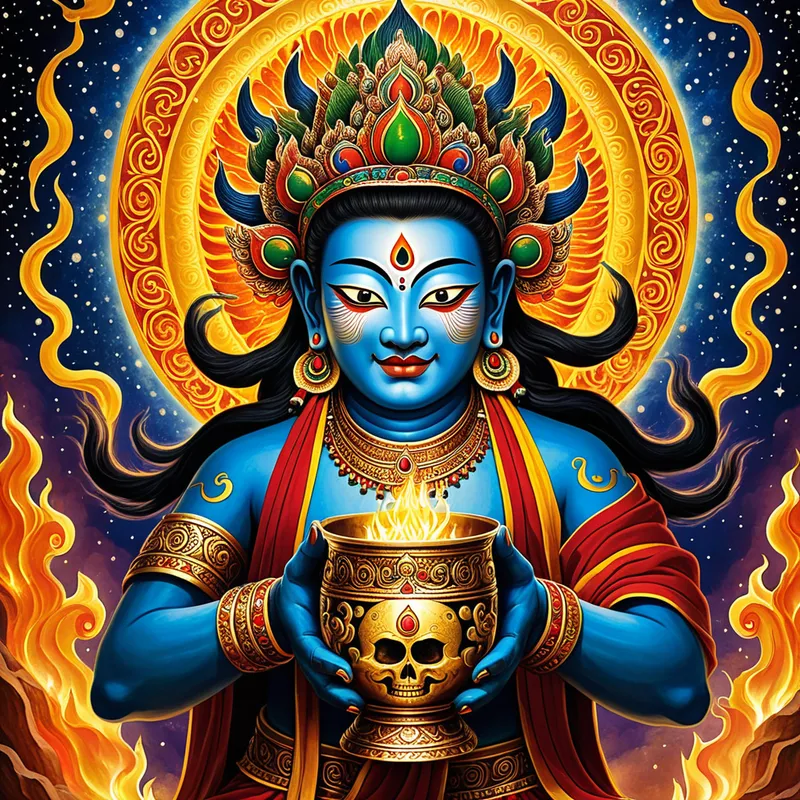
Kapala Myth Meaning & Symbolism
A myth of wrathful compassion, where a skull becomes a sacred vessel, transforming the poison of ego into the nectar of enlightened awareness.
The Tale of Kapala
Listen. In the high, wind-scoured places where the air is thin and the mind grows sharp, there is a story not written in ink, but in bone. It begins not with a birth, but with an ending. A body, once vibrant with breath and blood, lies still upon the cold stone. The vultures have done their work; the sun and wind have bleached what remains. All that is left is a dome of bone, a hollow echo of a life once lived—a skull.
But in the eyes of the bodhisattva, no thing is merely itself. To the tantrika, this empty vessel is not an end, but a potent beginning. It is found by a wandering yogin, whose vision pierces the veil of appearances. He does not see a relic of death. He sees a chalice waiting to be filled.
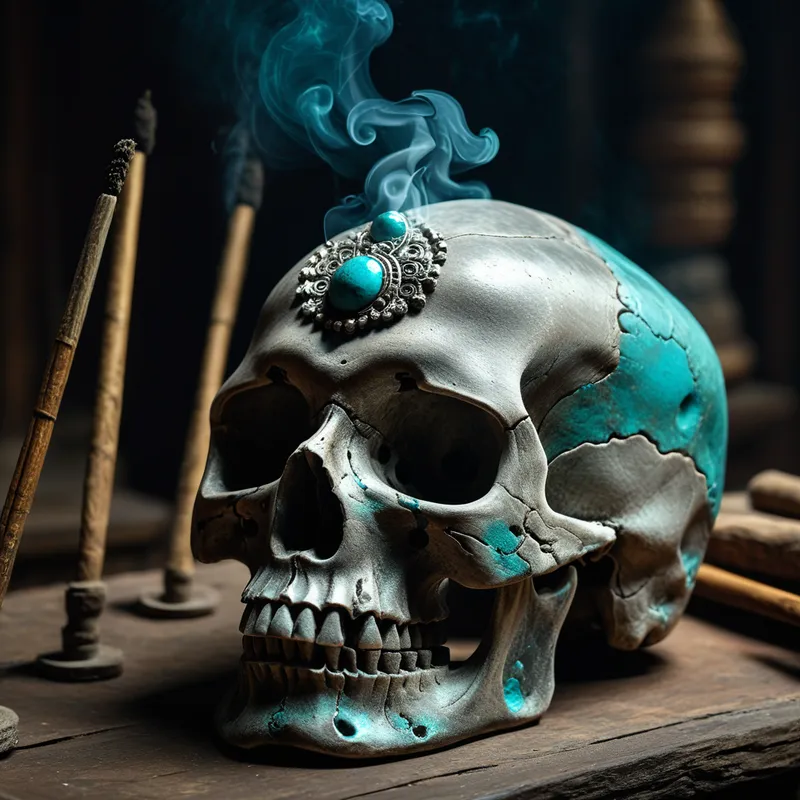
With hands steady from decades of meditation, he cleanses the bone in pure water and consecrates it with mantras that vibrate in the silent spaces between atoms. He sees the previous owner—not as a ghost to be feared, but as a donor, a participant in this sacred alchemy. The skull is adorned: lined with silver, crowned with a lid of precious metal, inlaid with turquoise and coral like frozen drops of sky and earth’s blood.
Now, it is placed upon the altar. Before it, the tantrika visualizes the entire universe as a dance of energy. He summons the fierce, compassionate presence of a wrathful deity—perhaps Mahakala, whose roar shatters illusion. Into the skull-cup, the yogin pours not wine, but the symbolic offerings: amrita, the nectar of immortality, but also the dark, intoxicating brew of worldly attachment and ego.
He holds the cup aloft. This is the moment of transmutation. The deity’s fierce gaze, a blaze of wisdom, falls upon the contents. The poison of greed, hatred, and delusion—the very substances offered—does not vanish. It is transformed. Through the power of non-dual awareness, the poison is recognized as not other than the nectar. The skull, the emblem of our most fundamental fear, becomes the container for our most profound realization. It holds the elixir of life, death, and what lies beyond both. The story does not end with a victory, but with a silent, thunderous understanding held in the palm of a hand.
Cultural Origins & Context
The Kapala is not the product of a single mythic tale, but a profound symbol woven into the fabric of Vajrayana Buddhism as it took root in the Himalayas. Its origins are syncretic, drawing from ancient Indian tantric traditions, Bön practices, and the stark existential realities of life on the Tibetan plateau.
In a land where the physical environment makes the presence of death immediate and undeniable, Tibetan culture developed a radical intimacy with mortality. Jhator practices, where bodies are returned to the elements, provided a direct, unflinching source for ritual objects. The Kapala, therefore, is not a morbid fantasy but a grounded artifact of this worldview. It was used by mahāsiddhas and tantric practitioners in their rituals, serving as a constant, tactile reminder of anicca (impermanence).
Its societal function was dual. Exoterically, it was a powerful ritual implement in elaborate ceremonies, used to hold offerings to wrathful deities. Esoterically, it was a personal memento mori and an alchemical tool for the yogin. By meditating upon and even drinking from the Kapala, the practitioner consciously ingested the truth of death, not to despair, but to ignite a fierce urgency for liberation. It was a shock to the system, a deliberate confrontation with the shadow to awaken a wisdom beyond fear.
Symbolic Architecture
The Kapala is a masterclass in non-dual symbolism. Every aspect of its form and function deconstructs our ordinary, terrified relationship with existence.
The Skull itself represents the ultimate fate of the ego, the personal "I" that clings to life. It is the empty shell of identity, a teaching on the void nature (śūnyatā) of the self. It is not a symbol of nihilism, but of potential—the space left behind when illusion is cleared away.
The Vessel/Cup transforms this symbol of ending into one of capacity. It represents the mind itself—empty, clear, and capable of holding any experience without being contaminated. The adornment with precious metals and stones signifies that this raw awareness, when recognized and worked with, is our most priceless jewel.
The greatest alchemy is not turning lead into gold, but turning the lead of our mortality into the gold of boundless awareness. The Kapala is the crucible where this transmutation occurs.
The Contents—whether visualized as blood, amrita, or poison—symbolize the raw material of samsaric existence: our passions, neuroses, and fears. The ritual act of offering and transforming these contents mirrors the tantric path of "taking the result as the path." One does not reject desire or anger; one invites it into the sacred space of practice to see its true, empty, luminous nature.
Psychologically, the Kapala represents the conscious integration of the Shadow. It is the act of picking up the very thing we are most repulsed by—our own mortality, our darkest impulses—and declaring it the essential ingredient for wholeness.

The Dreamer's Resonance
When the symbol of the Kapala surfaces in a modern dream, it signals a profound somatic and psychological initiation. This is not a gentle nudge from the unconscious; it is a stark confrontation.
Somatically, the dreamer may experience a chilling clarity, a visceral sense of hollow-ness or lightness in the head, or a paradoxical feeling of both fragility and immense strength. It often accompanies life transitions where an old identity is dying—the end of a career, a relationship, or a long-held self-concept. The psyche is presenting the "bone-structure" of the situation, stripping away the flesh of story and sentiment to reveal the essential, unadorned truth.
Psychologically, to dream of holding or being offered a Kapala is to be invited to "drink your own poison." It suggests the dreamer is being called to consciously ingest a difficult truth they have been avoiding—a grief, a failure, a limitation. The dream asks: Can you hold the reality of your own impermanence? Can you take the very thing that frightens you and make it the source of your wisdom? The process is one of radical acceptance, where what was once perceived as a terrifying void is recognized as a vessel for a new, more authentic way of being.

Alchemical Translation
The myth of the Kapala provides a direct map for the process of psychic transmutation, or individuation. It models a path that does not bypass the darkness, but goes straight through its heart.
Step 1: Confrontation with the Mortal Shell (The Nigredo). This is the initial encounter with the "skull"—the disillusionment, the depression, the shattering of a persona. In life, this is the moment of crisis where everything we thought was solid melts away. The Kapala teaches us not to look away, but to pick up the pieces of our shattered self-image.
Step 2: Purification and Consecration (The Albedo). The cleaning and adorning of the skull represent the work of making conscious what was unconscious. We examine our "bones"—our core patterns, traumas, and fears—not with judgment, but with the respectful attention of an artisan. We consecrate them by understanding their origin and their role in our story.
Step 3: The Offering and Transmutation (The Rubedo). This is the active ritual of transformation. We consciously "offer" our neuroses, our anger, our clinging—our psychological poison—into the vessel of our now more-aware mind. We apply the fierce, compassionate gaze of the witness. The alchemical fire is the heat of sustained, non-dual awareness. In this crucible, the poison is not destroyed; its energy is liberated and seen as a misguided form of life-force. Rage becomes fierce protectiveness; grasping desire becomes passionate engagement with life; ignorance becomes the space for wonder.
The goal is not to become a being of light, but to become a being who can hold the full spectrum from bone to nectar, from shadow to radiance, in one integrated vessel.
The final stage is Embodiment. The Kapala is no longer an external object, but the very shape of one's consciousness. The individual becomes the empty, luminous vessel that can contain the full, chaotic, beautiful drama of human experience without being shattered by it. They have performed the ultimate alchemy: turning the base metal of mortal fear into the gold of liberated presence. They hold the cup of their own life, and drink deeply, without flinching.
Associated Symbols
Explore related symbols from the CaleaDream lexicon: