
Kamandalu Myth Meaning & Symbolism
The myth of the Kamandalu, a vessel of primordial waters, embodies the cosmic cycle of creation, dissolution, and the alchemical containment of life's essence.
The Tale of Kamandalu
Listen. Before the worlds were worlds, there was only the dark, boundless ocean of Narayana. Upon its endless surface slept Vishnu, coiled upon the serpent Ananta Shesha. From his navel grew a lotus, and upon the lotus bloomed Brahma, tasked with fashioning the universe. But from where would he draw the substance? The waters were all, and they were one. He needed a vessel, a crucible, a point of separation to begin the great work of differentiation.
Thus, the first Kamandalu was born—not made, but willed from the very fabric of potential. It was the hollow of a gourd, the curve of a skull, the waiting womb of space itself. Into this vessel, Brahma dipped, drawing forth the primordial waters. With them, he began to spin the threads of reality.
Eons turned. The cosmos breathed in and out. In a later age, the great churning of the ocean, the Samudra Manthan, commenced. Gods and demons coiled the serpent Vasuki around the mountain Mandara and pulled. From the depths emerged treasures and terrors: the moon, the celestial cow, the poison Halahala. And amidst the chaos, the waters themselves were agitated into a potent, life-giving essence.
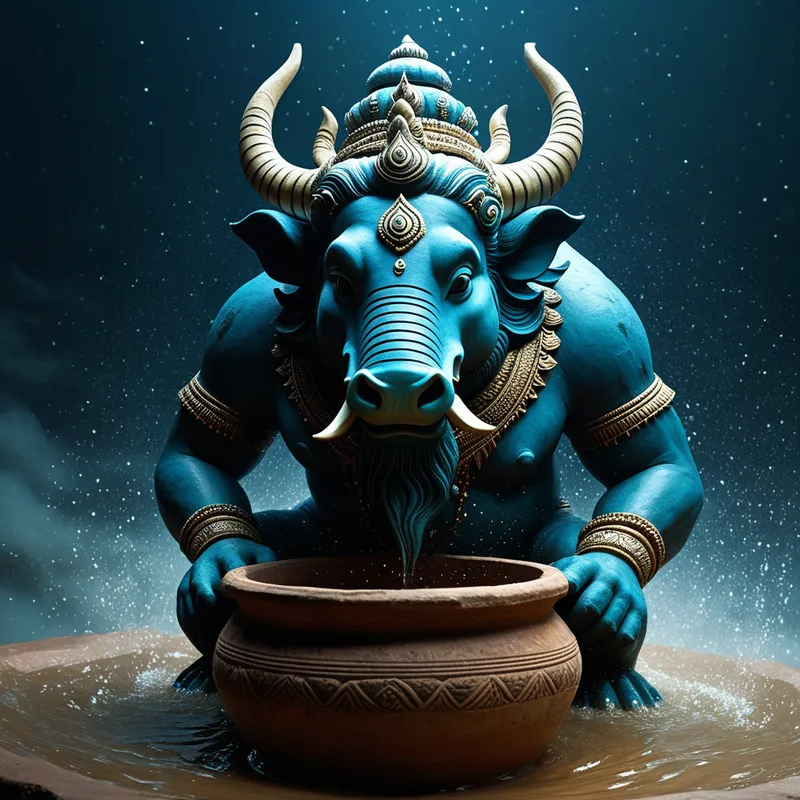
It is said that the great sage Agastya, witnessing the imbalance of the world—where the oceans threatened to overflow the land—took up his Kamandalu. He journeyed to the source. With a breath of intention, he drank. He drank not a sip, but the essence of an entire ocean, containing its vast, saline power within the modest curve of his vessel. The land was saved, and within Agastya’s Kamandalu, the ocean now resided in potent, concentrated form, a secret held in trust.
And in the forest hermitages, the rishis kept their Kamandalus close. They were carved from wood, shaped from clay, or grown as gourds. At dawn, the sage would walk to the river, the vessel empty, a hollow echo. He would dip it into the current, feeling the cold shock of the living water fill the void. This water was not for thirst alone. It was for purification, for offering, for blessing. It was the contract between the inner tapas—the sacred heat of austerity—and the outer, flowing world. The Kamandalu held the boundary where the wild river became sacred libation, where chaos was invited into a form that could bless.
Cultural Origins & Context
The Kamandalu is not merely a prop in mythology; it is an artifact rooted in the lived reality of ancient sannyasi and rishi culture. Its origins are pragmatic: a lightweight, durable water carrier for ascetics who renounced settled life and its possessions. Typically made from a dried bottle gourd, it symbolized the ultimate in functional simplicity and self-containment.
This humble object was then elevated through narrative and ritual into a core symbol of spiritual authority and cosmic function. The myths surrounding it were passed down through the Puranas and epic tales, often recited by storytellers and priests. Its primary societal function was pedagogical. The Kamandalu served as a tangible teaching tool about the nature of reality: the universe itself is a vessel (pātra), the divine is both the container and the contained (Bhagavan and Bhakta), and the individual seeker must become a worthy receptacle for grace (prasāda). It modeled the ideal of the sage: one who carries their own source, who transforms the raw materials of existence into something consecrated.
Symbolic Architecture
The Kamandalu is a master symbol of sacred containment. Its symbolism operates on multiple, interlocking levels.
The universe is born from a vessel, and to a vessel it must return. All creation is an act of careful pouring.
On the cosmic level, it represents the womb of space-time, the yoni from which all manifestation arises. It is the first act of distinction—the separation of the waters from the waters, the creation of an interior and an exterior. This makes it a symbol of Maya itself, not as mere illusion, but as the divine creative power that gives form to the formless.
Psychologically, it symbolizes the vas bene clausum—the well-sealed vessel of alchemy. This is the integrated ego, the cohesive self capable of containing the turbulent waters of the unconscious without being shattered or flooded. The sage with the Kamandalu represents the consciousness that can hold paradox, intense emotion (rasa), and spiritual power (shakti) without identification or leakage.
The act of filling and emptying it mirrors the cosmic cycles of Srishti, Sthiti, and Pralaya. To fill it is to engage with the world, to accept experience. To empty it is to offer it back, to practice non-attachment, to undergo a symbolic dissolution.
The Dreamer's Resonance
When the Kamandalu appears in a modern dream, it rarely arrives as a literal pot. It manifests as the experience of sacred containment. One might dream of holding a cracked bowl that miraculously does not leak, of discovering a room within one’s heart that is vast and ocean-filled, or of trying to capture a rushing waterfall in cupped hands.
Such dreams often surface during periods of intense emotional or psychic overload—when one feels flooded by responsibilities, grief, or creative chaos. The Kamandalu dream is the psyche’s blueprint for a necessary psychological process: the development of a stronger, more resilient container for the soul’s contents. The somatic sensation accompanying it can be a paradoxical feeling of simultaneous emptiness and profound fullness, a calm center within a storm.
If the dream-vessel is broken or leaking, it points to a rupture in one’s boundaries, an inability to process and hold experience, leading to burnout or emotional dissipation. If it is overflowing, it may signal a grace too great for the current structure of the self to hold, calling for expansion. The dream asks: What are you trying to contain? Are you a vessel strong enough for your own depths?

Alchemical Translation
The myth of the Kamandalu provides a precise model for the alchemical process of individuation—the Jungian journey toward psychic wholeness. The initial state is the undifferentiated ocean of the unconscious, where all potentials swirl but nothing is distinct. The first, crucial step is the formation of the vas—the vessel of the conscious ego.
Individuation begins not with expansion, but with the courage to define a boundary. The self is created by what it chooses to hold, and what it chooses to pour out.
This ego-vessel must be strong enough to withstand the coniunctio oppositorum—the churning of opposites within (the Samudra Manthan of the psyche). We must contain our own “poison” (shadow) and “nectar” (the Self) as they arise from the depths. The sage Agastya’s act of drinking the ocean is the ultimate alchemical feat: the internalization of the entire outer world, the realization that the macrocosm is contained within the microcosm of the integrated individual.
The final stage is symbolized by the sage offering tirtha (sacred water) from his Kamandalu. This is the alchemical rubedo, the reddening, where the transformed substance is offered back to the world. The personal transformation is complete not when one is full, but when what one contains has become a blessing for the environment. The individuated person becomes a source of purification and life, not by spilling their contents chaotically, but by conscious, intentional offering. The Kamandalu thus charts the path from chaotic potential (water) to contained power (vessel) to consecrated gift (libation)—the full cycle of the soul’s alchemy.
Associated Symbols
Explore related symbols from the CaleaDream lexicon: