Kalpavriksha Myth Meaning & Symbolism
The celestial wish-fulfilling tree, born from the churning of the cosmic ocean, a symbol of ultimate abundance and the paradox of desire.
The Tale of Kalpavriksha
Listen. Before time was counted in breaths, when the cosmos was a single, silent ocean of potential, the gods and the titans found themselves weary. A great malaise had fallen upon them—a weakness of spirit, a mortality of essence. They knew of a nectar, amrita, hidden in the depths of the world-ocean. To obtain it, they would have to churn the ocean itself, a task impossible for any one side alone. Thus, a fragile, desperate alliance was forged between devas and asuras.
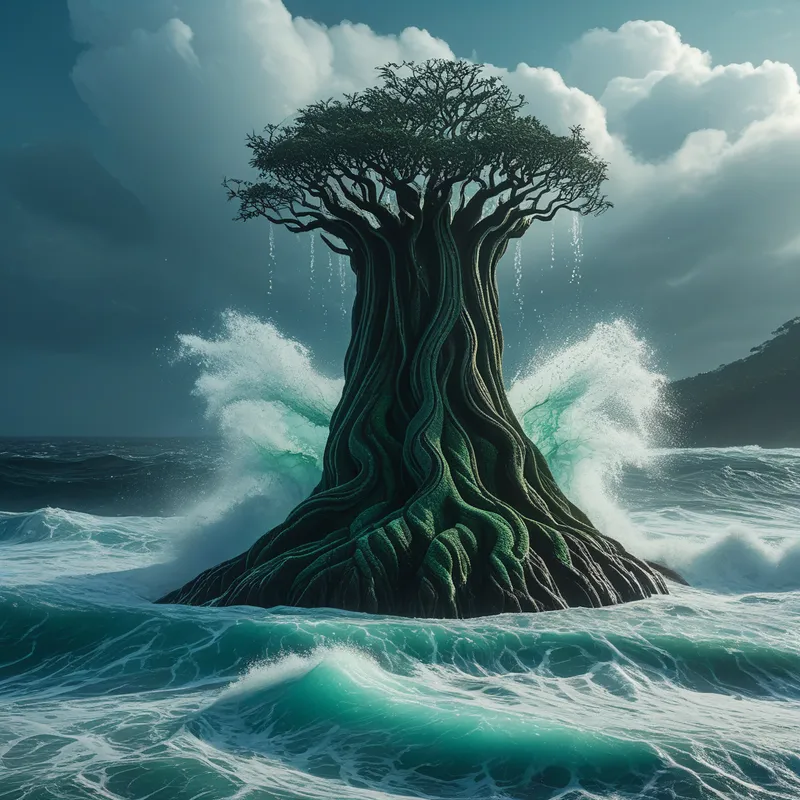
They uprooted the great mountain Mandara and set it upon the back of Kurma, the steadfast tortoise. Around the mountain, they coiled the king of serpents, Vasuki. The gods took the head, the titans the tail. With a collective groan that shook the foundations of space, they began to pull. Back and forth, in a cosmic tug-of-war, they churned the milky waters for an age. The ocean roiled and frothed, a tempest of divine exertion.
First came poison, a black, seething horror that threatened to end all things. Shiva drank it to save creation, holding it in his throat, which turned blue. Then, wonders began to emerge from the froth: the moon, placed in the sky; the goddess of wine; the celestial elephant Airavata; the wish-fulfilling cow Kamadhenu. Each emergence was a gasp of awe, a reward for the monumental labor.
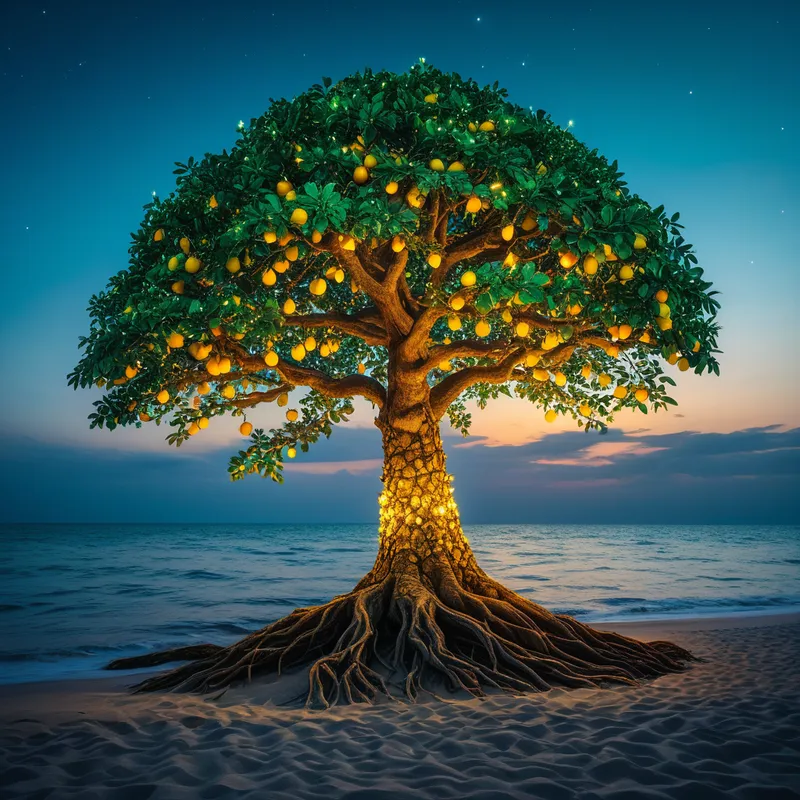
And then, it rose. Not with a crash, but with a deep, resonant hum that stilled the very waves. A tree. But no ordinary tree. Its bark held the sheen of polished gold, its leaves were like plates of jade and lapis lazuli, and from its branches hung fruits of every imaginable kind—pearls, rubies, fragrant mangoes, and glowing orbs of pure light. It was Kalpavriksha, the tree that grants all desires. It did not merely grow; it manifested. The air around it thickened with the scent of rain on dry earth, of blooming lotuses, and of sweet, unknown spices. It was taken to Svarga, the heavenly realm, and planted there, a permanent testament to the fruits of cosmic struggle, a living promise at the heart of paradise.
Cultural Origins & Context
The myth of the Kalpavriksha finds its most elaborate telling in the Puranas, particularly the Vishnu Purana and the epic Mahabharata. It is a core narrative of the Samudra Manthan, one of Hinduism's fundamental cosmogonic tales. Passed down orally by sages and later inscribed by scholars, this story was not mere entertainment. It served a vital societal and theological function. It explained the origin of divine treasures and beings, reinforced the concept of dharma through the uneasy deva-asura alliance, and provided a metaphorical blueprint for the Vedic ritual of sacrifice—the churning of the cosmic ocean mirroring the churning of the mind and spirit through discipline to yield spiritual treasures. The Kalpavriksha, in particular, became a ubiquitous symbol in temple sculpture, classical poetry, and folklore, representing the boundless generosity of the divine and the idealized state of a kingdom ruled by dharma, where all needs are met.
Symbolic Architecture
The Kalpavriksha is the ultimate symbol of the fulfilled wish, but its psychology is profoundly complex. It is not simply a material cornucopia. It is the archetypal axis mundi, the central pillar of reality where the divine intersects with the manifest world. Its roots are in the chaotic, unconscious depths of the primordial ocean (the Mulaprakriti), and its branches hold the luminous fruits of conscious realization in the heavenly realm.
The tree does not create desires; it mirrors them. It is the psyche's own capacity for manifestation, showing us the literal fruit of our deepest yearnings.
Psychologically, it represents the totality of the Self—the potential within each individual that contains the seed of every possible outcome, every latent talent, every unspoken dream. The fact that it emerges only after the ordeal of churning, after confronting the poison (Halahala), is critical. It signifies that true, sustainable abundance—whether spiritual, emotional, or creative—is not a starting point but a result. It is the prize earned only after engaging with the shadow (the asuras), applying sustained effort (the churning), and integrating the toxic aspects of existence (Shiva's act).
The Dreamer's Resonance
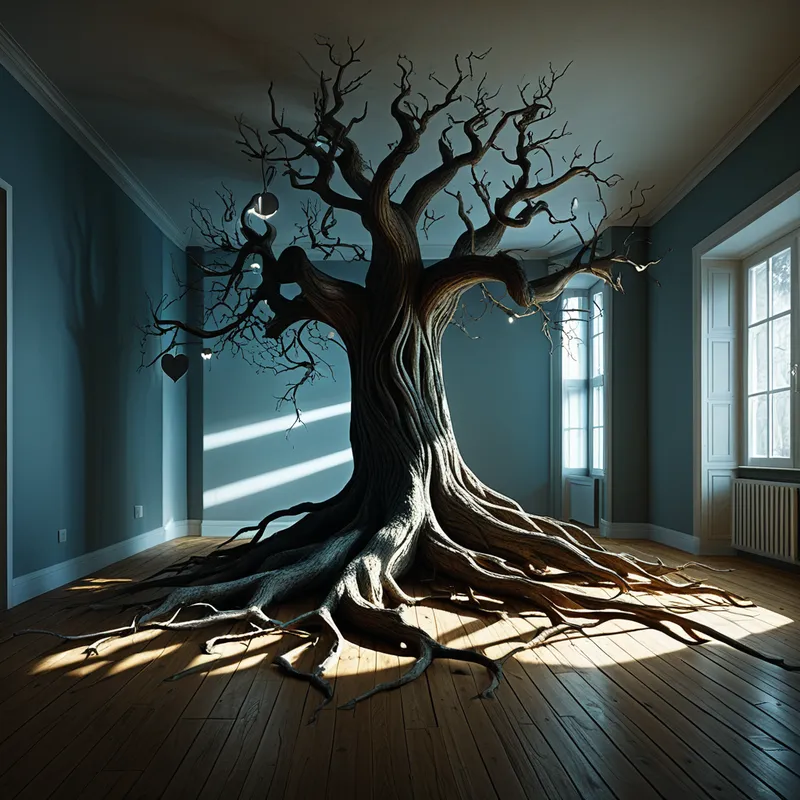
When the Kalpavriksha appears in a modern dream, it rarely manifests as a clear, heavenly tree. Its symbolism is often disguised, working through the language of the personal unconscious. One might dream of a mysterious tree in a backyard bearing impossible fruit—a laptop that writes novels by itself, a apple that tastes of forgiveness, a clock that grants more time. Or the symbol may invert: a barren tree that promises fruit but delivers only dust, reflecting a sense of spiritual or creative barrenness despite outward effort.
Somatically, such dreams may be accompanied by sensations of fullness or aching emptiness in the chest or gut—the physical echo of yearning. Psychologically, the dreamer is likely at a crossroads of potential. The psyche is presenting the image of ultimate fulfillment, asking the critical, often uncomfortable questions: What do you truly wish for? What are you churning within yourself? Have you dealt with your poison? The dream-Kalpavriksha confronts the dreamer with the immense, sometimes terrifying, responsibility of their own creative and manifesting power.
Alchemical Translation
The journey to the Kalpavriksha is a perfect allegory for the alchemical process of individuation—the Jungian path to psychic wholeness. The initial state is one of lack (the gods' weakness), prompting the ego (the devas) to recognize it cannot proceed alone. It must form an alliance with the shadow (the asuras), the rejected and powerful parts of the self. The churning is the disciplined work of analysis, introspection, and engaging with life's conflicts—the opus that agitates the calm, stagnant waters of the unconscious.
The first yield is always poison. The confrontation with repressed trauma, shame, and anger (Halahala) is a necessary, perilous stage. This poison must not be rejected, but contained and transmuted (as Shiva does), a process that changes the very vessel of the self.
Only after this integration do the treasures begin to surface. The emerging beings and objects (the moon, Kamadhenu) represent the nascent, autonomous complexes and talents coming to light. The Kalpavriksha is the culmination: the fully realized Self, the psychic structure that can now "grant wishes" because it is in alignment. Its fruits are not indiscriminate material gifts, but the authentic expressions of the individual's unique essence—creative works, deep relationships, wisdom, and a sense of purpose that feels both given and earned.
For the modern individual, the myth teaches that fulfillment is not about finding a magic tree, but about undertaking the churning. Our desires are the serpent Vasuki, the tension that, when engaged with consciously, becomes the instrument of our own transformation. The paradise (Svarga) where the tree finally rests is not a external location, but the state of an integrated psyche, where one has access to the inner Kalpavriksha—the boundless, wish-fulfilling potential of a self that has dared to confront the depths.
Associated Symbols
Explore related symbols from the CaleaDream lexicon: