Kali's Tongue Myth Meaning & Symbolism
The goddess Kali, drunk on the blood of demons, dances in fury until Shiva becomes her mirror, shocking her into self-awareness and stillness.
The Tale of Kali's Tongue
Listen. The air is thick with iron and incense. The great battle is done. The demon Mahishasura lies slain, his armies scattered like ashes in the wind. But the victory has birthed a storm that will not cease.
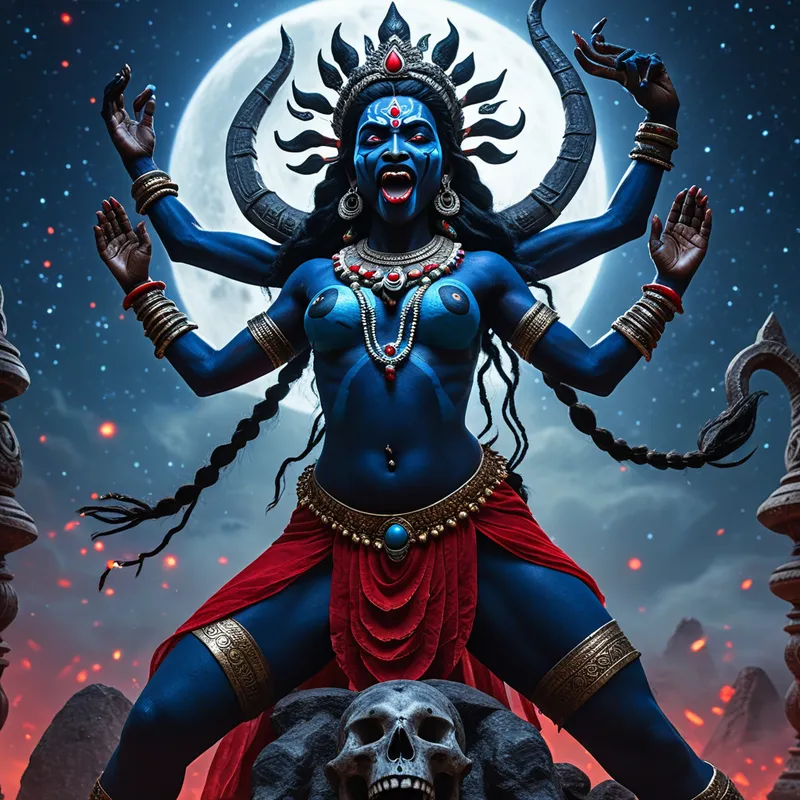
From the forehead of the great goddess Durga, in a flash of cosmic fury, she emerges: Kali. She is the night of dissolution, her skin the blue-black of a sky before the storm, her form slender and terrible. Adorned with a garland of fifty-one severed heads, a skirt of swinging arms, she wields the sword of discrimination and the skull-cup of experience. Her hair is wild, unbound, streaming behind her like a comet’s tail. She has come to finish the work, to devour every last drop of demonic essence, every seed of arrogance and illusion that remains.
And she is drunk. Drunk on the hot, metallic blood of the adversaries, drunk on the ecstatic power of her own limitless rage. The battlefield, the shamshana, is her dance floor. She dances the Tandava, the dance of destruction. With each thunderous stamp of her foot, the earth quakes. The rhythm of her dance is the pounding of a frantic heart, the clatter of bones, the scream of worlds ending. Her laughter is a sharp blade against the silence of the void. She is pure, unchecked, autonomous power. She has forgotten her purpose, forgotten herself. She is the force of nature that, once unleashed, knows only its own momentum.
The gods watch from the trembling heavens. They are terrified. This is the Mother who has saved them, now become a whirlwind that threatens to grind all creation—friend and foe alike—back into primordial dust. They cannot look away from her whirling form, from the flash of her teeth, from the terrifying length of her tongue, lolling crimson from her mouth in a gesture of insatiable hunger and fierce delight. They turn in desperation to the one who remains still amidst all motion: Shiva.
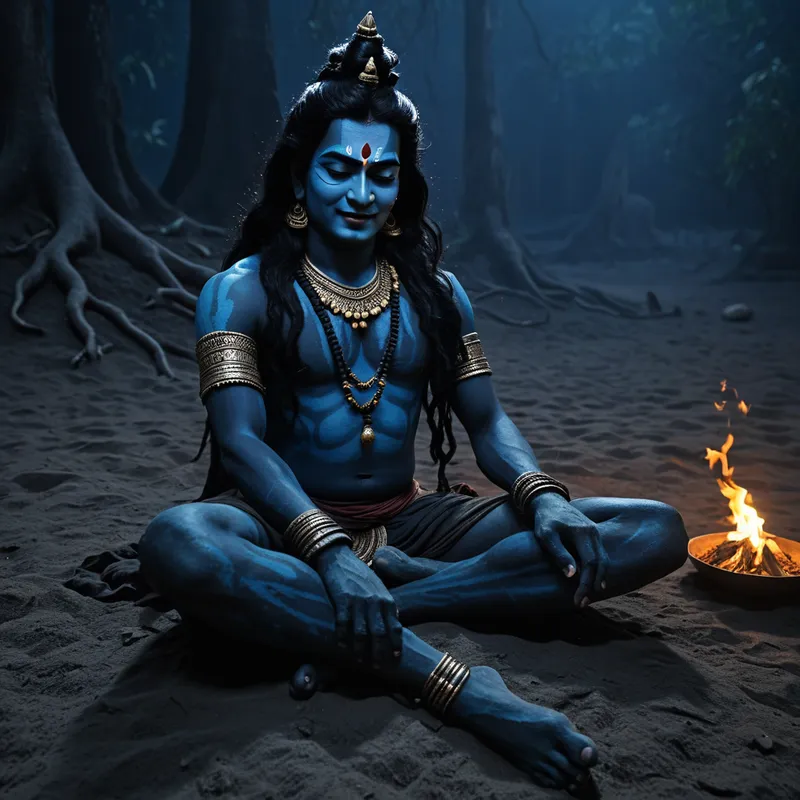
Shiva, the Lord of Ascetics, hears their silent plea. He sees his consort, his Shakti, lost in her own terrible majesty. Without a word, he descends to the blood-soaked earth. He does not raise a weapon. He does not chant a mantra. He simply lies down. He positions himself directly in the path of her catastrophic dance.
And Kali, in her ecstatic, blinding fury, dances on. She spins and stamps, her senses turned entirely outward, consuming the world. Her foot comes down—and finds not the yielding ground, but the firm, calm chest of her own lord.
The moment of contact is an electric shock to the universe.
Her dance halts. The wild rhythm ceases. Her gaze, which had been fixed on some distant, annihilating horizon, drops. She looks down. She sees Shiva, her beloved, lying serene beneath her foot. She sees her own tongue, still extended in a roar that has now died in her throat. In that instant, the outward-turned fury turns inward. The destroyer meets the witness. The dancer sees the dance floor. A wave of shocking, profound recognition floods her being. The fury transmutes into shame, the ecstasy into awe. She bites her extended tongue. The gesture is one of sudden, instinctive self-correction, a sacred silencing. The bloodlust cools. The goddess of time stands still in time.
Cultural Origins & Context
The myth of Kali’s tongue is primarily found within the corpus of the Devi Mahatmya and later elaborated in various Puranas and Tantric commentaries. It is not a standalone children’s fable but a sophisticated theological and philosophical narrative told by sages and tantrikas to illustrate a profound truth about the nature of reality and consciousness.
Its societal function was multifaceted. On one level, it served as an etiological story, explaining a common iconographic feature: why Kali is almost always depicted with her tongue stuck out. On a deeper level, it was a teaching story for initiates. Within the Tantric path, which often embraced the terrifying and the taboo to achieve liberation, Kali represented the raw, unadulterated power of reality (Shakti), while Shiva represented pure, silent consciousness (Purusha). The myth taught that unchecked power is chaotic, and silent consciousness alone is inert. Enlightenment, or a balanced world, exists only in their conscious union—when Shakti recognizes Shiva.
Symbolic Architecture
The myth is a perfect symbolic map of a psychological and cosmic process. Kali represents the unleashed, unconscious Shadow—the sum of all our repressed rage, primal instincts, and destructive potential. This is not "evil," but raw, amoral life force. Her dance on the battlefield is the psyche in a state of identification with a single, overwhelming complex, often triggered by a righteous battle (slaying inner "demons" of ignorance) that then takes on a life of its own.
The tongue is the organ of taste and speech. Extended, it symbolizes unbridled appetite and the roar of the ego. Bitten, it becomes the seal of silence, the integration of experience that transcends words.
Shiva represents the observing Self, the transcendent awareness within us that does not participate in the drama but can witness it completely. He is the "cooling" principle (often covered in ashes, symbolizing the burned-out remains of all passions) that lies down, not to fight the chaos, but to receive it. His act is the ultimate in non-violent resistance and profound grounding.
The moment Kali steps on him is the critical juncture of self-reflection. It is the shocking, often painful moment when our raging emotional state suddenly sees itself from the outside. We witness our own fury, our own grief, our own destructive patterns. This mirroring—provided by the inner Shiva, the Self—is what halts the autonomous complex. The bite of the tongue is the conscious inhibition, the sacred pause that allows the energy to be transformed rather than discharged.

The Dreamer's Resonance
When this myth pattern appears in modern dreams, it seldom manifests as literal deities. Instead, the dreamer may experience:
- The Unstoppable Dance: Dreams of being in a frantic, out-of-control motion—running without destination, dancing until exhaustion, being caught in a whirlwind or torrent. This is the Kali-energy, the somatic feeling of a psychological complex that has taken the driver's seat.
- The Shocking Mirror: A pivotal dream image where the dreamer suddenly sees their own reflection in the midst of chaos. The reflection might show them as a monster, or it might be calm and still while the dreamer is in turmoil. This is the Shiva-moment, the intervention of the Self.
- The Gesture of Halting: Dream actions like biting one's lip, suddenly becoming mute, or having one's foot get "stuck" while running. These symbolize the innate psychic mechanism that attempts to force a moment of pause and integration when an emotion or drive has become autonomous and destructive.
The psychological process is one of moving from possession by an emotion (being Kali) to having an emotion in the presence of a larger awareness (witnessing Kali from the perspective of Shiva).

Alchemical Translation
For the modern individual seeking wholeness (individuation), the myth of Kali’s Tongue models the alchemical process of nigredo and solutio—the blackening and the dissolving. The rage, the depression, the obsessive thought pattern—these are our personal "Kali-dance." The standard ego response is to fight it, to deny it, to try to slay it with positive thinking. This only gives the dance more energy.
The alchemical translation, guided by the myth, is different. It is the practice of the "Shiva posture."
One must learn to lie down in the path of one's own storm. This is the conscious act of turning toward the difficult emotion without judgment, of allowing oneself to fully feel the fury or the grief, but from a grounded place of witnessing.
You do not become the dance; you provide a silent, stable ground for the dance to happen upon. In therapeutic terms, this is mindfulness or somatic experiencing. In the moment of full, felt contact—when the raging feeling truly touches the grounded witness—the transformation occurs. The energy loses its autonomous, destructive charge. The extended tongue of blind consumption is bitten. The raw power (Shakti) is recognized by and married to conscious awareness (Shiva).
The myth assures us that this terrifying, chaotic force within is not our enemy, but a divine aspect of ourselves that has lost connection to the whole. Our task is not to destroy it, but to become the Shiva who can receive it, so that the fierce goddess within may recognize herself, bite her tongue, and transform from a force of blind destruction into a force of conscious, transformative power.
Associated Symbols
Explore related symbols from the CaleaDream lexicon: