Kafka's Castle Myth Meaning & Symbolism
A land-surveyor's endless, labyrinthine struggle to gain entry to a remote Castle, whose authority is absolute, inscrutable, and perpetually out of reach.
The Tale of Kafka's Castle
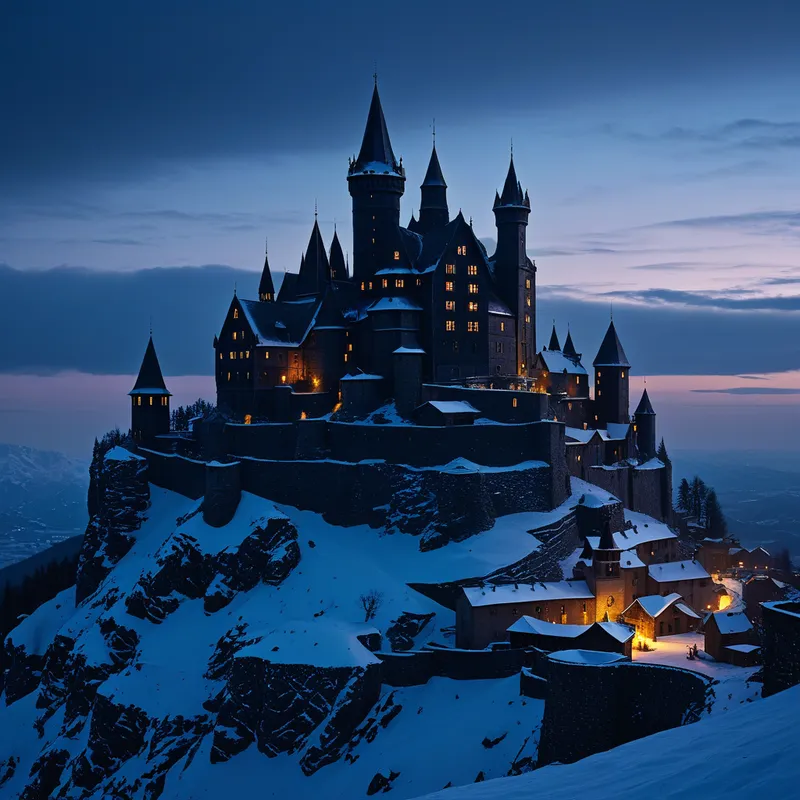
Listen, then, to the tale of the one who arrived. He came to the village as the snow began to fall in earnest, a fine, dry powder that settled on everything and muffled the world. His name was K., and he had been summoned. He had been called to his profession, to serve the great Castle that loomed on the hill above. This was his truth, his papers, his purpose.
Yet, from the moment he stepped off the coach at the Bridge Inn, the air tasted of impossibility. The Castle was there, yes—a jumble of towers and walls against the grey sky, sometimes clear, sometimes lost in cloud—but the road to it did not exist. The village lanes twisted back on themselves, leading only to more cottages, more snow, more faces closed as shutters. When he declared his mission, the villagers looked at their boots. The Castle had sent for a land-surveyor? They had heard nothing. Perhaps there was a mistake. Perhaps he should speak to the Superintendent. Or maybe a messenger.
So began the pilgrimage through paper and rumor. K. sought an audience, a confirmation, a single thread to grasp in the vast tapestry of authority. He encountered Frieda, who offered a fleeting, desperate warmth. He tangled with the Assistants, who were like mocking reflections of his own futility. He waited in corridors, studied village hierarchies more complex than theology, and listened to stories of Klamm and others—beings so remote their very signatures were objects of reverence.
Every door that seemed to crack open slammed shut on a technicality. A message was misinterpreted. An official was asleep. The file was lost, or perhaps it never existed. The Castle was a system of perfect, circular logic that admitted no outsiders, for to be outside was the definition of not belonging. K.’s certainty—"I am the land-surveyor"—eroded into a question, then a plea, then a silent, staring vigil at the window, gazing at the lights of the Castle, which promised order and meaning but gave only their distant, cold glow.
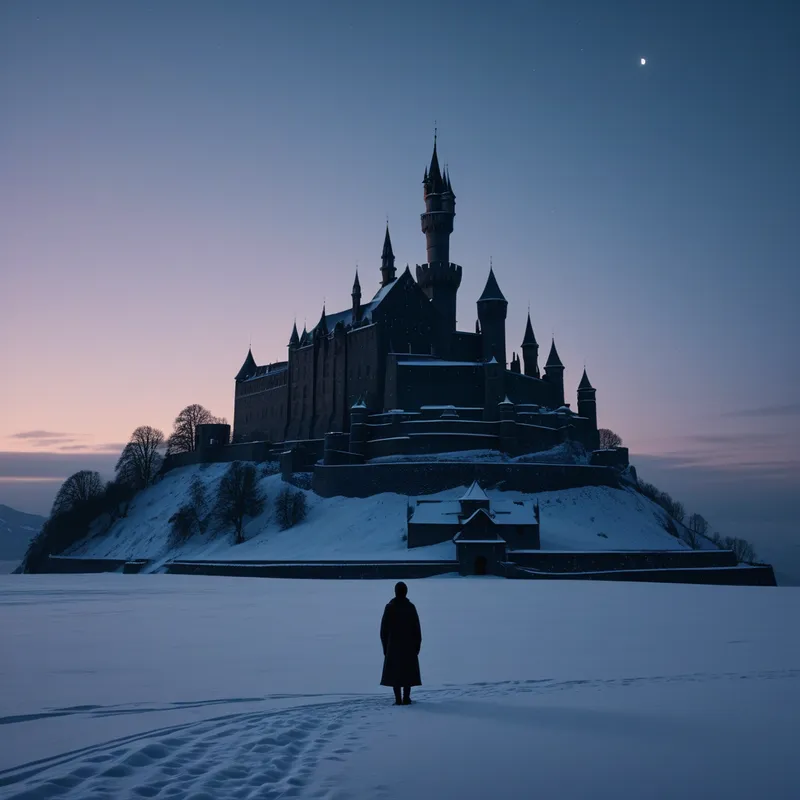
The snow never ceased. The path never formed. The struggle did not end in victory or defeat, but in the relentless, suffocating atmosphere of the attempt itself. He was forever approaching, forever denied, forever in the village, beneath the shadow of the hill, in the long twilight of the summons.
Cultural Origins & Context
This is a myth born not from campfires but from the filing cabinet and the telephone line. Its bard was Franz Kafka, a clerk of the Workers' Accident Insurance Institute in early 20th-century Prague. He did not sing his tales; he typed them in the quiet hours, leaving his greatest, The Castle, deliberately incomplete. The myth was passed down not through oral tradition but through publication, becoming a foundational text of the Modern era’s spiritual disquiet.
Its societal function is diagnostic. It emerged as the individual confronted the colossal, impersonal structures of the modern world: sprawling bureaucracies, legal abstractions, corporate entities, and governmental systems that operate with a logic opaque to the human heart. The myth gives form to the pervasive feeling that the centers of power and meaning are both omnipresent and inaccessible, that one’s life is a case file in a room one can never enter. It is the folklore of the age of administration, a ghost story where the haunting presence is not a specter but a system.
Symbolic Architecture
The Castle is not a place, but a state of being. It represents the ultimate Self, the God-image, the source of all meaning and legitimacy, but one that has been translated into the cold vernacular of procedure and hierarchy. It is divinity rendered as bureaucracy.
The Castle is the soul’s intuition of a cosmic order, perceived through the distorting lens of a rational, alienated mind.
K. is the modern ego, summoned by a deep, inner call (the supposed appointment) but utterly unequipped to navigate the psychic terrain it must traverse. His tools—logic, assertion, persistence—are useless against the labyrinth of the unconscious, which operates by its own, seemingly irrational laws. The villagers are the complexes and inherited patterns (the personal and collective unconscious) that have adapted to this system; they know its absurdity is the only reality.
The endless, fruitless negotiations symbolize the ego’s futile attempt to gain the approval of the Self on the ego’s own terms. The missing file is the sought-after proof of one’s own existence and purpose, which the system of the psyche never provides in a form the ego can recognize.
The Dreamer's Resonance
When this myth stirs in the modern dreamer, it manifests as the dream of the impossible task. You are late for an exam for a class you never attended. You are trying to run but your legs are lead. You are in an airport terminal where the gates constantly change and your passport is invalid. The somatic sensation is one of profound frustration, weight, and anxious paralysis—the nervous system flooded with the adrenaline of urgency meeting the concrete wall of futility.
Psychologically, this is the process of confronting what Jung called the shadow of one’s own striving. The dreamer is encountering a psychic structure—often an internalized authority (parental, societal, perfectionistic)—that has taken on the absolute, unreachable quality of the Castle. The dream signals that the conscious attitude of forced entry or dogged persistence has failed. The psyche is forcing a state of humble, bewildered stasis, a necessary prelude to a different kind of knowing.

Alchemical Translation
The alchemical process modeled here is not one of triumphant individuation, but of the essential, painful nigredo—the blackening, the putrefaction. It is the stage where the old, heroic ego, convinced of its right to a place in the order of things, must be dissolved in the acid of absurdity and failure.
The triumph of the Kafkaesque ordeal is not in reaching the Castle, but in the utter incineration of the belief that one ever could—or should—on the old terms.
K.’s endless struggle is the prima materia, the base matter of the modern soul: the ego’s alienation. The alchemical fire is the sustained, humiliating friction of encountering an unfathomable system. The transmutation occurs, if it occurs at all, in the moment where striving ceases to be about external validation and becomes a stark, simple fact of existence. To become the one who is always approaching is to internalize the quest itself as identity, divorced from the illusion of destination. The gold produced is not clarity or accession, but a paradoxical freedom found in radical acceptance of the labyrinth. The seeker realizes he is not outside the Castle trying to get in; he is, and always was, a cell in its unknowable body. The goal then shifts from conquest to a new kind of navigation—a sensing, a listening, a different way of being in the village, which may, in the end, be the only true form of contact with the Castle’s mysterious authority.
Associated Symbols
Explore related symbols from the CaleaDream lexicon: