Jupiter's Metal Myth Meaning & Symbolism
A celestial myth of stolen essence, divine punishment, and the alchemical birth of tin, symbolizing the spirit's descent into matter for eventual liberation.
The Tale of Jupiter's Metal
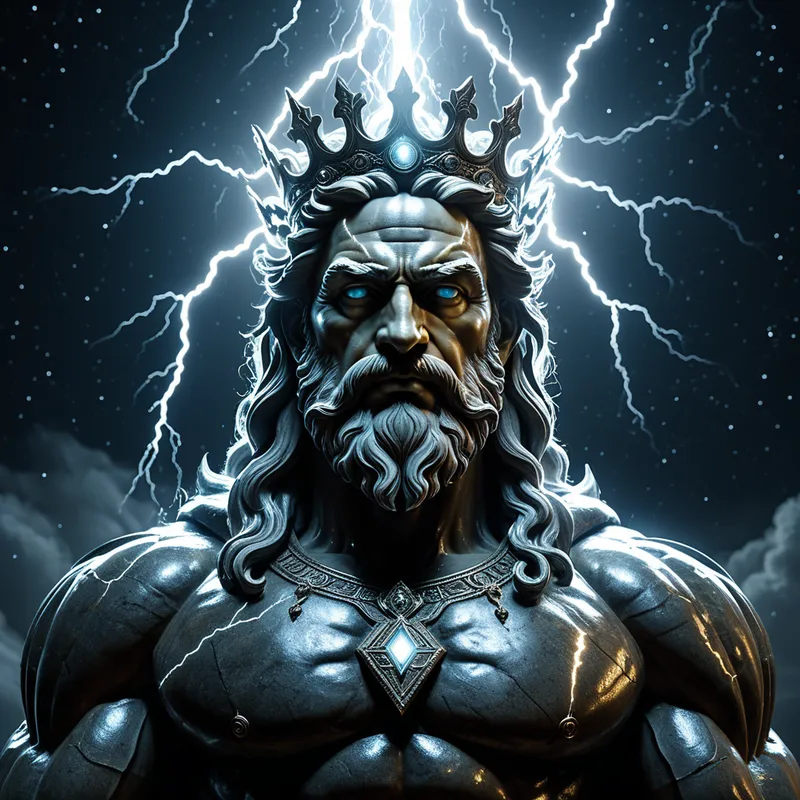
In the time before time, when the sky was a raw and churning ocean of potential, the Jupiter ruled from his citadel of cloud and thunder. Below, the young Earth slept, a dark and fertile womb of unshaped clay and silent stone. The gods walked the upper airs, their substance pure spirit and intention, while the clay of Earth dreamed only of weight and stillness. A great chasm lay between them, a silence of unbridgeable essence.
Jupiter, in his sovereign wisdom, held a secret. In the deepest vault of his celestial palace, he kept the Prima Materia—not the base matter of Earth, but its divine prototype, a shimmering, metallic light that held the blueprint of form itself. It was the unmanifest idea of metal, of structure, of the bones of the world. To release it was to give the Earth a skeleton, to grant the formless clay a destiny of shape and purpose. But Jupiter hesitated. Structure brings limitation; spirit incarnate knows the burden of weight.
Yet, within the dark soils of the sleeping Earth, a presence stirred. Not a god, nor a mortal, but a Telluric Spirit, a child of the deep clay. It felt the call of the shimmering light above as a physical ache, a longing in its stony heart for definition. It dreamed not of clouds, but of edges; not of lightning, but of gleam. Driven by this profound hunger, the spirit began a impossible ascent. It climbed not with hands, but with will, scaling the very gradients of being, from density towards light.
After an age of striving, it breached the floor of heaven. There, in the silent vault, it beheld Jupiter’s treasure: a pool of liquid, stellar silver, humming with the song of potential order. With a gesture that was both theft and desperate prayer, the spirit scooped a portion of this radiant substance into its own earthy form. The moment the celestial metal touched its clay, a terrible alchemy began. The spirit screamed, not in pain, but in the shock of transformation. Its form crackled and solidified, its essence forever changed.
The crime was instantly known. Jupiter’s thunder shook the foundations of both realms. The god appeared, not in rage, but in terrible, solemn judgment. “You have taken the untainted idea into the realm of flaw,” his voice echoed. “You have mingled the boundless with the bound. For this, you shall become the bridge you sought to create.”
Jupiter raised his hand. A bolt of pure law, not of destruction but of definition, struck the transformed spirit. It did not shatter, but was fixed. The stolen light within it cooled, crystallized, and descended. The spirit fell, not as a punished thief, but as a falling star of meaning. It plunged into the waiting Earth, and where it struck, the first ore was born—a metal that was neither fully celestial nor fully terrestrial. It was bright like captured moonlight, malleable yet resonant, possessing a faint cry when bent. The alchemists would later name it Jupiter’s Metal, the spirit that stole from heaven to give the earth its voice.
Cultural Origins & Context
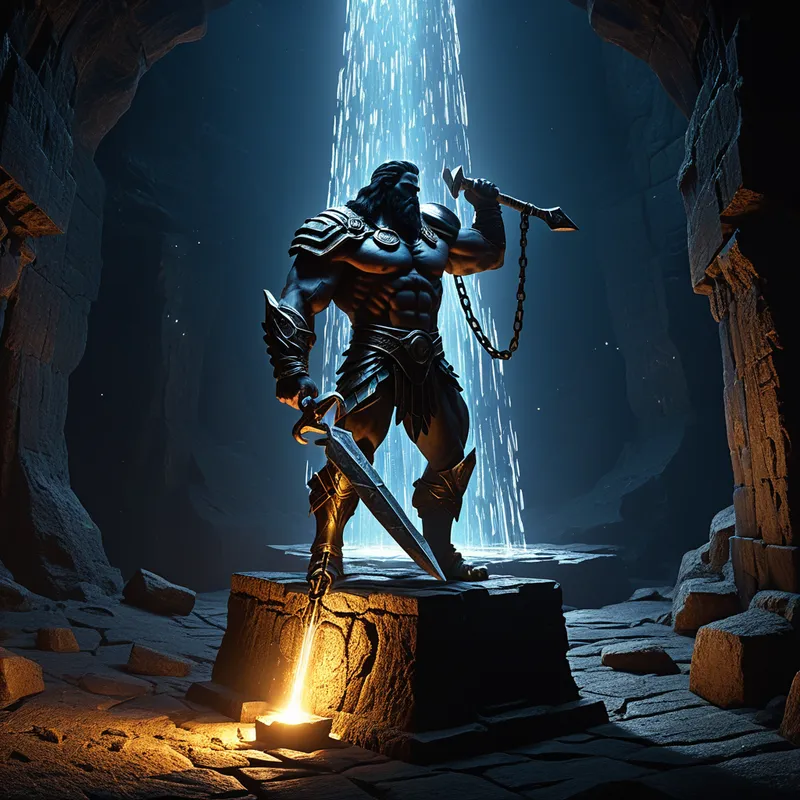
This myth finds its home not in the public temples of Rome, but in the sealed workshops and encrypted manuscripts of the European alchemical tradition, spanning from the late medieval period through the Renaissance. It is a “myth” not of a people, but of a practice—a narrative created by adepts to encode the spiritual dimensions of their physical labor. Passed down in emblem books, such as the Mutus Liber, and in cryptic poems, it was a story told by firelight, its meaning debated over alembics and athanors.
Its societal function was initiatory. It served as a guiding parable for the alchemist, who saw themselves in the Telluric Spirit: a being of “base” earthly consciousness yearning for the divine Lapis. The story explained the very nature of the metal tin (Stannum, ♃), assigning it a celestial origin and a melancholic, bridging character. It framed the alchemist’s work not as invention, but as recollection and redemption—a process of helping matter remember its stolen celestial spark and perfect it.
Symbolic Architecture
At its core, the myth maps the inevitable and painful process of incarnation. Jupiter represents the transcendent principle, the unified field of spirit and pure idea that exists prior to manifestation. The Telluric Spirit is the longing of the unconscious, undifferentiated earth (the psyche’s latent potential) for consciousness and form.
The theft is the first sin of individuality—the separation of the spark from the whole, which is also the birth of the soul.
The stolen celestial metal is the scintilla, the fragment of divine consciousness that becomes embedded in the flesh of the world and the psyche of the individual. Jupiter’s punishment is not vengeful, but the necessary act of the Self imposing the laws of reality upon this raw potential. The resulting metal, tin, is a perfect symbol of the resultant human condition: outwardly bright and sociable (tin’s properties), yet inwardly prone to a “melancholy” or cry under pressure—the lament of spirit confined in matter, the ego aware of its divine origins yet bound by earthly laws.

The Dreamer's Resonance
When this myth stirs in the modern dreamer, it often manifests as dreams of celestial theft or forbidden knowledge. One might dream of stealing a glowing orb from a high, guarded place, or of capturing moonlight in a jar. Somaticlly, this can feel like a thrilling yet anxious activation in the chest—the feeling of harboring a secret power.
Psychologically, this signals the ego’s dawning recognition of a content or potential from the Self (Jupiter’s vault) that it is attempting to integrate. The “crime” is the necessary act of consciousness claiming a piece of the unconscious for itself, a vital but destabilizing step in growth. The subsequent feeling of being “cast down” or transformed in the dream mirrors the often-depressive or disorienting phase after a major insight, where the new awareness must be grounded into one’s earthly life and personality, a process that always feels like a limitation of the initial, boundless inspiration.

Alchemical Translation
For the individual on the path of individuation, the myth of Jupiter’s Metal models the critical stage of Nigredo giving way to Albedo. The base, leaden state of unconscious suffering (the Telluric Spirit’s longing) actively seeks the light, even if through “rebellious” means like therapy, art, or crisis that break old rules.
The theft is the courageous, perhaps arrogant, act of the ego claiming a piece of the Self’s authority—deciding to heal, to create, to change. Jupiter’s transformative lightning is the inevitable confrontation with the consequences of that choice: the hard, limiting work of integration. The born metal, tin, is the new, fragile psychic structure that results.
The goal is not to return the metal to heaven, but to work it at the forge of experience until its celestial cry becomes the resonant song of a soul that has made a bridge of its own fall.
Thus, the modern alchemy is this: to take that stolen, melancholy spark of awareness—our trauma, our genius, our unique wound—and, through the repeated hammer blows of conscious work, not rid it of its earthly alloy, but transmute the entire complex into a conductor. We become the bridge, the Rebis, capable of channeling between the divine inspiration of the unconscious and the manifest reality of our lived lives. Our “tin,” our imperfect humanity, becomes the sacred metal of Jupiter, the necessary vessel for the lightning to find its ground.
Associated Symbols
Explore related symbols from the CaleaDream lexicon: