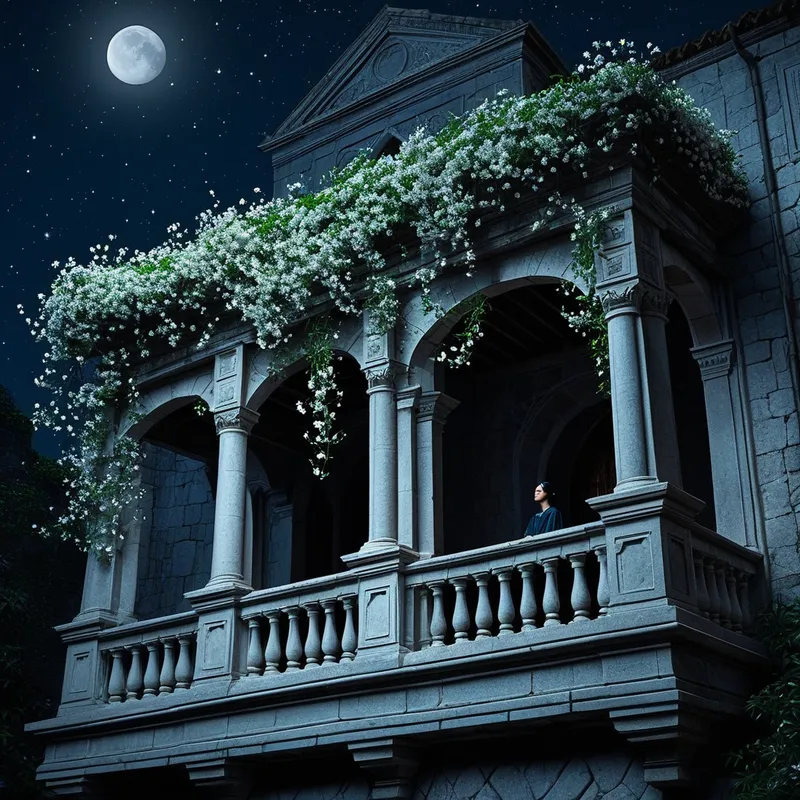
Juliet's balcony in Romeo and Myth Meaning & Symbolism
A myth of two lovers separated by a stone divide, whose yearning creates a sacred space of communion, defying the world's divisions.
The Tale of Juliet's balcony in Romeo and
Hear now the whisper that rides on the night wind, a story not carved in one stone but etched into the soul of the world itself. It speaks of a divide, not of earth or ocean, but of mortar and custom, of a wall built high by ancient hands. Upon one side of this great divide stood the House of Sun, its stones warm with the pride of daylight. Upon the other, the House of Moon, cool and cloistered in tradition’s shadow.
And within these houses were two spirits: one a flame of passionate speech and restless courage named Romeo; the other a well of luminous depth and quiet wisdom named Juliet. The world declared them strangers, enemies by birthright, their very glances across the public square a kind of treason.
But the heart knows no edicts. In the secret kingdom of a moon-drenched garden, the flame found the well. Romeo, scaled the walls not of her family’s fortress, but of his own prescribed fate. He stood in the fragrant dark, a pilgrim in forbidden sanctum. And above him, framed against the star-strewn velvet of the sky, was the Balcony.
It was not mere architecture. It was an altar of air and stone, a platform suspended between the private soul and the public world. There, Juliet appeared—not as a daughter of the House of Moon, but as a goddess of the night itself, her form outlined in silver. The air grew still. The conflict was the very space between them: the chilling void of the night air, the unyielding solidity of the railing. He was rootless earth; she was untouchable sky.
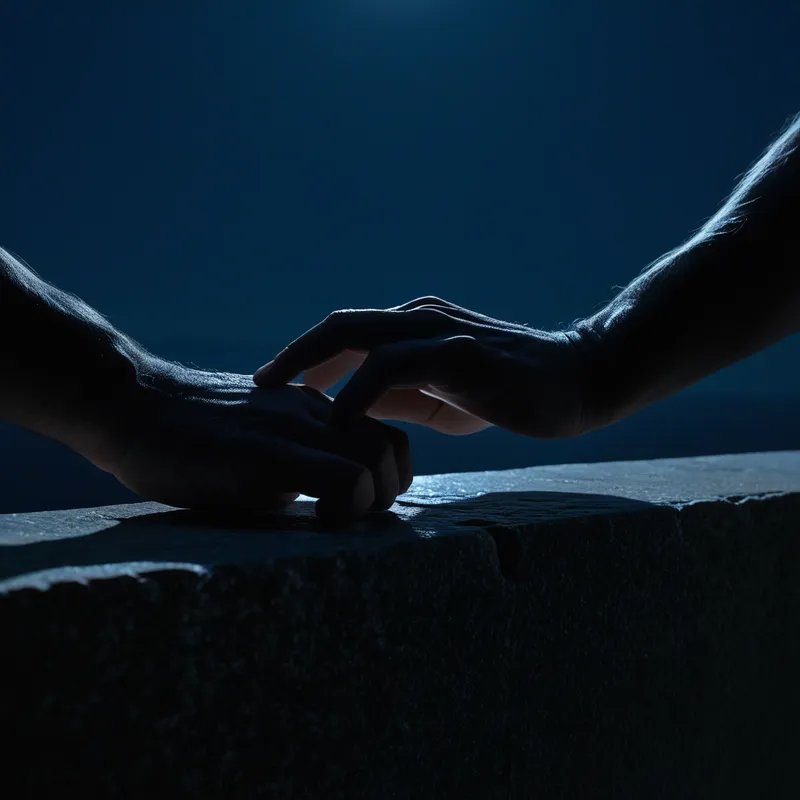
Yet, into that void, they cast words. Not mere speech, but incantations. Vows lighter than moonlight yet heavier than mountains poured forth. They spoke of renaming the stars, of defying the very gravity of their names. The rising action was not a battle cry, but a murmuring duet. The stone of the balcony, witness to generations of silent duty, became the plinth for a new sacrament. He strained upward; she leaned downward. The space did not vanish, but it became sacred—charged, electric, a cathedral built of longing.
Their resolution was not a union of bodies, but a profound, temporary fusion of spirits. In that suspended moment, the divide was not breached but transfigured. The balcony was no longer a barrier, but the very site of revelation. They exchanged the oath of the soul, a promise that bound them beyond the laws of sun or moon. As the first grey hint of dawn threatened the edges of the night, they parted—not as enemies, but as two halves of a single, now-cracked, celestial sphere. The garden fell silent, holding its breath, forever altered by the echo of a truth spoken across an impossible gap.
Cultural Origins & Context
This is a myth that belongs to no single bloodline, yet lives in all. Its most famous inscription comes from the quill of a Elizabethan poet, but its bones are far older. We find its echoes in the troubadour songs of Provençal courts, where the beloved was always elevated, separated by the castle wall of social station. We hear it in the ghazals of the East, where the lover is forever at the locked gate, yearning for a glimpse of the divine beloved on the balcony.
Its societal function is dual. On one hand, it is a cautionary tale, whispered to uphold the walls that separate tribe from tribe, class from class. It shows the peril of reaching across the divide. Yet, on a deeper, more enduring level, it functions as a mythic vessel for the most fundamental human experience: the ache of separation and the dream of union. It was passed down not just by bards and playwrights, but by every individual who has ever felt a chasm between their inner truth and the outer world, who has ever looked up—or down—across a seemingly uncrossable space toward a longed-for connection.
Symbolic Architecture
The myth’s power is built upon a trinity of symbols. First, the Balcony itself. It is the ultimate liminal object. It is part of the house (the structured self, the family psyche, the social identity) yet projects out into the unknown (the world, the other, the unconscious). It represents the point where the private interior dares to interface with the vast exterior.
The balcony is the architecture of the soul's interface—the fortified ego extending a precarious platform toward the mystery of the Other.
Second, the Vertical Divide. Romeo below, in the dark, fertile, instinctual garden; Juliet above, in the realm of ideals, beauty, and spiritual aspiration. This is the classic split between earth and spirit, between the shadowy complexities of desire and the illuminated clarity of the anima. Their positions are not static; he ascends (seeks spirit), she descends (embodies spirit in form).
Third, the Voiced Oath. The union is not achieved through touch, but through speech. The word becomes the bridge. This symbolizes the naming and articulation of longing, which is the first and most critical step in any psychological integration. To voice the desire is to create a psychic reality that can begin to challenge the material one.

The Dreamer's Resonance
When this myth stirs in the modern dreamer’s chamber, it signals a profound somatic and psychological process. To dream of standing on a balcony, looking down or calling out, often speaks to a feeling of isolation within one’s own life or identity—a sense of being trapped in a role (the “house”) and yearning for connection with a lost or forbidden part of the self or another.
Conversely, to dream of gazing up at a balcony, of seeing a luminous but distant figure, indicates an active yearning for something perceived as higher: an ideal, a state of being, a spiritual truth, or an unattainable love that feels like it belongs to a different order of existence. The somatic sensation is often one of straining, of aching in the chest and throat—the physical correlate of longing. The dream is mapping the internal landscape of separation, showing the dreamer the precise architecture of the gap they feel within their own psyche or their life. It is not a nightmare of pursuit, but a melancholic poem of distance, asking: What part of me is up there, out of reach? What part of me is down here, in the dark, yearning?
Alchemical Translation
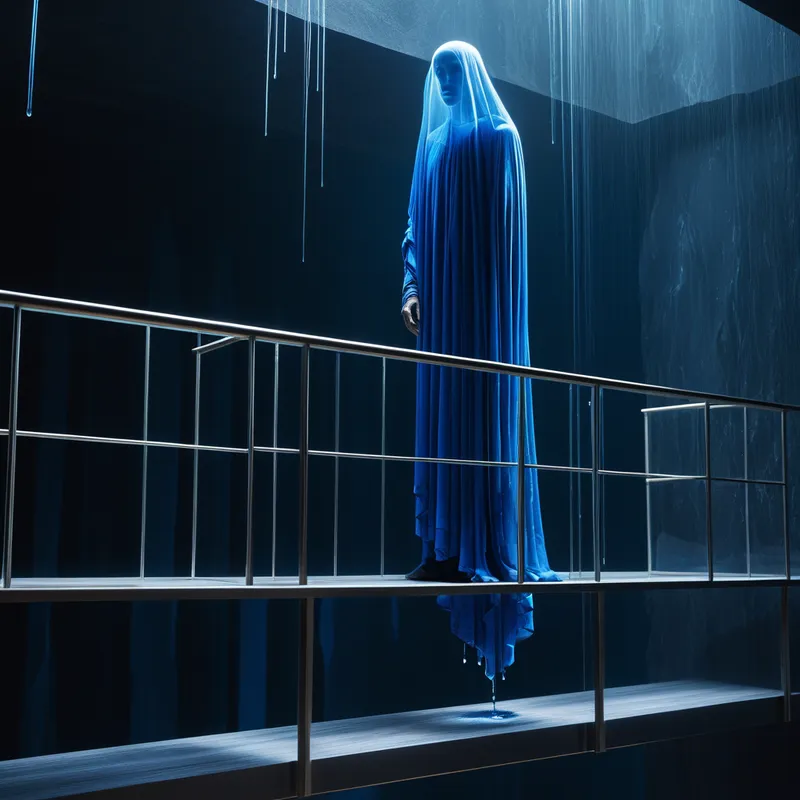
The alchemical process modeled here is the individuation of the Lover archetype. The base material is the leaden, divided state of the psyche: the conscious mind (one house) estranged from the unconscious (the other house), or the ego separated from its anima/animus.
The first operation is not union, but the courageous creation of a sacred space—the balcony—where the separated parts can behold each other without immediate consumption.
Romeo’s climb into the garden is the descent into the unconscious. The appearance of Juliet on the balcony is the emergence of the anima into a space where she can be perceived. The conversation is the critical coniunctio. It is not a violent merging, but a sacred dialogue between the earthly ego and the spiritual image. They exchange oaths—this is the commitment to this inner relationship, the vow to honor this newly perceived connection within oneself.
The tragedy in the external story often overshadows the internal triumph. Psychically, the triumph is the recognition itself. The balcony moment is the mystical union that forever alters the inner landscape. Once you have spoken your truth across the inner divide, once you have seen your own anima or animus on that balcony, you can never fully return to the ignorant, undivided hostility of the former state. The inner houses may still be at war, but you now hold the secret of the garden and the oath sworn in moonlight. You have begun the alchemical work of transmuting the lead of separation into the gold of conscious, inner relatedness. The wall remains, but you have built, if only for a night, a bridge of air and words across it.
Associated Symbols
Explore related symbols from the CaleaDream lexicon: