
Jacob's Pillow Myth Meaning & Symbolism
A fleeing man uses a stone for a pillow, dreams of a ladder to heaven, and awakens to declare the terrifying place the house of God.
The Tale of Jacob's Pillow
The world was made of dust and deceit. Jacob, his name meaning "supplanter," moved through the fading heat of the day like a ghost, the taste of his brother's betrayed fury still bitter on his tongue. He had stolen the birthright, stolen the blessing, and now the land itself seemed to recoil from his footsteps. The sun bled into the hills of Bethel, and with it went all warmth, all certainty.
Exhaustion, a heavier cloak than any he carried, finally pulled him down. The ground was hard, unyielding. His hands, skilled in grasping, found only stones. He chose one—not for its beauty, but for its mere presence, a cold, indifferent lump. This was his pillow. His head, full of schemes and fear, rested upon the unfeeling earth. The desert wind whispered secrets he could not understand, and the vast dome of stars, indifferent to his guilt, watched as he fell into the abyss of sleep.
Then, the world tore open.
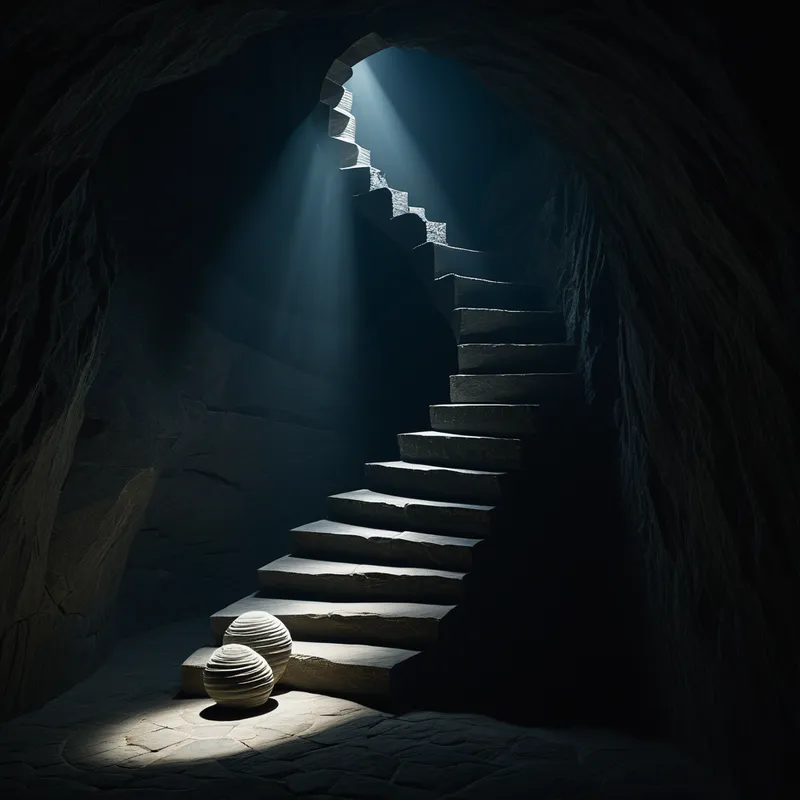
Not with sound, but with vision. A ladder—or was it a staircase, a mountain, a vast, living conduit?—was set upon the earth, and its top reached into the heavens. And upon it, ascending and descending in a silent, solemn procession, were the malakim, the messengers of the Holy. Their forms were of light and purpose, a traffic of grace between the realms. And there, above it all, stood YHWH Himself. No face was seen, but a voice, vast and intimate as the night, poured into Jacob's soul.
"The land on which you lie I will give to you and your offspring," the voice declared, a promise woven into the fabric of the dream. "Behold, I am with you and will keep you wherever you go."
Jacob awoke with a gasp, the cold stone still against his cheek. But everything was different. The air vibrated. The very ground hummed beneath him. Terror, a pure and sacred terror, seized his limbs. "Surely YHWH is in this place," he whispered to the empty dawn, "and I did not know it." This was no mere campsite; it was the gate of heaven, the house of El. This terrifying, lonely spot was the center of the world.
He took the stone, the mute witness to his unraveling and his calling, and set it upright as a pillar. He anointed it with oil, a sacrament of recognition. He renamed the place Bethel, though the fear never left him. The stone was no longer a pillow for a fugitive's rest. It was a marker, a testament: here, the fleeing man met his destiny. Here, the earth became a threshold.

Cultural Origins & Context
This narrative is embedded in the foundational Book of Genesis (Chapter 28). It belongs to the cycle of patriarchal stories, oral traditions refined over centuries before being codified. These stories served as the identity-forming mythology for the tribes of Israel, explaining their covenant with their deity and their contested claim to the land of Canaan. The tale of Jacob at Bethel functions as a crucial "theophany" site legend—a story explaining why a specific, often unremarkable, location is considered intensely sacred. It anchors the divine promise of land and progeny to a tangible place, transforming a random stone in the wilderness into a national and spiritual landmark. It was told not just as history, but as a map of the soul's potential encounter with the divine, especially in moments of profound dislocation and crisis.
Symbolic Architecture
The myth is a perfect symbolic blueprint for a psychological crisis that becomes a revelation. Jacob, the ego driven by cunning and shadow, is forcibly removed from his familiar structures (his family, his homeland). His journey is not one of quest, but of flight. The "pillow" is the lowest point—literally using the bare, hard earth as support. It represents a surrender, a moment where conscious striving fails and the unconscious can break through.
The stone pillow is the ego's defeat and the Self's foundation. We must lay our head upon the hard truth of our situation before the ladder can appear.
The Sullam is the central symbol of connection. It is not something Jacob builds; it is revealed. It represents the permeable boundary between the conscious and unconscious realms, the personal and the transpersonal. The angels ascending and descending signify the constant traffic between these levels—inspirations, insights, and directives flowing both ways. YHWH standing above it represents the Self, the totality of the psyche that encompasses both the personal and the divine. The promise is not of ease, but of presence and meaning within the journey.
Jacob's reaction—"surely YHWH is in this place, and I did not know it"—is the core of the symbolic revelation. It signifies the dawning awareness that the sacred, the numinous, is not confined to temples or established rites. It can erupt anywhere, especially in the "nowhere" of our personal exile. The anointed pillar is the act of consciousness memorializing this encounter, creating a psychic landmark to which one can return.

The Dreamer's Resonance
When this myth pattern activates in the modern psyche, it often manifests in dreams of profound transition and vertigo. One may dream of finding a simple, heavy object (a stone, a book, a piece of driftwood) that suddenly becomes the anchor for a visionary experience. Dreams of strange staircases, escalators to nowhere, glass towers, or DNA-like helices echo the Sullam. The feeling is not typically of joy, but of awe-filled dread—the mysterium tremendum et fascinans.
Somatically, the dreamer may awaken with a sense of the dream's gravity, a literal weight on the chest or a feeling of the bed itself being significant. Psychologically, this dream cluster signals that the dreamer is in a liminal state—between jobs, relationships, identities, or stages of life. The unconscious is announcing that this period of loss, fear, and homelessness is, paradoxically, the precise ground where a new orientation to the Self is being established. The dream asks: What hard truth are you resting your head upon? And can you bear to see the traffic of angels that passes through your despair?
Alchemical Translation
The alchemy modeled here is the transmutation of exile into covenant. The base material is the leaden weight of Jacob's guilt, fear, and alienation—his "fugitive state." The process begins with the nigredo, the blackening: his lonely flight into the desert, the dark night of the soul where all former identities are stripped away. The stone pillow is the mortificatio, the crushing of the ego's pretensions.
The ladder is not climbed; it is witnessed. Individuation is not an achievement of the will, but a revelation granted to the surrendered.
The vision of the ladder is the albedo, the whitening, the illuminating flash that reveals the hidden order within the chaos. It shows the dreamer that their personal crisis is situated within a vast, living network of psychic meaning (the ascending/descending angels). The promise from the Self (YHWH) is the rubedo, the reddening: the infusion of life and purpose into the journey itself, not its conclusion.
The final, crucial step is Jacob's awakening and his ritual act. This is the coniunctio, the conscious integration of the experience. He does not stay in the dream. He returns, terrified, to the waking world and names the place. He anoints the stone. This is the alchemical work: to take the raw, numinous experience and ground it in a symbolic act that alters one's relationship to ordinary reality. The modern individual's "pillar of anointing" may be a journal entry, a piece of art, a committed life decision, or simply a new, humbled awareness that the most barren places in one's life are potentially the very Bethel, the house of God, where the deepest transformation begins. The goal is not to escape the journey, but to recognize it as holy ground.
Associated Symbols
Explore related symbols from the CaleaDream lexicon: