Jacob's Pillar at Bethel Myth Meaning & Symbolism
A fugitive's dream of a celestial ladder transforms a stone into a sacred pillar, marking a covenant between the human and the divine.
The Tale of Jacob’s Pillar at Bethel
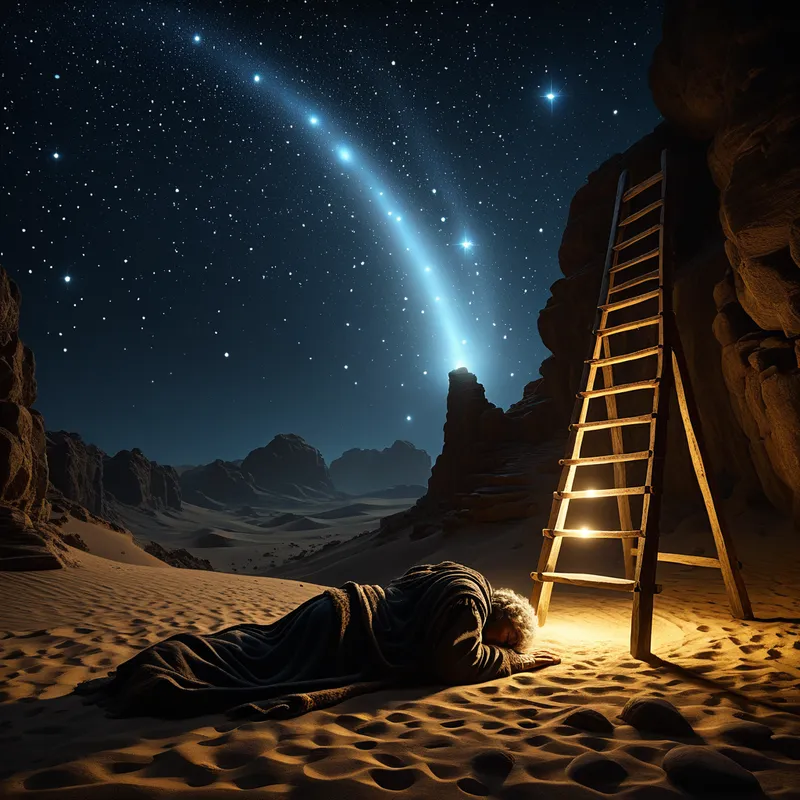
Listen. The air is thick with the dust of deceit and the metallic taste of fear. A man flees. His name is [Jacob](/myths/jacob “Myth from Biblical culture.”/), and the ground he treads is cursed by his own making. He has stolen a birthright with a bowl of stew and a blessing with the pelt of a goat. His brother’s rage is a furnace at his back, hotter than the sun on the stones of [the wilderness](/myths/the-wilderness “Myth from Biblical culture.”/). He is utterly alone, a soul adrift between a lost home and a [promised land](/myths/promised-land “Myth from Biblical culture.”/) he cannot yet see.
Night falls like a shroud over the stony hills of a place called Luz. Exhaustion is a heavier cloak. He finds a stone—just one among millions—and lays his head upon it. It is cold, unyielding, a fitting pillow for a fugitive. [The world](/myths/the-world “Myth from Tarot culture.”/) dissolves into the deep, black well of sleep.
And then, the dream.
It erupts from the silence. Not a gentle vision, but a cosmic architecture imposed upon the darkness. A ladder—or perhaps a staircase, a [ziggurat](/myths/ziggurat “Myth from Mesopotamian culture.”/) of light—is set upon [the earth](/myths/the-earth “Myth from Hindu culture.”/) where he lies. Its top reaches into the heavens, and behold, the messengers of YHWH are ascending and descending upon it. They are not gentle cherubs, but beings of purpose, streaming in a silent, radiant traffic between realms. And there, above it all, stands YHWH Himself. His voice is not thunder, but a declaration that shapes reality: “I am YHWH, the God of Abraham your father and the God of [Isaac](/myths/isaac “Myth from Biblical culture.”/). The land on which you lie I will give to you and to your offspring.”
The promise unfolds—descendants as countless as the dust, a blessing to all families of the earth. And then, the most personal covenant: “Behold, I am with you and will keep you wherever you go… I will not leave you.”
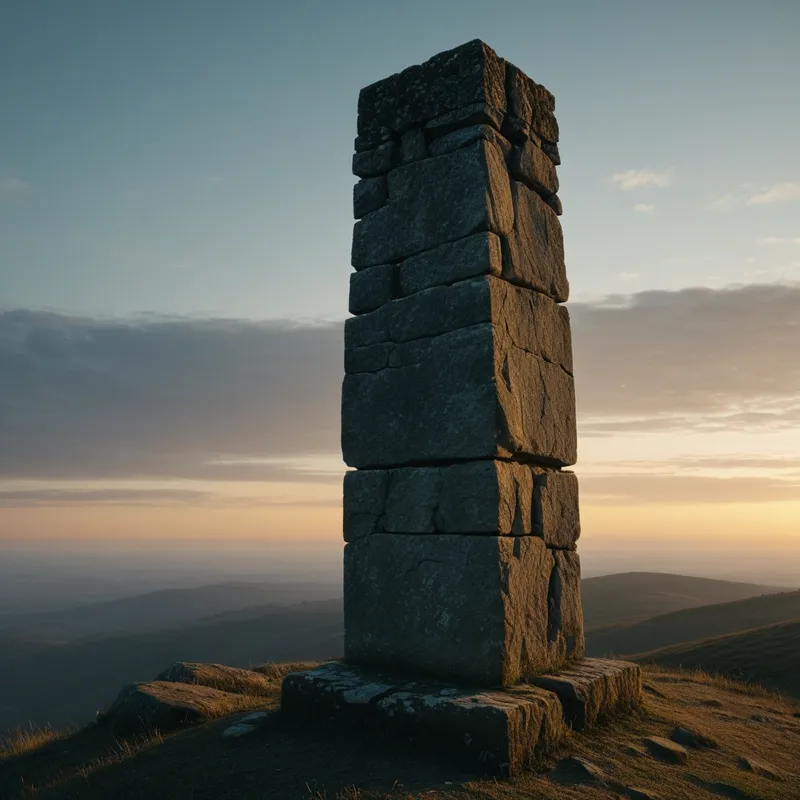
Jacob wakes. [The desert](/myths/the-desert “Myth from Biblical culture.”/) is still dark, but the world is irrevocably changed. A terror, a holy awe, seizes him. “Surely YHWH is in this place, and I did not know it!” he whispers. The stone beneath his head is no longer a stone. It is a witness, a connector, a point of contact. He takes it, sets it upright as a pillar, and anoints it with oil—a libation to the moment, a consecration of [the threshold](/myths/the-threshold “Myth from Folklore culture.”/). He names the place Bethel. The common stone has become a sacred pillar, and the fugitive has met his destiny.
Cultural Origins & Context
This narrative is woven into the foundational tapestry of the Book of Genesis. It belongs to the cycle of patriarchal stories—oral traditions of family, covenant, and land that were refined and codified during the monarchic and exilic periods of ancient Israel. The story functions as a crucial etiology, explaining the sanctity of Bethel, a major cultic site that rivaled [Jerusalem](/myths/jerusalem “Myth from Biblical culture.”/). It anchors the identity of a people in a specific, tangible location touched by the divine.
Passed down by storytellers and priests, the tale served multiple societal functions. It validated Jacob’s (and thus Israel’s) claim to the land and his role in the ancestral covenant. It transformed a local Canaanite site (Luz) into an Israelite sacred space, a common practice of cultural reclamation. Most profoundly, it offered a template of divine encounter: God meets individuals not only in established temples but in the liminal, desperate spaces of their own journeys.
Symbolic Architecture
At its core, the myth is an archetypal map of a psychological awakening. Jacob is the sleeping ego, fleeing the consequences of its own [shadow](/symbols/shadow “Symbol: The ‘shadow’ embodies the unconscious, repressed aspects of the self and often represents fears or hidden emotions.”/). The [stone](/symbols/stone “Symbol: In dreams, a stone often symbolizes strength, stability, and permanence, but it may also represent emotional burdens or obstacles that need to be acknowledged and processed.”/) [pillow](/symbols/pillow “Symbol: A pillow represents rest, comfort, and the subconscious mind, often signifying emotional support.”/) represents the hard, unconscious [foundation](/symbols/foundation “Symbol: A foundation symbolizes the underlying support systems, values, and beliefs that shape one’s life, serving as the bedrock for growth and development.”/) of the [psyche](/myths/psyche “Myth from Greek culture.”/)—dense, [material](/symbols/material “Symbol: Material signifies the tangible aspects of life, often representing physical resources, desires, and the physical world’s influence on our existence.”/), and seemingly inert.
The ladder is the axis mundi, the world axis, the psychic structure that allows communication between the conscious mind and the vast, dynamic realms of the collective unconscious.
The ascending and descending angels symbolize the constant flow of psychic contents—insights, complexes, archetypal energies—between these levels. The divine voice is the voice of the Self, the central [archetype](/symbols/archetype “Symbol: A universal, primordial pattern or prototype in the collective unconscious that shapes human experience, behavior, and creative expression.”/) of order and wholeness, announcing the individual’s place in a grander [pattern](/symbols/pattern “Symbol: A ‘Pattern’ in dreams often signifies the underlying structure of experiences and thoughts, representing both order and the repetitiveness of life’s situations.”/). The transformation of the stone into a pillar is the critical act: [the ego](/myths/the-ego “Myth from Jungian culture.”/), having witnessed this numinous [reality](/symbols/reality “Symbol: Reality signifies the state of existence and perception, often reflecting one’s understanding of truth and life experiences.”/), must erect a marker. It must consciously acknowledge and memorialize the [moment](/symbols/moment “Symbol: The symbol of a ‘moment’ embodies the significance of transient experiences that encapsulate emotional depth or pivotal transformations in life.”/) of [connection](/symbols/connection “Symbol: Connection symbolizes relationships, communication, and bonds among individuals.”/), turning a passive experience into an active foundation for [identity](/symbols/identity “Symbol: Identity represents the sense of self, encompassing personal beliefs, cultural background, and social roles.”/).

The Dreamer’s Resonance
When this myth stirs in a modern dream, the dreamer is at a profound psychic crossroads. To dream of a ladder or staircase connecting realms suggests a nascent awareness of deeper layers of [the self](/myths/the-self “Myth from Jungian culture.”/). The specific image of a stone becoming significant—a pillow, a marker, an altar—points to a process of grounding numinous experience.
The somatic feeling is often one of awe mixed with anxiety, Jacob’s “surely God is in this place.” The psychological process is one of confrontation with the numinous. The dreamer’s old, fleeing identity ([the trickster](/myths/the-trickster “Myth from Various culture.”/) Jacob) is being called to stop, to lie down upon the hard truth of their situation, and to receive a vision of their potential wholeness. The dream signals that a foundational aspect of the psyche, once ignored, is now demanding recognition as the very conduit to meaning and purpose.
Alchemical Translation
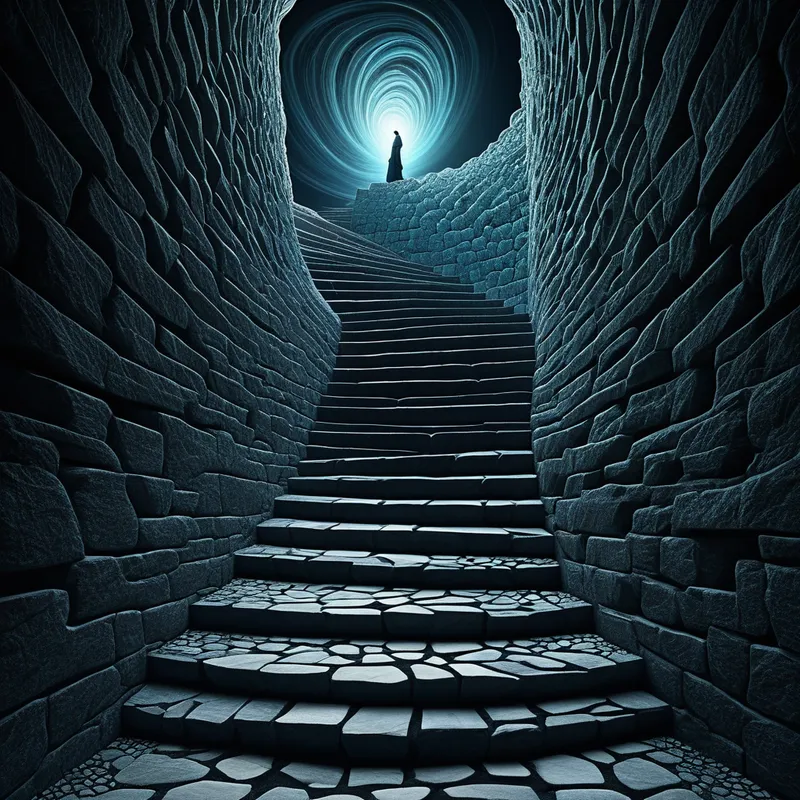
The alchemy of Bethel is the transmutation of the lapis—the common stone—into the philosopher’s stone—the sacred pillar. Psychologically, this is the individuation process in miniature.
First, the [nigredo](/myths/nigredo “Myth from Alchemical culture.”/): Jacob’s flight is the darkening, the descent into chaos and alienation. His sleep is the necessary dissolution of ego-centric consciousness. Then, the illuminating vision: the ladder appears, representing the transcendent function that mediates between opposites (heaven/earth, conscious/unconscious). The divine promise is the albedo, the washing clean, the revelation of the latent pattern within the soul.
The anointing of the pillar is the rubedo, the reddening. It is the conscious, embodied act of sacrifice—pouring one’s vital energy (the oil) onto the newly realized truth, making it sacred and central to one’s life.
For the modern individual, the myth models the journey from being a victim of circumstance (a fugitive) to becoming a steward of covenant. It teaches that awakening often comes not in [triumph](/myths/triumph “Myth from Roman culture.”/), but in exhaustion; that the foundation of our new life (Bethel, the House of God) is built upon the very [thing](/myths/thing “Myth from Norse culture.”/) we once used merely for rest or escape. We are called to take the cold, hard fact of our existence—our trauma, our flaw, our loneliness—set it upright, anoint it, and recognize it as the very place where the world of meaning connects to our solitary journey.
Associated Symbols
Explore related symbols from the CaleaDream lexicon: